

10/3 Wire with Ground Explained for Home Wiring Projects

You're standing in the electrical aisle, holding a spool marked 10/3 with ground, and the label feels more confusing than helpful. The good news is that the name is doing real work, it tells you the wire size, the conductor count, and the safety path built into the cable. The tricky part is that the right answer isn't just “what is it,” it's “when does this cable belong in the job?”
A 10/3 wire with ground is built for heavier residential circuits, especially where a single cable needs to carry two hot legs, a neutral, and a dedicated equipment ground. That makes it a common fit for 30-amp household loads, but not a universal answer for every project. The smart DIY move is to match the cable to the load, the voltage, the location, and the breaker before anything gets pulled through a wall.
Table of Contents
- What 10/3 Wire With Ground Actually Means
- Inside the Cable Conductors and Gauge
- Ampacity and Voltage Ratings Explained
- Color Coding and the Role of Each Conductor
- Common Residential Uses for 10/3 Cable
- Indoor vs Outdoor and Conduit Compatibility
- Common Mistakes and Troubleshooting for DIYers
- Buying Tips and Your Pre-Install Checklist
What 10/3 Wire With Ground Actually Means
A homeowner standing in the aisle with a cable spool in hand usually wants one thing first, a plain answer to what 10/3 with ground means. The label is not a model name. It is a shorthand description of what is inside the jacket, and it tells you enough to judge whether the cable belongs in the job or whether it is more cable than you need.
The 10 refers to the American Wire Gauge size of each copper conductor. The 3 means there are three insulated conductors, and with ground means there is also a bare copper grounding conductor in the same cable. In common NM-B product specifications, that construction is described as 10 AWG copper conductors with three insulated conductors plus one bare grounding conductor.
That setup is why 10/3 cable shows up on heavier branch circuits instead of ordinary lighting runs. It gives you a package that can handle more current than standard 15 A or 20 A residential cable, while keeping the conductors bundled in one sheath. The easiest way to picture it is a wider lane on a road. It is built for more traffic, but that does not mean every circuit needs it.
The buyer's real decision is usually not whether the label is correct. It is whether the cable is the right size for the load, the right number of conductors for the equipment, and the right type for the place where it will be installed. A cable can be perfectly labeled and still be the wrong choice if it is oversized for a simple circuit or if the installation environment calls for a different cable type.
The same naming pattern appears on other cables too. A 12/2 cable has two insulated conductors and a ground, while a 6/3 cable has three insulated conductors in a much heavier package. Once that pattern makes sense, the label stops feeling like shorthand from a catalog and starts working like a quick reference for planning a circuit.
Practical rule: read the first number as the wire size, the second as the insulated conductor count, and with ground as the separate safety conductor.
That rule helps, but it is only the starting point. The next questions are the ones that keep a DIY project on the right side of code and safety. What current does the load need, what voltage does the circuit use, where will the cable run, and what appliance or equipment will it serve. If those answers do not line up, the cable choice is off, even if the spool looks like it should be enough.
Inside the Cable Conductors and Gauge
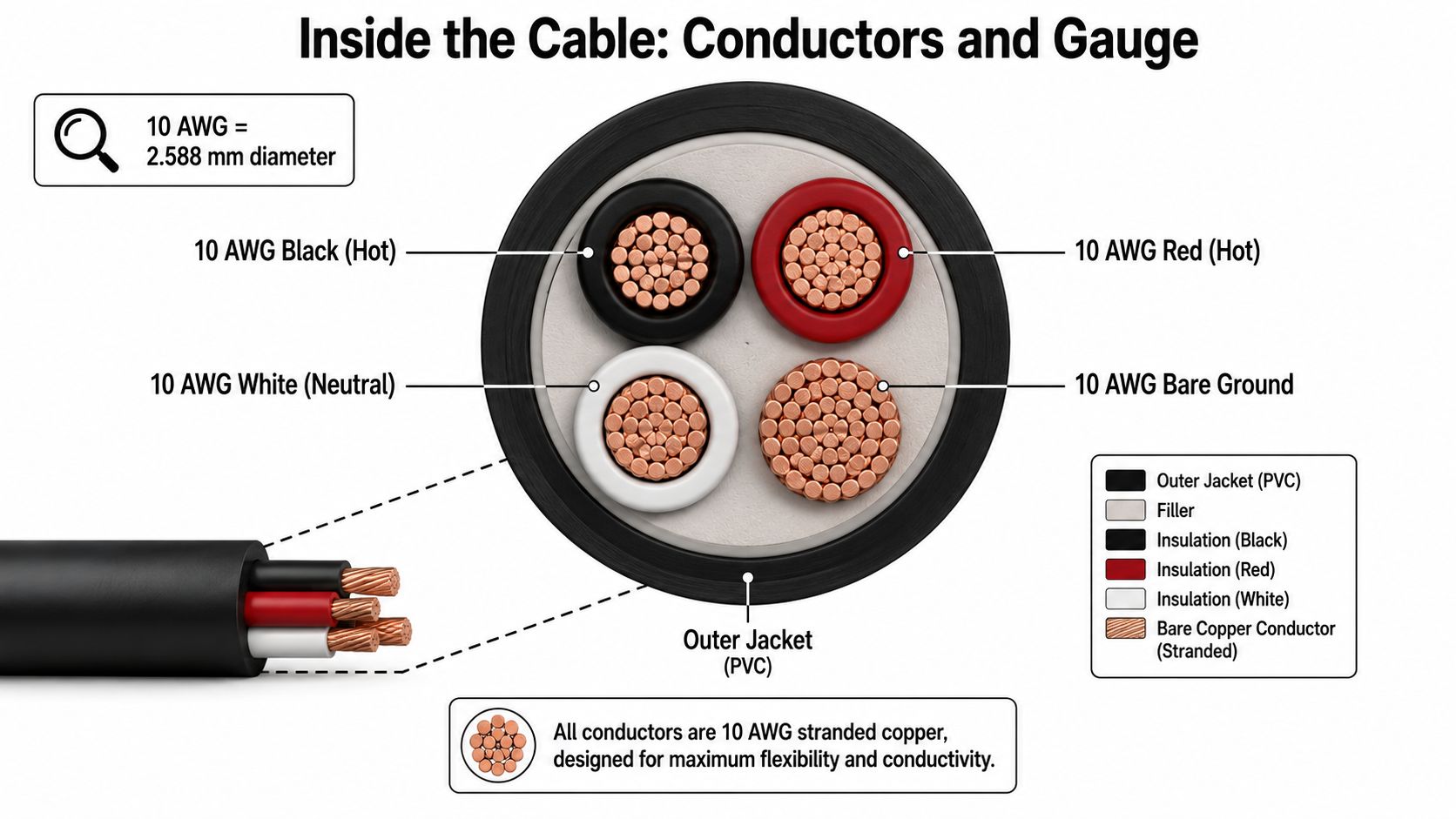
What sits under the jacket
A 10/3 wire with ground in NM-B residential cable is typically built as three 10 AWG insulated copper conductors plus one bare 10 AWG equipment grounding conductor. One supplier also lists the cable at about 0.43 in nominal diameter and 0.163 lb/ft, which is a useful reminder that this isn't flimsy branch-circuit cable supplier listing. That bulk affects how it moves through studs, how much space it takes in boxes, and how sharply it wants to bend around corners.
AWG numbers work backward from what many people expect. A smaller gauge number means thicker wire, so 10 AWG is larger and more sturdy than 12 AWG or 14 AWG. That thickness lowers resistance, which lowers heat, which is why 10 AWG shows up on circuits that need more current.
Why the physical build matters
The ground conductor is not filler. It creates a low-impedance fault path, so a breaker can trip quickly if a hot conductor contacts metal parts or an appliance chassis. That's one reason the cable is accepted in circuits with substantial inrush or motor-starting loads, provided the rest of the installation is correct.
The geometry also affects the install itself. A thicker cable means more attention to box fill, bend radius, and routing through framing cavities. Installers who treat it like ordinary 14/2 cable usually run into cramped junction boxes or damaged sheath, and both of those problems can create more work than the original pull.
Ampacity and Voltage Ratings Explained
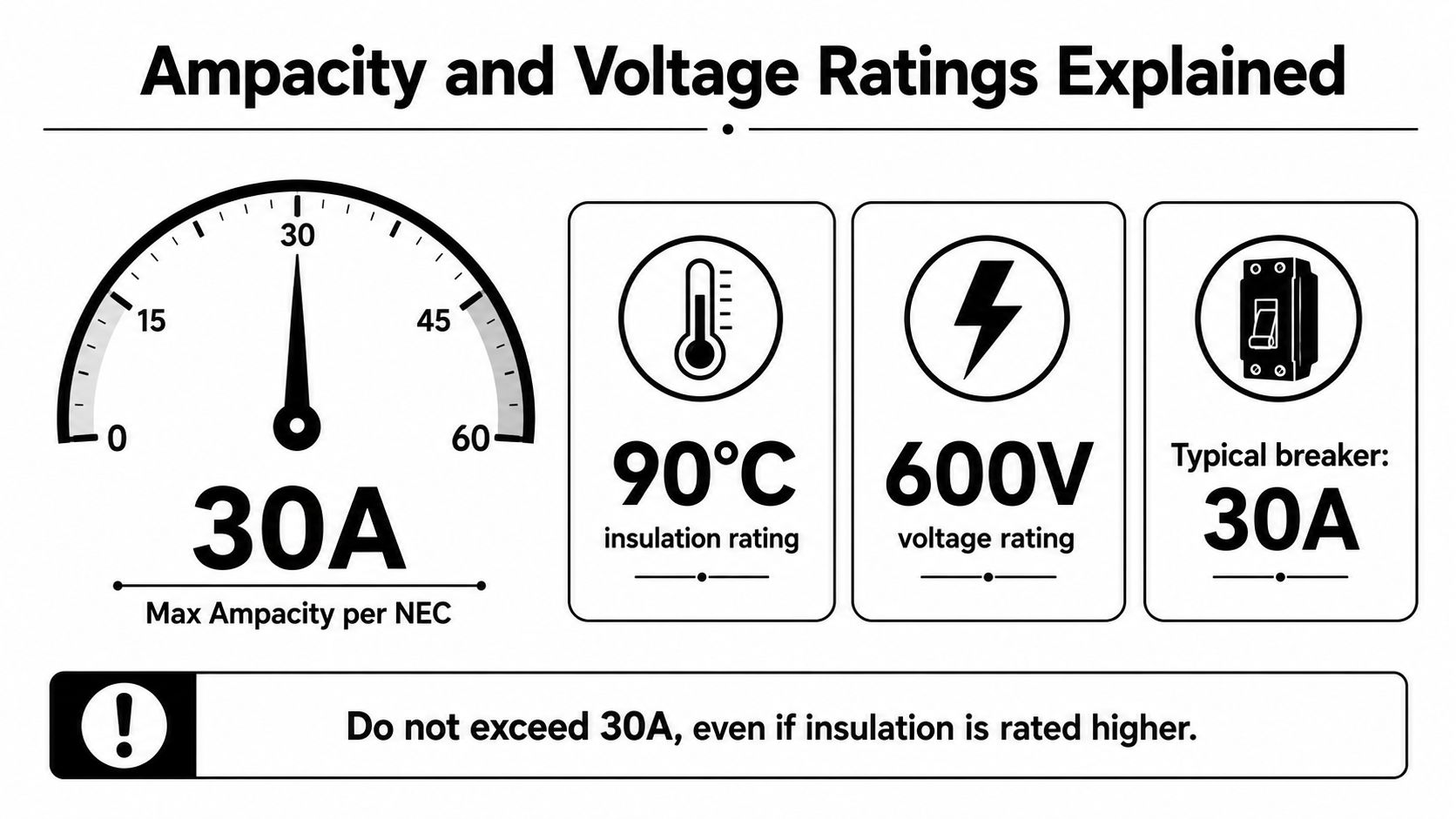
The number on the jacket is only part of the story
A 10/3 WG Romex spec sheet may list a 600 V voltage rating, a 30 A current rating, and a 90 °C temperature rating spec sheet. That can make the cable look like the answer for any demanding circuit, but the jacket rating is only one piece of the decision. In a finished NM-B installation, the usable ampacity is still governed by the code rules for the cable and its terminations, which is why this type of cable is commonly treated as a 30-amp choice manufacturer listing.
That difference is easy to miss. The insulation may be rated for higher heat, but the breaker, the device, and the installation environment decide what you can safely use in the wall. A cable jacket is like a label on a tool chest, helpful for identifying capability, but it does not override the limits of the jobsite.
How 30 amps shows up in real use
At 240 V, a 30 A circuit fits the kind of household loads that need more current than a standard lighting run, but do not need a larger feeder. Wiring references describe 10/3 as a cable used for 240 V applications and note that it is typically used at 30 amps wiring guide. Some guidance also treats 24 amps as a more conservative continuous-use target depending on the installation conditions and insulation details wiring guide.
For a DIYer, that means the breaker size, the appliance nameplate, and the expected duty cycle all need to agree before the cable goes in. A planning check like the one in these smart home energy management tips can help a household sort out load demands before a circuit is added.
Bottom line: the cable's label may include a high insulation rating, but the key install decision comes down to the 30 A use case.
Color Coding and the Role of Each Conductor
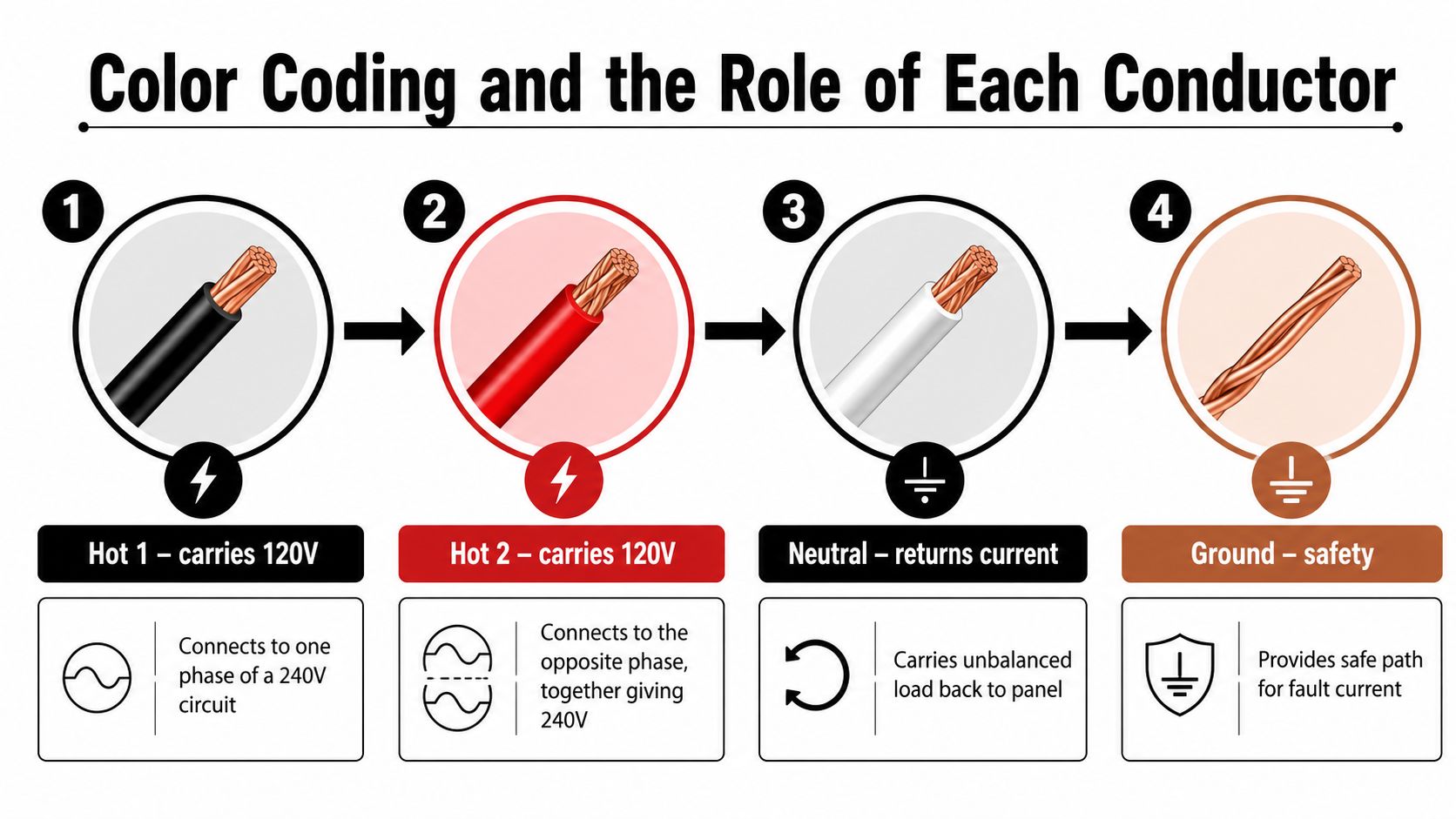
Black, red, white, and bare copper
The conductor set in this cable is usually black, red, white, and bare copper. Technical references consistently identify it as three insulated conductors with a bare copper ground, with the insulated wires typically color-coded black, red, and white conductor guide. That color set is what makes the cable useful for 240 V and other multi-wire residential applications.
Black and red are the hot legs. Used together, they supply the two phases needed for a 240 V load. White is the grounded conductor, often used as the neutral when the circuit needs one. The bare copper wire is the equipment grounding conductor, which exists for safety rather than normal load current.
Why the ground conductor is nonnegotiable
A good way to think about the conductors is with household plumbing. The hots are the supply pipes, the neutral is the return path, and the ground is the emergency drain. If a hot wire touches a metal frame, the ground gives fault current a low-impedance path back to the panel so the breaker can open fast.
That's not a nice extra, it's the part that protects the metal enclosure from sitting energized. A DIYer who skips the ground or treats it as optional is removing the very wire that helps a fault clear quickly. In a cable built this way, the grounding conductor is part of the design, not an accessory.
Common Residential Uses for 10/3 Cable
Where this cable usually belongs
A homeowner usually reaches for 10/3 with ground when the circuit has to carry two hot legs, a neutral, and a safety ground in one jacket. That is the setup many 240 V appliance runs rely on, which is why this cable often shows up on dedicated branch circuits for larger household loads. The practical question is not just whether the cable can fit the load, but whether the appliance and the installation method call for it.
A dryer circuit is one of the clearest examples. The appliance needs its own branch circuit, the load is steady and predictable, and the wiring path is usually straightforward. Some air-conditioning equipment also uses this type of cable, but the nameplate on the equipment always has the final word, because the appliance rating, not the cable size alone, sets the requirement.
Quick reference for common uses
| Application | Typical Voltage | Breaker Size |
|---|---|---|
| Electric dryer | 240 V | 30 A |
| Electric range or cooktop | 240 V | 30 A |
| Some air-conditioning systems | 240 V | 30 A |
| Small subpanel feeder for a detached garage or workshop | 120/240 V | 30 A |
Practical rule: if the load needs a dedicated 30 A circuit and the wiring path matches the environment, 10/3 is often the cable that fits the job cleanly.
A detached garage feeder is where some DIYers get tripped up, because they hear “heavy-duty” and assume any thick cable will do. The cable still has to match the equipment, the breaker, and the wiring method. A dryer, a range, a small subpanel, and a larger appliance can all look like similar jobs from across the room, but each one has its own wiring rules and its own limits.
Indoor vs Outdoor and Conduit Compatibility
The jacket decides the location
Standard 10/3 NM-B with ground belongs in dry indoor locations. That distinction matters because the cable jacket, not just the conductors inside it, determines whether the install is appropriate. Technical references note that UF-B versions of 10/3 with ground are rated for outdoor and underground use and can have different jacket thickness and overall diameter than indoor NM-B cable environment guide.
That is the mistake many buyers make. “With ground” does not mean “okay anywhere.” It means the cable has a grounding conductor built in. The wet-location or burial question is answered by the jacket type, not by the presence of the bare wire.
Matching cable type to the environment
- NM-B, indoor, dry spaces, typical residential framing runs.
- UF-B, outdoor or underground use, where moisture exposure is part of the design.
- Conduit with individual conductors, used when the run is exposed or when the job calls for a different wiring method.
Those options also change the hardware around the cable. Conduit work, wet-location cable, and armored systems all require different connectors, boxes, and attention to bend radius than a simple NM-B pull through studs. The wrong jacket in the wrong place can turn a clean install into a code problem.
Common Mistakes and Troubleshooting for DIYers
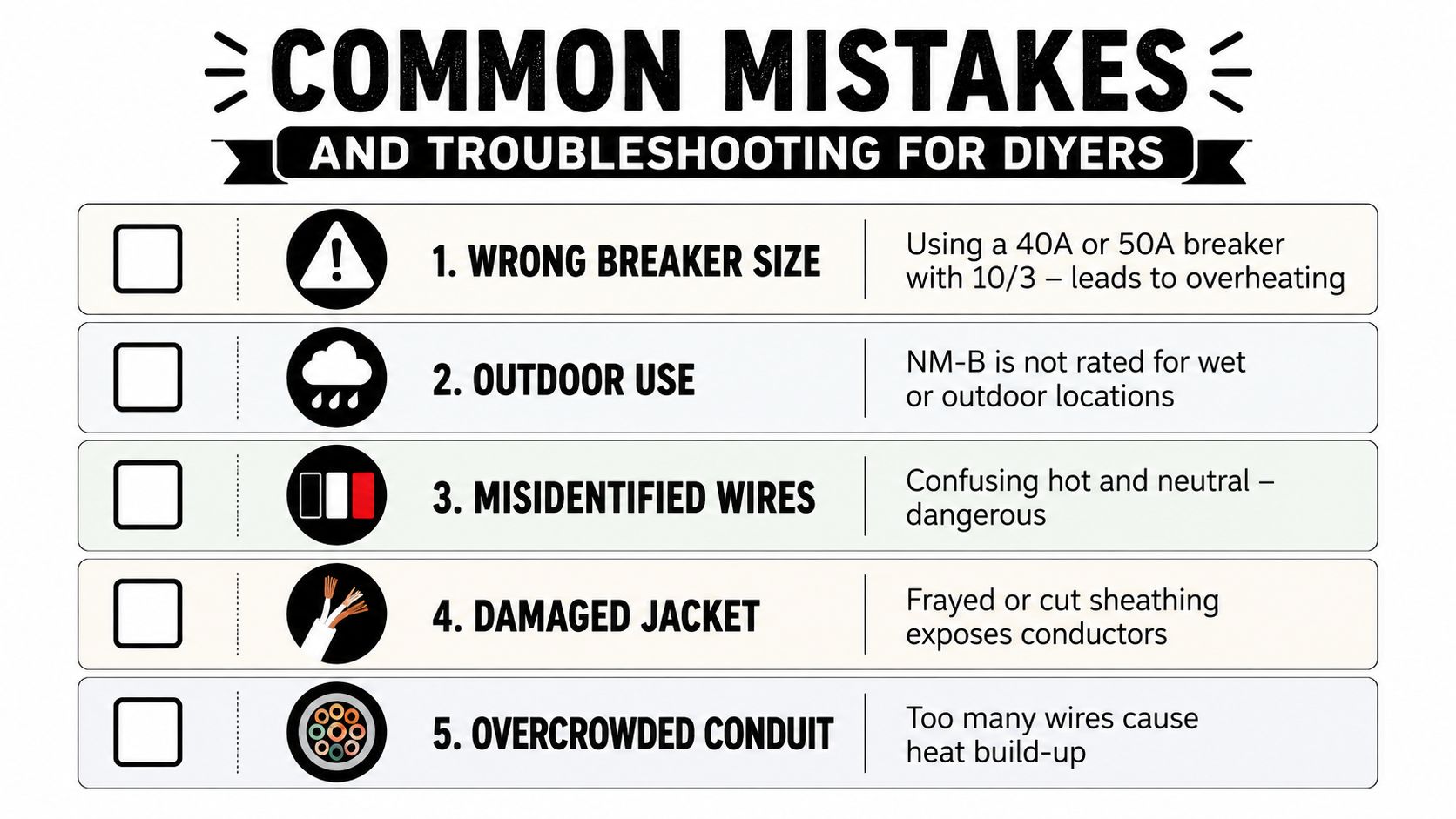
The errors that show up again and again
DIY discussions keep circling the same question, whether 10/3 is enough for welders or detached structures, while technical guides still frame it as a 30-amp, three-conductor-plus-ground cable for ranges, dryers, and similar residential circuits DIY forum discussion. That gap between “looks heavy” and “is right” is where most mistakes begin.
- Wrong breaker size. If a 40 A or 50 A breaker is used because the wire looks thick, the cable can be protected incorrectly. The fix is to match the breaker to the cable and the appliance, not to the eye test.
- Outdoor use of NM-B. If the run is exposed to moisture or buried, standard NM-B isn't the right jacket. The fix is to move to the cable type rated for the environment.
- Misidentified conductors. If black, red, white, and bare are mixed up, the circuit can lose its intended hot, neutral, or ground function. The fix is to identify each conductor before landing it on a terminal.
- Damaged sheath. If the jacket is nicked during pulling, the conductors are no longer fully protected. The fix is to stop and inspect before energizing anything.
- Overcrowded box or conduit. If too many conductors are stuffed into a small space, heat build-up and mechanical damage become real risks. The fix is to size the enclosure for the cable count and route.
Smart door lock installation planning often involves low-voltage thinking, but the habit of checking layout before the first cut still applies here. Electrical work rewards that same discipline, especially when the cable is already near its practical limit.
If a breaker trips immediately, a ground fault or short is the first thing to suspect. If it trips under load, the likely causes are an undersized breaker for the appliance or a derating issue from bundled cables.
Buying Tips and Your Pre-Install Checklist
What to look for before the spool goes in the cart
The first buying decision is whether the project needs a full spool or cut-by-the-foot cable. A full spool makes sense for longer runs or multiple circuits, while smaller jobs are easier to manage when the cable is sold by length. The second decision is jacket type, because indoor NM-B and outdoor UF-B solve different problems even when the conductor package looks similar.
Product labeling also matters. One product sheet states the cable is rated 90°C but the amp rating is limited to the 60°C conductor rating under the NEC, which is a good reminder to read past the big number on the jacket manufacturer listing. The printed rating is useful, but the code limit still decides the installation.
A pre-install checklist that keeps mistakes down
- Match the breaker to the load. The appliance nameplate and the circuit rating need to agree.
- Match the jacket to the environment. NM-B stays indoors in dry locations, UF-B belongs outdoors or underground.
- Check the panel space. A 30 A breaker needs a real slot and a compliant termination path.
- Plan box fill and bend radius. The cable is physically bulkier than lighter branch wiring, so layout matters before the first staple goes in.
- Confirm the conductor roles. Black, red, white, and bare need to land where the circuit design expects them.
For tools, testers, and home-improvement accessories that make a project easier to manage, browsing Granted Solutions home improvement picks can save time compared with piecing everything together from scratch. The bigger win, though, is still the same one on every wiring job, read the label, match the load, match the environment, and pull the right cable the first time.
Granted Solutions makes it easier to gather the practical gear that keeps home projects organized, from problem-solving tools to everyday essentials that save time at the bench and around the house. If this guide helped clarify 10/3 wire with ground, visit Granted Solutions to explore useful home-improvement picks and check out options that support your next project with less guesswork.
Leave a comment