

Automatic Garment Steamer Buying Guide and Smart Usage Tips

A wrinkled shirt can turn a simple morning into a frustrating search for an ironing board, an open outlet, and enough time to use both. An automatic garment steamer offers a faster alternative for everyday creases, especially when clothing is already hanging in a wardrobe or on a hook. It won't create every sharp line an iron can, but it can make daily garment care far less demanding.
The right choice depends on steam output, tank design, heat-up time, fabric type, and safety controls. This guide explains what an automatic garment steamer does, where it outperforms a traditional iron, where it falls short, and how to use one without creating water spots or burn risks.
Table of Contents
- Why an Automatic Garment Steamer Belongs in Your Home
- How an Automatic Garment Steamer Actually Works
- Automatic Garment Steamer vs a Traditional Iron
- Key Specs to Compare Before You Buy
- Setting Up and Using Your Steamer Safely
- Where an Automatic Garment Steamer Shines and Where It Falls Short
- Maintenance, Troubleshooting, and Long-Term Care
- Smart Shopping Tips and Where to Find the Right Pick
Why an Automatic Garment Steamer Belongs in Your Home
A weekday shirt can become a household problem before breakfast. It is creased in the wardrobe, the ironing board is behind storage boxes, and a child may be pulling at a sleeve. A countertop or handheld automatic garment steamer cuts that setup down to a hanger, a nearby outlet, and a filled tank.
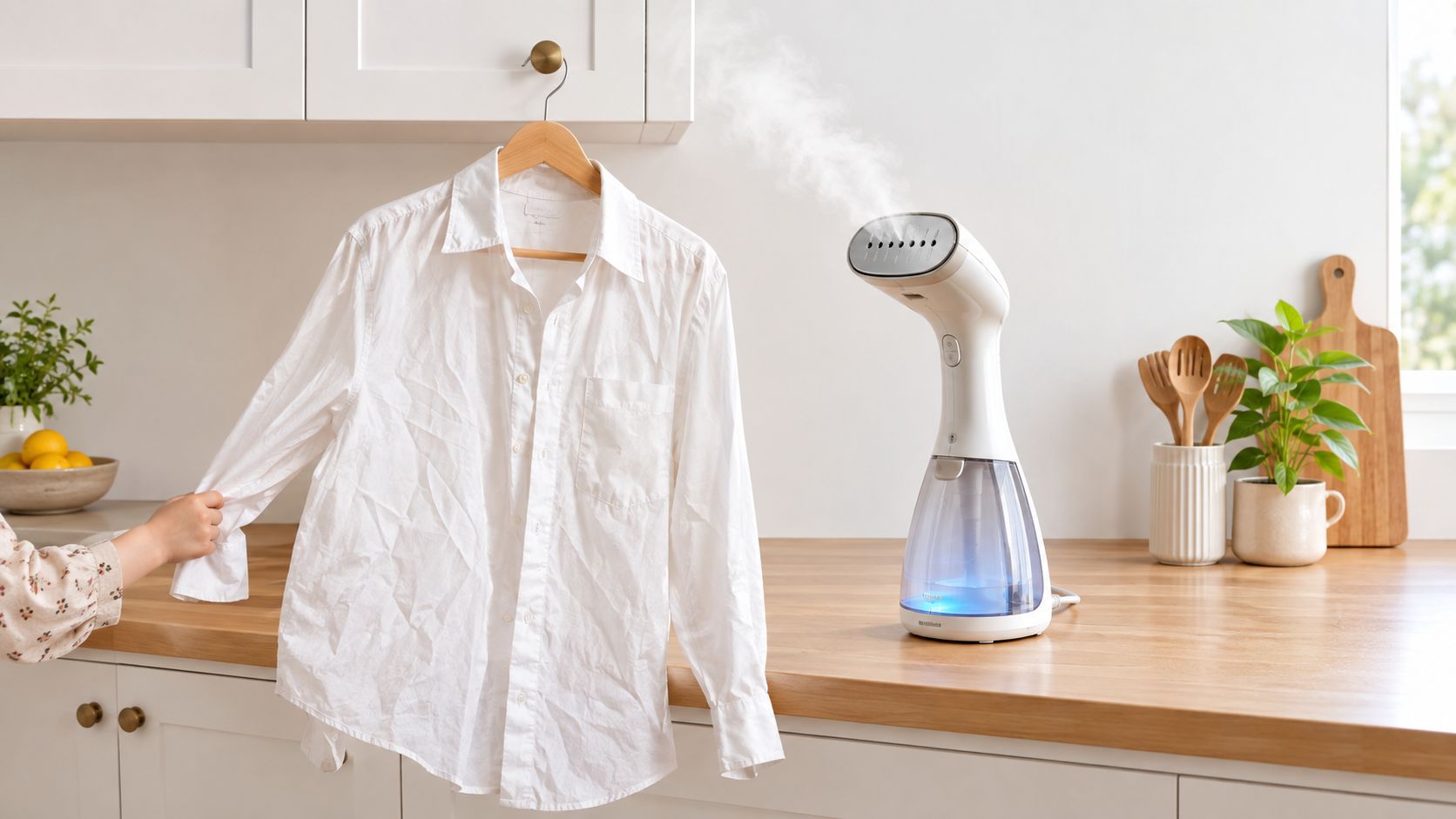
Three problems it solves
Speed is its clearest advantage. A steamer has to produce usable vapor quickly, or it fails the morning-routine test. Some current models heat in roughly half a minute. The Philips 1000 Series lists a 45-second heat-up time and 36 g/min continuous steam output, specifications that translate into a practical shirt refresh before leaving home (Philips 1000 Series garment steamer).
Convenience matters when the fabric is too large or awkward for an ironing board. Vertical steaming suits hanging shirts, dresses, coats, curtains, and other household textiles. The same Philips model has a removable 1.8 L tank, which supports longer sessions than a compact travel reservoir. Choose a handheld unit for one outfit. Choose a standing model when several garments or curtains need attention.
Fabric fit makes steam useful beyond simple speed. Moist heat relaxes wrinkles without dragging a hot soleplate across synthetics, knits, and many delicate fabrics. It still demands care. Check the garment label, keep the nozzle moving, and avoid treating “delicate” as a guarantee of zero risk.
Practical rule: A steamer is the better primary tool for light wrinkle removal. An iron remains the better tool for sharp, pressed edges.
Safety is the buying gap many guides overlook. Steamers avoid leaving a heated soleplate on a low surface, which can reduce one burn risk around children, but they still contain hot water and release hot vapor. Look for automatic shut-off, a stable tank, and anti-drip construction. The category has established commercial foundations, with global garment steamer value estimated between USD 2.6 billion and USD 3.1 billion in 2025 (Grand View Research garment steamer market analysis). That market interest makes careful selection more important. A faster machine with poor stability or dripping output can create a new household nuisance instead of solving the old one.
How an Automatic Garment Steamer Actually Works
An automatic garment steamer turns water into controlled vapor, then sends that vapor through a hose or wand onto clothing hanging vertically. That setup matters in practice. You can smooth a shirt on its hanger without clearing space for an ironing board, while curtains can stay in place during treatment.
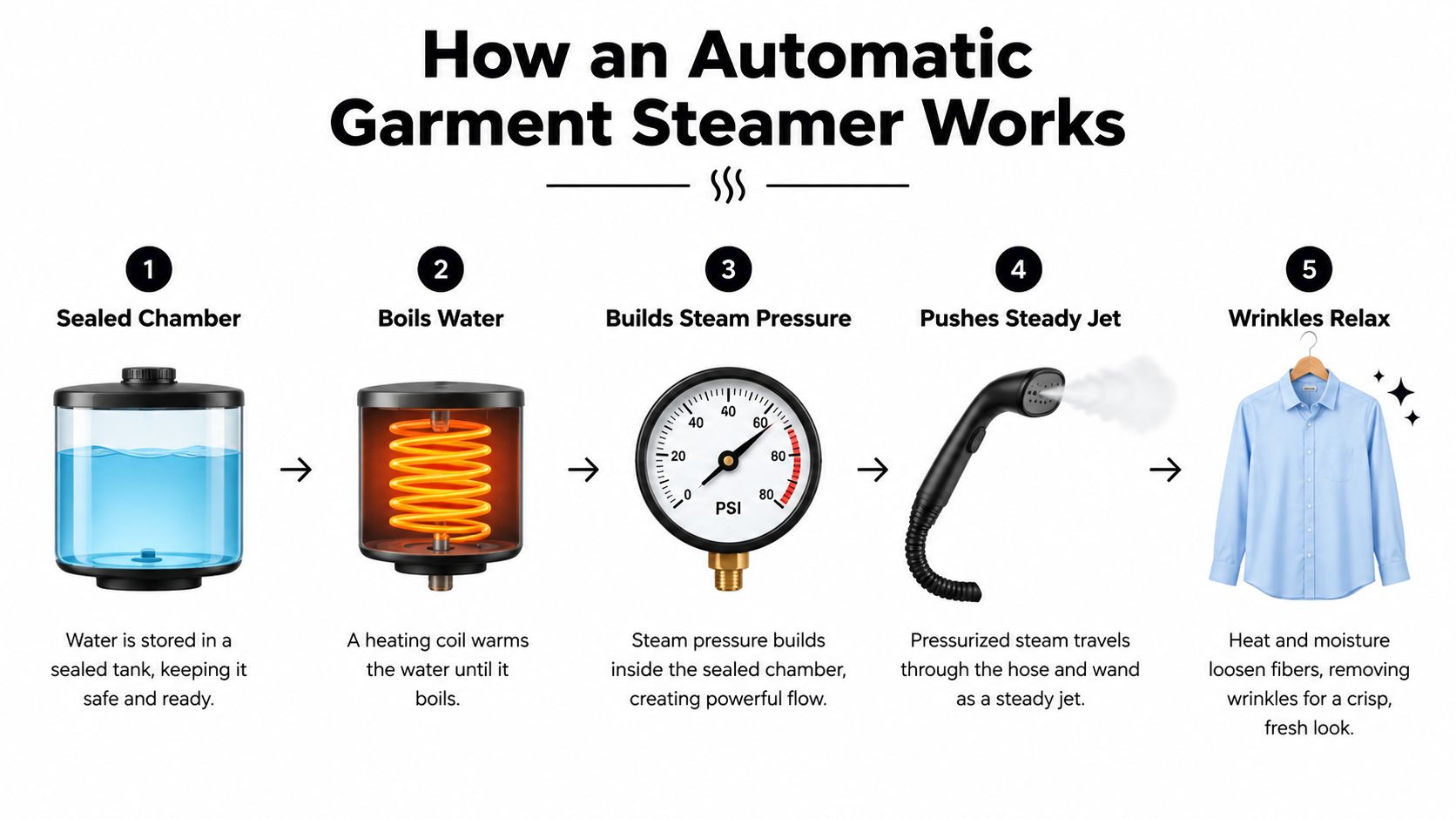
From water to wrinkle release
The process has five working stages:
- The tank holds water. Detachable reservoirs are easier to fill and empty. Fixed tanks keep the appliance compact but can be less convenient to clean.
- A heating element produces vapor. Water enters a heating chamber, where the element converts it into hot steam.
- The unit controls the flow. A pump-driven design pushes vapor through the hose. A gravity-fed design depends more on tank position and hose alignment.
- The wand directs the vapor. The nozzle spreads steam over the garment rather than pressing fabric against a hot surface.
- The fibers relax. Heat and moisture soften the distortion behind a wrinkle, allowing the fabric to hang smoother under its own weight.
The output only helps when the garment receives enough heat and moisture. Peer-reviewed textile research found that steam treatment can improve wrinkle recovery in cotton, while steam pressure and nozzle distance affect heat transfer. In the tested setup, the greatest heat flux occurred at 50 mm and 207 kPa, so holding the nozzle too far away can weaken results (peer-reviewed textile steam-treatment research). Keep the head moving, especially over synthetics and delicate fabric, and follow the care label.
What automatic means
“Automatic” usually covers continuous steam delivery, thermostat-controlled heating, pump assistance, and automatic shut-off when the tank empties or the appliance sits idle. A pump-driven model generally maintains steadier output as you move the wand down a shirt or dress. Gravity-fed models can perform well, but tilting the tank or bending the hose may interrupt flow.
Tank design affects the morning routine. A detachable tank makes refilling, draining, and descaling simpler. A fixed boiler may use space efficiently, yet stale water and mineral buildup become harder to manage. Treat the reservoir as a maintenance part, not disposable storage.
Water-based appliances share practical handling concerns. Guidance on compact humidifier tank handling and countertop convenience reinforces the same habit: empty leftover water instead of letting it sit. For a steamer, also check that the base is stable and the nozzle cannot drip onto skin, flooring, or a garment. Hot vapor can burn, and spilled hot water creates a separate risk from an iron's heated soleplate.
Automatic Garment Steamer vs a Traditional Iron
A wrinkled shirt before work exposes the choice. An automatic garment steamer relaxes fabric while it hangs. A traditional iron combines heat, pressure, and a flat surface to press fabric into shape. Choose between a softer finish and a sharper one, not between a universally better appliance.
| Criterion | Automatic Garment Steamer | Traditional Iron |
|---|---|---|
| Setup | Needs a hanger and a safe hanging area | Needs an ironing board or heat-safe pressing surface |
| Everyday speed | Fast for light wrinkles on hanging garments | Better for deliberate pressing and stubborn flat creases |
| Finish | Soft, natural smoothing | Crisp edges, seams, collars, pleats, and cuffs |
| Fabric range | Useful for knits, poly-blends, curtains, drapery, and many delicate items | Better for heavy cotton, linen, structured wool, and pressed trousers |
| Travel | Compact handheld models suit luggage and small rooms | Less convenient without a stable surface |
| Learning curve | Keep the wand moving at a safe distance | Control temperature, pressure, and direction |
| Main weakness | Struggles with sharp lines and thick layers | Needs more setup and can scorch fabric if misused |
Where the steamer saves time
The steamer is the faster choice when a garment is already hanging and the wrinkles are light. A button-down shirt, knit dress, polyester blouse, or lightweight jacket can often be refreshed without removing the hanger or clearing floor space for an ironing board. It also handles curtains and other large textiles that are awkward to spread flat.
For a morning touch-up, steam output matters because it determines how quickly fibers relax. Keep the wand moving from top to bottom, pull the garment lightly taut, and let gravity support the finish. This method reduces the pressure marks that a soleplate can leave on delicate or textured fabric.
A steamer also lowers one household hazard, but it does not remove safety concerns. There is no hot soleplate resting on a board, yet hot vapor can burn, and a dripping nozzle or spilled tank water can damage flooring, skin, or clothing. Set it on a stable base and keep the steam path clear.
Where the iron still wins
An iron remains the right tool for sharp shirt collars, pressed trouser lines, flat seams, pleats, heavy denim, thick cotton, and linen. Steam relaxes fibers, but pressure fixes a seam in a defined position. Structured garments need that contact, so a steamer may leave them looking soft rather than polished.
Use a steamer as the main appliance when your wardrobe mostly needs quick wrinkle removal. Choose an iron first when crisp creases and structured fit define your clothes. Homes with varied wardrobes can use both: the steamer for daily touch-ups, the iron for formal finishing. Many households do not need both, but neither appliance fully replaces the other.
Key Specs to Compare Before You Buy
A steamer's label matters only when it predicts what happens to your clothes. Compare wattage, steam output, tank capacity, heat-up time, and water-control features, then connect each specification to your routine. A high output can shorten shirt touch-ups, while a small tank may become irritating during curtain or family laundry sessions.
| Spec | What to look for | Why it matters |
|---|---|---|
| Wattage | Enough heating power for sustained steam | Supports faster recovery and steadier vapor |
| Steam output | A clearly stated g/min figure | More steam can relax wrinkles faster |
| Tank capacity | A removable tank matched to the session | Reduces refills when steaming several items |
| Heat-up time | A quick start for morning use | Makes short touch-ups practical |
| Anti-drip and anti-calc | Valves, filters, cartridges, or removable parts | Helps limit water marks and mineral faults |
| Auto shut-off | Shut-off during idling or low-water conditions | Adds protection if the appliance is interrupted |
Wattage and steam output
Wattage shows how much electrical power the heater uses. It does not guarantee a better finish by itself. Automatic garment steamers in the 1,500 to 1,800 W class commonly provide about 25 to 36 g/min of continuous steam and reach operating temperature in roughly 25 to 30 seconds, according to a manufacturer overview (automatic garment steamer performance specifications). That combination is well suited to quick wrinkle relaxation on shirts, jackets, and other everyday garments.
Steam output, measured in grams per minute, gives a clearer view of fabric performance. A steady flow keeps the textile exposed to usable vapor, so fibers relax more consistently than they do with occasional bursts. Choose a published output figure over vague wording such as “professional steam.” The number matters because weak output can turn one shirt into a slow, repetitive job.
Tank size and heat-up time
Tank size decides whether the appliance fits a quick morning routine or a longer household session. A portable steamer with a small reservoir stays easy to carry, but it needs more refills. A SteamOne portable model lists 30 g/min output, a 140 ml tank, and about eight minutes of continuous steaming (SteamOne portable steamer specifications). That setup fits a few garments, not a full laundry load.
Choose more capacity for curtains, several work outfits, or repeated family use. Heat-up time affects whether you use the steamer at all. A unit that starts quickly is more likely to handle a last-minute shirt. A slow boiler tends to remain in storage, even if its maximum output looks impressive.
Water management and safety
Anti-drip valves, anti-calc systems, removable filters, and automatic shut-off address real ownership problems. Drips can leave marks on fabric, mineral buildup can reduce steam consistency, and unattended heating creates avoidable risk. These features also matter around flooring and clothing, where spilled water can cause damage and hot vapor can burn.
A Lakeland model lists anti-drip and anti-calc functions, along with 12 to 15 g/min continuous steam and a 30-second heat-up time (Lakeland garment steamer documentation). Treat those details as practical buying evidence, not decoration. For frequent use, prioritize controlled water delivery and automatic shut-off alongside raw power.
Setting Up and Using Your Steamer Safely
If a shirt is hanging in the bathroom and you are rushing out the door, safe setup still takes priority. Place the steamer on a stable surface, check the fabric-care label, and keep children away from the hose and nozzle. Steam burns skin quickly. Hot water can also escape if the tank is overfilled, tilted, or poorly sealed.
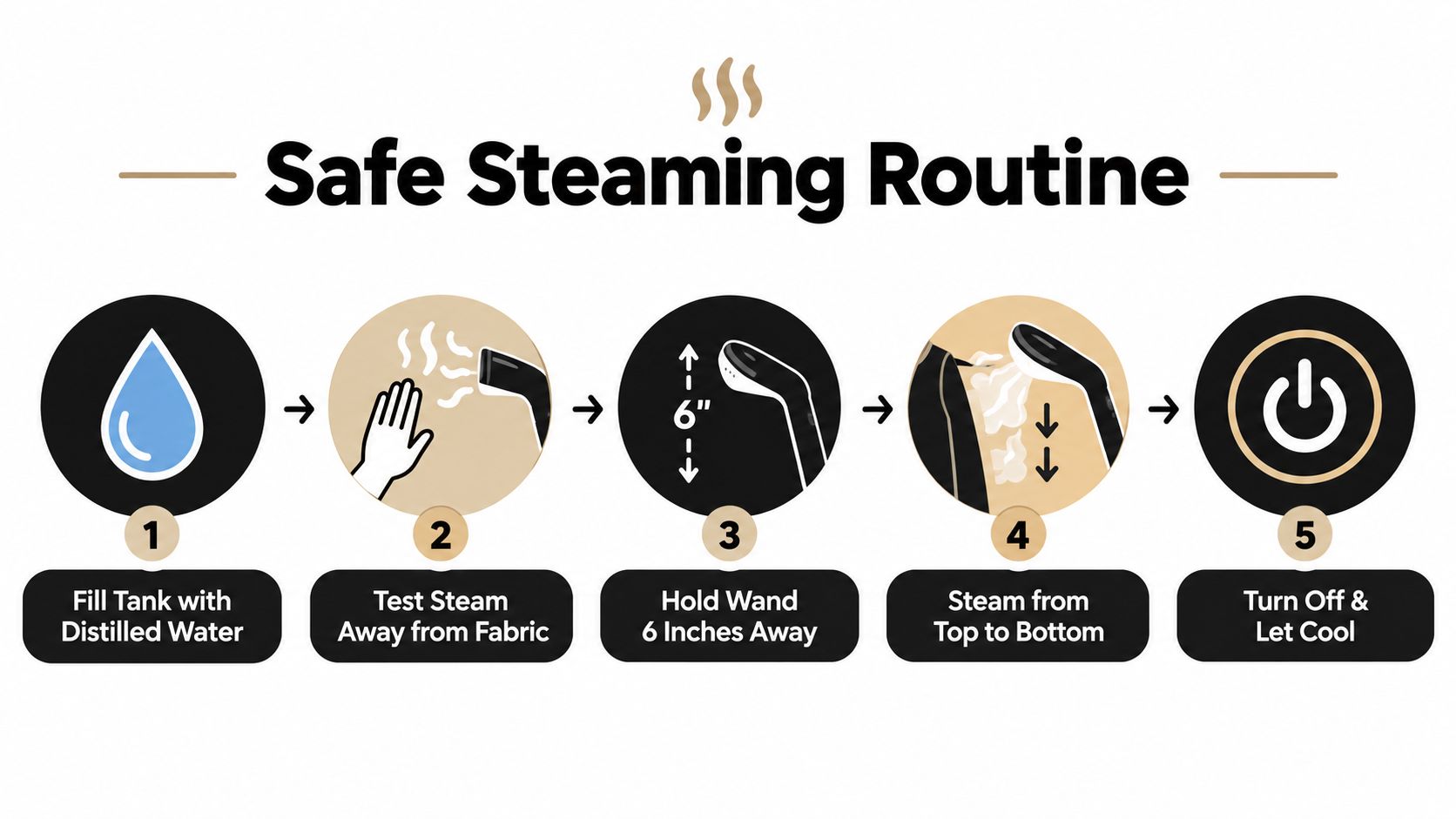
A reliable steaming routine
- Fill the reservoir carefully. Distilled or filtered water helps limit mineral deposits. Stop at the marked fill line.
- Attach the hose, hanger, and accessories. Finish assembly before connecting the appliance to power.
- Hang the garment securely. Use a sturdy door hook, rack, or built-in hanger. Never steam clothing against your body.
- Test the first burst away from the fabric. Water left in the nozzle may spit before the steam becomes steady.
- Keep the nozzle about 5 to 10 cm from the textile. Follow the appliance instructions for fabrics that need a different distance.
- Work from top to bottom. Pull the garment gently taut with your free hand and move the wand downward. This gives steam access to folds without soaking one spot.
- Let the garment hang briefly. Cooling in a relaxed position helps the finish settle before wearing or storing it.
Fabrics and hazards that need caution
Silk, velvet, waxed fabrics, and textiles with delicate surface finishes need a slower approach. Keep the nozzle off the surface unless both the care label and appliance instructions permit direct contact. Test an unseen area first, particularly on dark fabric, where water marks show easily.
A steamer's safety features reduce risk but do not replace careful handling. Auto shut-off helps if someone interrupts the routine. Anti-drip construction limits hot-water spots, and a cool-touch housing reduces contact risk near the handle. Inspect the tank cap, seals, and hose before use, especially after storage or transport.
A 2026 CPSC recall involving VEVOR steamers reported hot-water spitting, leaking, and dripping, plus tank-cap failures and burn injuries. The notice listed 6 reports involving hot-water spitting, leaking, or dripping, 12 tank-cap failure reports, and 2 burn injuries, including a permanent scar and a second-degree burn (garment steamer safety and recall information). Check recall information, inspect the sealing parts, and confirm the return policy before buying. Spill protection varies between models.
Never steam clothing while it's being worn. A hanger costs less than a burn.
Where an Automatic Garment Steamer Shines and Where It Falls Short
A steamer earns its place when a shirt is wrinkled before work, curtains need smoothing without removal, or a dress has been crushed in storage. It works on hanging fabric, so you avoid setting up an ironing board for a quick refresh. A compact model also suits travel and small rooms, though its limited tank capacity makes it a poor choice for a large laundry load.
The jobs steam handles well
Curtains and drapes are ideal because they can stay on the rod while you move the nozzle downward. Tablecloths, hanging coats, lightweight upholstery, pleated skirts, chiffon, knits, and poly-blends also benefit from vertical access and light contact. Steam relaxes surface wrinkles without pressing delicate fabric against a hot plate.
Handheld models suit one or two garments. SteamOne's listed runtime of about eight minutes shows the short session a portable unit can support. A standing model is the better choice for several garments, large textiles, or regular family use.
The result is a relaxed finish, not a pressed one. That distinction matters during a rushed morning: steam can make a blouse presentable quickly, while an iron takes longer but creates sharper edges.
The jobs an iron handles better
Heavy denim and thick cotton often need more than a soft steam pass. Structured wool blazers, crisp collars, cuffs, sharp trouser lines, and seams that must lie flat respond better to an iron's soleplate and downward pressure. Choose an iron for formal clothing where a defined crease or pressed finish matters.
Maintenance can also decide whether a steamer performs well. Mineral scale may restrict flow, cause irregular steam, and lead to spitting. A market summary identifies recurring category problems including water leaks, irregular steam flow, maintenance challenges, and weaker performance on thick textiles (garment steamer market and product limitations).
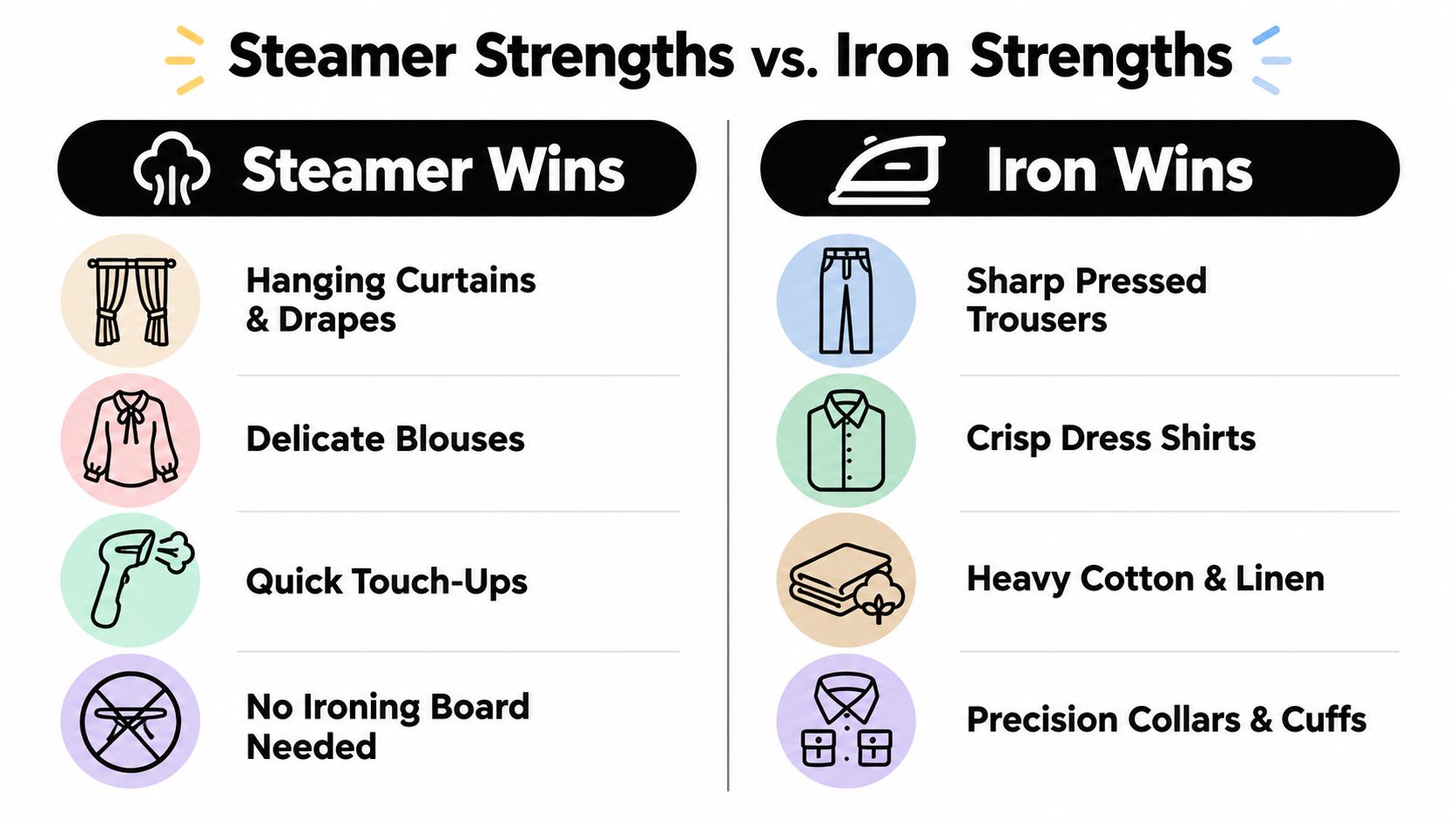
Choose a steamer for hanging items, delicate handling, travel, and daily wrinkle removal. Choose an iron for crisp collars, firm seams, thick fabric, and a pressed appearance. The same heat-and-contact principle applies to tools such as the electric hot comb hair straightener, where temperature control affects the final result.
Maintenance, Troubleshooting, and Long-Term Care
Water management determines whether an automatic garment steamer stays reliable. Stale water can create odors, while mineral deposits can restrict the heating chamber, hose, or nozzle. Follow the owner's manual first. Some manufacturers prohibit vinegar, while others specify a particular descaling solution.
A simple care routine
Empty the reservoir after every session and let it dry before storage. Wipe the nozzle face with a soft cloth to remove residue, then keep the unit upright in a cool, dry place. Wrap the cord loosely. A sharp bend at the appliance base can damage it over time.
Descale only according to the manufacturer's instructions. If the manual permits it, diluted white vinegar or citric acid can loosen mineral buildup. Empty the appliance afterward and rinse it through repeated clean-water cycles until the cleaning odor disappears. Direct the first output away from clothing. This prevents loosened residue or droplets from marking a shirt or curtain.
Match the symptom to the likely cause
- Weak or absent steam: Mineral buildup, a restricted hose, unsuitable water, or a failing pump may be responsible. Empty the tank, check the hose for kinks, clean the approved filter or nozzle, and run the manufacturer's cleaning cycle.
- Water spitting: Residual water in the heating chamber, an overfilled reservoir, scale flakes, or a cold start can produce droplets. Switch the unit off, let it cool, drain excess water, and test the first output away from fabric.
- Visible leaks: Inspect the tank seal, cap, hose connection, and reservoir for cracks. Keep the unit level, since over-tilting can let condensation or water escape.
- Steam that smells stale: Drain and rinse the tank, then leave it open to dry. A persistent odor points to residue inside the system and calls for approved descaling.
- Steam that stops during use: The tank may be empty, auto shut-off may have activated, or the unit may have overheated. Let it cool before refilling or restarting.
Treat leaks as a safety issue, not merely a performance nuisance. A cracked reservoir, damaged electrical cord, or repeated leak that creates a burn risk requires replacement or professional service. Do not improvise a repair around water and electricity.
Smart Shopping Tips and Where to Find the Right Pick
A shirt still looks rumpled five minutes before leaving, while curtains need freshening and an iron would require a board. Choose the steamer around that routine, not its accessory list. A compact handheld suits occasional shirts, travel, and small wardrobes. A standing model with a larger removable tank handles curtains, several outfits, and repeated use with fewer refills.
Use this checklist before buying:
- Compare steam output: Choose a published g/min figure, then consider what it means on fabric. Higher output can smooth a heavier shirt faster, while gentler output may suit delicate garments.
- Check heat-up time: Quick heat-up matters during rushed mornings. A steamer that takes too long will stay in the cupboard.
- Inspect the tank: A removable tank simplifies filling, draining, and cleaning. Capacity should match how many garments you usually steam.
- Treat safety as mandatory: Auto shut-off, anti-drip construction, stable placement, and a secure cap reduce spill and burn risks. These protections matter especially around curtains, children, and crowded bedrooms.
- Read the warranty: Clear coverage and responsive support matter more than the lowest unbranded price.
- Compare finalists directly: Place three models side by side using steam output, heat-up time, tank capacity, safety features, and return terms.
A good shortlist solves a real household problem without creating difficult upkeep. For more practical affordable home essentials, compare products by daily convenience and household use.
Granted Solutions curates functional home products, including garment-care finds when available. Visit Granted Solutions to explore useful upgrades and gift-worthy choices.
Leave a comment