

Automatic Pool Cleaner Vinyl Liner

A robot glides across the pool floor while the owner watches from the deck. It reaches the wall, pauses near a corner, and leaves behind a faint mark where the cleaner has rubbed against the liner. The pool is cleaner, but the purchase suddenly feels risky.
That concern is reasonable. A vinyl liner needs gentler treatment than concrete or fiberglass, and the safest automatic pool cleaner vinyl liner setup depends on more than a product label. Brush material, suction control, tracks, navigation, water chemistry, and liner condition all affect the outcome. A careful buyer can avoid the common mistake of choosing a machine that cleans well on hard surfaces but creates unnecessary stress on flexible vinyl.
Table of Contents
- Why Vinyl Liner Owners Worry About Automatic Pool Cleaners
- The Three Cleaner Types and How They Actually Work
- Which Cleaner Type Is Safest for a Vinyl Liner
- Features That Make a Cleaner Liner-Safe
- Setup and Prevention Steps Before You Press Start
- The Hidden Variable Water Chemistry and Liner Age
- Quick Troubleshooting When Something Feels Off
- Your Vinyl-Safe Cleaner Checklist and Smart Next Step
Why Vinyl Liner Owners Worry About Automatic Pool Cleaners
Vinyl liners are flexible surfaces, so owners often worry about repeated contact rather than one dramatic accident. A rough brush may slowly wear the printed surface. A sharp edge can catch a wrinkle or seam. A cleaner that grips too firmly can pull at a weak section instead of just lifting debris.
The most common concerns are mechanical:
- Brush wear: Stiff or abrasive bristles can scuff the liner's surface and affect its printed pattern.
- Seam contact: A corner, wheel edge, or trapped piece of grit can snag a seam.
- Localized pressure: A heavy unit may rest on one area, especially if it gets stuck.
- Suction force: Excessive suction can press the cleaner tightly against the pool floor or wall.
- Wrinkles and loose areas: A cleaner can stress sections that are already poorly supported.
A vinyl warranty document warns that some patterns can be seriously scratched or abraded by rubbing with a pool brush, while cuts, abrasions, markings, and pattern removal may fall outside warranty coverage in the vinyl liner warranty document. That makes cleaner compatibility a practical protection issue, not merely a comfort preference.
Practical rule: A cleaner should never be expected to repair a weak liner. It should work only after the pool owner confirms that the liner is sound.
The category has also changed over time. John M. Davison patented the first swimming pool cleaner in 1913, a suction-side cleaner appeared in 1937, Andrew L. Pansini created the first automatic pool cleaner in 1955, and the first electric robotic pool cleaner emerged in 1967, according to the history of automated pool cleaners. This progression from basic debris removal to specialized machines helps explain why modern products increasingly include surface-specific guidance for vinyl.
The fear of damage is especially understandable because a liner is a major household component, not a disposable filter. Vinyl liner care guidance therefore emphasizes soft contact, cautious movement, and special attention around seams and corners. The right question isn't only whether a cleaner is automatic. It's whether its mechanics suit the liner underneath it.
The Three Cleaner Types and How They Actually Work
Before comparing models, a first-time buyer needs to identify the cleaner family. Automatic pool cleaners generally fall into three groups, and each one uses a different source of movement and suction.
Suction-side cleaners connect to the skimmer or a dedicated vacuum fitting. They work like a shop vacuum attached to a long hose. The pool pump creates suction, the cleaner moves across the surface, and debris travels through the hose toward the pool's filtration system.
Pressure-side cleaners connect to a return line and use pressurized water to move. Some use a booster pump. Instead of relying mainly on suction at the cleaner head, they push water around the unit and often collect debris in a mesh bag.
Robotic cleaners contain their own motor, pump, and filter. They operate independently from the pool's main circulation system and travel across the floor using wheels or tracks. Rotating brushes loosen debris while the onboard filter captures it.
A practical explanation of the mechanics appears in this guide to how automatic pool cleaners work. The key distinction is contact. A suction cleaner may use a flexible diaphragm or flapping foot. A pressure cleaner may drag a hose and tail across the liner. A robot usually relies on tracks or wheels, brushes, and controlled intake.
| Cleaner family | Main power source | Typical liner contact | Main question |
|---|---|---|---|
| Suction-side | Pool pump suction | Hose and suction head | Can the flow be controlled? |
| Pressure-side | Return-line pressure, sometimes a booster pump | Hose, wheels, and water-fed tail | Will movement stress corners or seams? |
| Robotic | Self-contained motor and pump | Tracks or wheels, brushes, filter intake | Are all contact materials soft and vinyl-rated? |
The category alone doesn't decide safety. A gentle suction cleaner with controlled flow may suit a particular pool, while a poorly designed robot with hard brushes may not. Still, knowing the category gives the buyer a useful starting point before reading the detailed specifications.
Which Cleaner Type Is Safest for a Vinyl Liner
For most vinyl-liner owners, a robotic cleaner rated specifically for vinyl is the safest default. It doesn't depend on the pool pump to create all of its cleaning force, and its self-contained design can reduce the need for a long suction hose or pressure hose dragging across the liner.
Suction-side units deserve closer inspection. High flow can make the cleaner hold tightly to the surface, particularly near corners, shallow areas, seams, or wrinkles. Guidance for inground pool cleaners recommends suction-side or robotic designs with soft rubber brushes, lightweight frames, and controlled navigation for better vinyl safety, while warning that excessive suction can stretch or lift a liner, as explained in this vinyl pool cleaner safety guidance.
Pressure-side cleaners avoid direct suction at the cleaner head, but they still introduce other contact points. A water-fed tail can repeatedly strike walls or corners, and the hose can rub across the surface. Pressure isn't automatically unsafe, yet the complete setup needs to be checked rather than judged by the word “pressure” alone.
| Cleaner Type | Power Source | Liner Contact | Typical Liner Risk |
|---|---|---|---|
| Suction-side | Pool pump suction | Suction head and hose | Excessive grip, hose drag, seam stress |
| Pressure-side | Return-line pressure | Wheels, hose, and tail | Repeated rubbing, corner contact, localized force |
| Robotic | Internal motor and pump | Tracks or wheels, brushes, intake | Hard brushes, rough tracks, or overly strong intake |
The important exception is design quality. A suction-side model with a flow restrictor may be gentle, while an inexpensive robot with stiff nylon bristles can still scour the liner. Modern robotic cleaners are generally a strong choice because they can combine controlled movement, onboard filtration, and soft contact materials, but every model still needs a specification check.
A simple buying rule works well: start with a vinyl-rated robotic cleaner, then confirm its brush material, track or wheel construction, suction behavior, and navigation. Consider suction or pressure equipment only when the pool owner understands how to regulate flow and inspect the contact points.
Features That Make a Cleaner Liner-Safe
The phrase “vinyl-safe” is useful, but it isn't detailed enough by itself. A buyer should treat it as an invitation to inspect the machine's actual contact materials and operating controls.
Start with the brush system
Soft rubber, soft PVC, and PVA foam brushes are preferred for vinyl surfaces. They can loosen ordinary debris without using the harsh contact associated with stiff bristles or abrasive pads. A vinyl-pool robot guide identifies rubber and PVA foam brushes as suitable options and advises avoiding sharp edges and aggressive scrubbers in its vinyl pool robot selection guide.
If a product page says only “deep scrubbing,” the buyer should look for the brush material before assuming that the feature is appropriate. Deep cleaning is useful only when the brush remains gentle.
Check the movement hardware
Wide, smooth tracks can distribute the unit's weight more evenly than narrow, hard plastic lugs. Rubber wheels may also be suitable when they have smooth edges and don't concentrate pressure in a small contact area. The same principle applies to the outer shell. A rounded bumper is preferable to exposed metal, sharp seams, or rough molded plastic.
Look for controlled suction
A cleaner should release easily rather than lock onto the liner. Adjustable intake settings, flow valves, or restrictors can help prevent a vacuum-like seal. This matters most around wrinkles, steps, corners, and seams, where a concentrated force can stress a flexible surface.
Use a quick box check
Before buying, the product description should answer these questions:
- Vinyl rating: Does the manufacturer explicitly list vinyl liners?
- Brush material: Are the brushes rubber, soft PVC, PVA foam, or a similarly non-abrasive material?
- Drive surface: Do the tracks or wheels have smooth, flexible contact areas?
- Suction control: Can the intake or water flow be adjusted?
- Hardware: Are there no exposed metal scrapers, sharp corners, or abrasive pads?
- Maintenance access: Can hair, grit, and calcium buildup be removed from brushes and intakes?
These checks are more valuable than a vague promise of “all-surface cleaning.” A retailer listing demonstrates that some models can work on fiberglass, concrete, and vinyl, as shown in this vinyl-surface pool vacuum listing. Multi-surface capability is possible, but the buyer still needs to verify how the machine makes contact.
Setup and Prevention Steps Before You Press Start
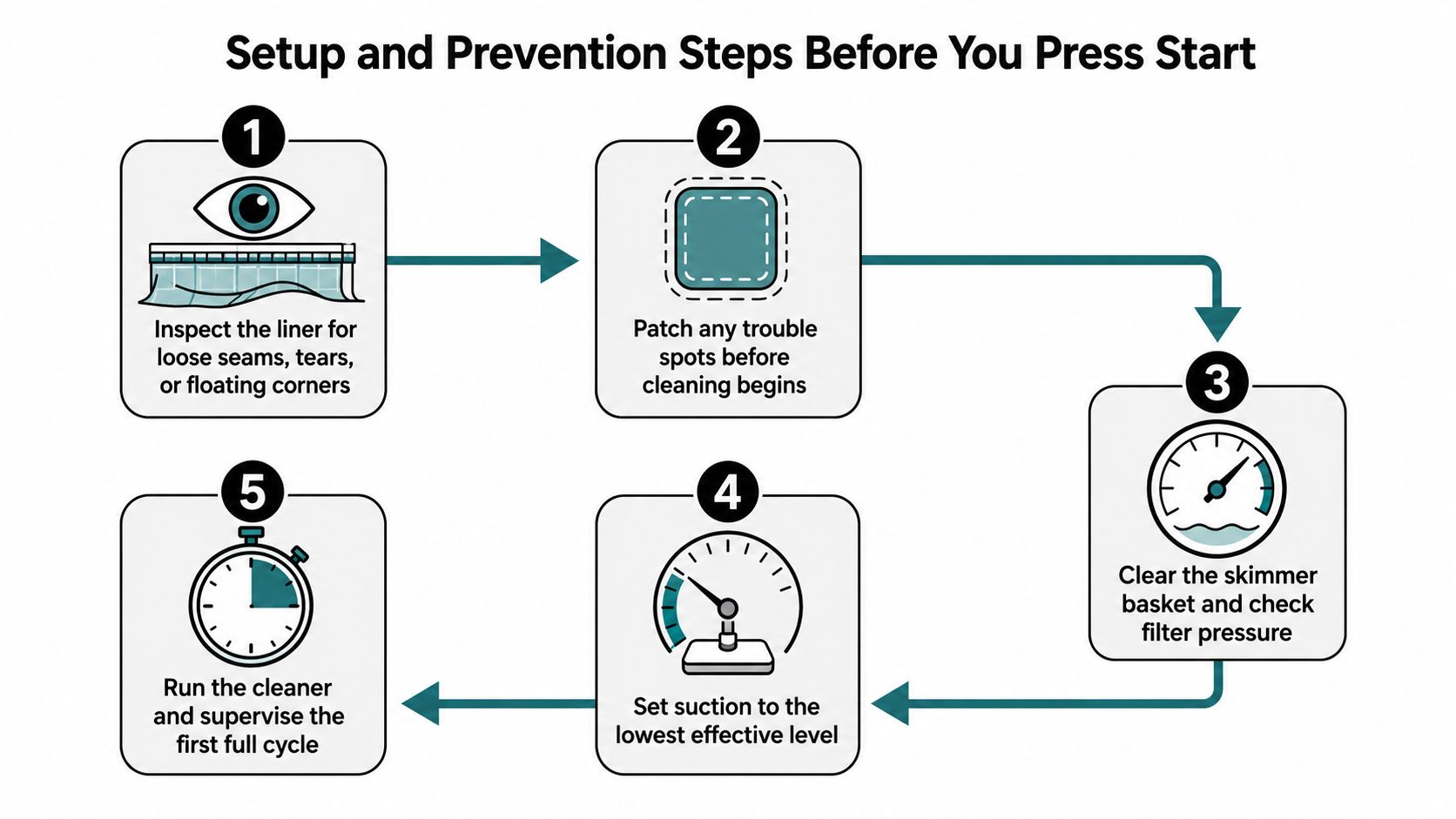
A safe cleaner can still cause trouble if the pool or equipment is poorly prepared. The first cycle should be treated like a test drive, not an unattended routine.
Inspect the pool first
Look along the waterline, seams, steps, corners, and floor for loose sections, tears, floating corners, or pronounced wrinkles. Any weak area should be repaired before an automatic cleaner runs. A machine can expose an existing problem faster, even when the cleaner itself is functioning normally.
Remove sharp debris by hand. Small stones, broken plastic, and trapped grit can turn a soft wheel or brush into a rubbing tool.
Prepare the circulation system
Suction-side equipment needs a stable water level near the skimmer. If the water level is too low, the system can draw air and behave unpredictably. The skimmer basket, pump basket, and filter should be checked so the cleaner receives consistent flow rather than struggling against a blockage.
For suction systems, a safety vac lock on wall vacuum fittings is an important installation detail. The pool-cleaner owner's manual describes this type of safety measure in connection with suction-entrapment prevention.
Manage hoses and cords
Uncoil hoses fully and remove twists before placing them in the water. A kink can pull the cleaner sideways, causing it to press repeatedly into a wall. Robotic power cables also need enough slack for natural movement without forming loops around the unit.
Run a short supervised cycle first. Watch how the cleaner climbs, releases from slopes, approaches steps, and behaves near the waterline. If the unit spins or stays pressed against one location, stop it instead of allowing repeated rubbing.
A simple maintenance habit helps too. Stubborn spots can be handled with a vinyl-appropriate manual tool so the automatic cleaner doesn't keep revisiting one area. After use, rinse the machine and store hoses flat and away from direct sun.
The Hidden Variable Water Chemistry and Liner Age
A “vinyl-safe” label doesn't make a weakened liner safe. Water chemistry and material condition determine how much mechanical contact the surface can tolerate.
Poorly maintained water can weaken vinyl before a cleaner ever touches it. Guidance from an expert interview highlights the importance of routinely maintaining alkalinity, pH, calcium hardness, and free chlorine, and notes that a compromised surface may lose parts of its pattern when a cleaner passes over it, as discussed in this expert interview on robotic pool cleaners.
The analogy is simple. A soft brush moving over healthy skin is very different from the same brush moving over sandpaper. Scale, brittle vinyl, and chemical damage can create a rougher, more fragile surface, so a machine that seems gentle in one pool may be too demanding in another.
The supplied evidence doesn't establish universal target ranges for these chemistry variables, so a responsible owner should follow the liner manufacturer's care instructions and test the water regularly rather than relying on invented “safe” numbers. The same caution applies to liner age. A manual warns against using a cleaner when the liner is brittle, aged, or already damaged, and notes that some patterns are especially vulnerable to surface wear or pattern removal.
| Water or liner factor | What should be checked | Possible concern |
|---|---|---|
| pH | Follow the liner and pool-care guidance | Chemical stress may increase brittleness |
| Alkalinity | Test routinely and correct drift | Unstable water can make care less predictable |
| Calcium hardness | Check for levels outside the recommended range | Scale can increase surface friction |
| Free chlorine | Keep within the manufacturer's guidance | Excessive chemical exposure may weaken vinyl |
| Liner condition | Look for wrinkles, fading, brittleness, tears, and loose areas | Mechanical cleaning may worsen existing damage |
Stop signal: If a cleaner pulls a visible wrinkle, exposes discoloration, or repeatedly works one weak spot, remove it and inspect the liner before another cycle.
The pool owner should also adjust the cleaning approach as the liner becomes older or more fragile. That may mean shorter supervised cycles, floor-only cleaning, or manual inspection before every run. Automation reduces effort, but it doesn't replace judgment about the condition of the surface.
Quick Troubleshooting When Something Feels Off
Even a vinyl-rated cleaner can behave differently after debris, hair, scale, or a circulation problem enters the picture. Early inspection is safer than allowing a small mechanical issue to become repeated friction.
The unit is stuck or spinning
First action: Lift the cleaner out and inspect the brushes, tracks, wheels, and intake. Hair wrapped around a drive component or calcium buildup near the intake can prevent normal movement. Clean the obstruction before trying another cycle.
If the unit keeps spinning after cleaning, check whether one track or wheel is worn. A machine that turns in place can rub the same patch of liner repeatedly, especially near a wall or step.
Suction feels weak
First action: Check the hose or cable for kinks and inspect the skimmer, filter, or pump basket for blockage. A suction-side cleaner may leave debris behind when the system can't provide steady flow, while a robotic cleaner may need its filter canister emptied.
Don't respond to weak cleaning by immediately increasing suction. A stronger setting can create more liner stress without solving a clogged basket or restricted hose.
A faint trail or pattern appears
First action: Stop the cleaner and inspect the contact surfaces. Look for embedded grit, rough brush sections, damaged tracks, or a hard object caught beneath the unit.
Rotating the machine or replacing worn drive components may help, but visible discoloration deserves caution. A pool cleaner maintenance guide can support routine inspection, yet it can't substitute for stopping the equipment when the liner shows a new mark.
The same response applies to wrinkles. A visible pull, lifted seam, or new color change means the cleaner should come out immediately. The pool owner should document the area, examine the machine, and correct the underlying problem before restarting.
Your Vinyl-Safe Cleaner Checklist and Smart Next Step
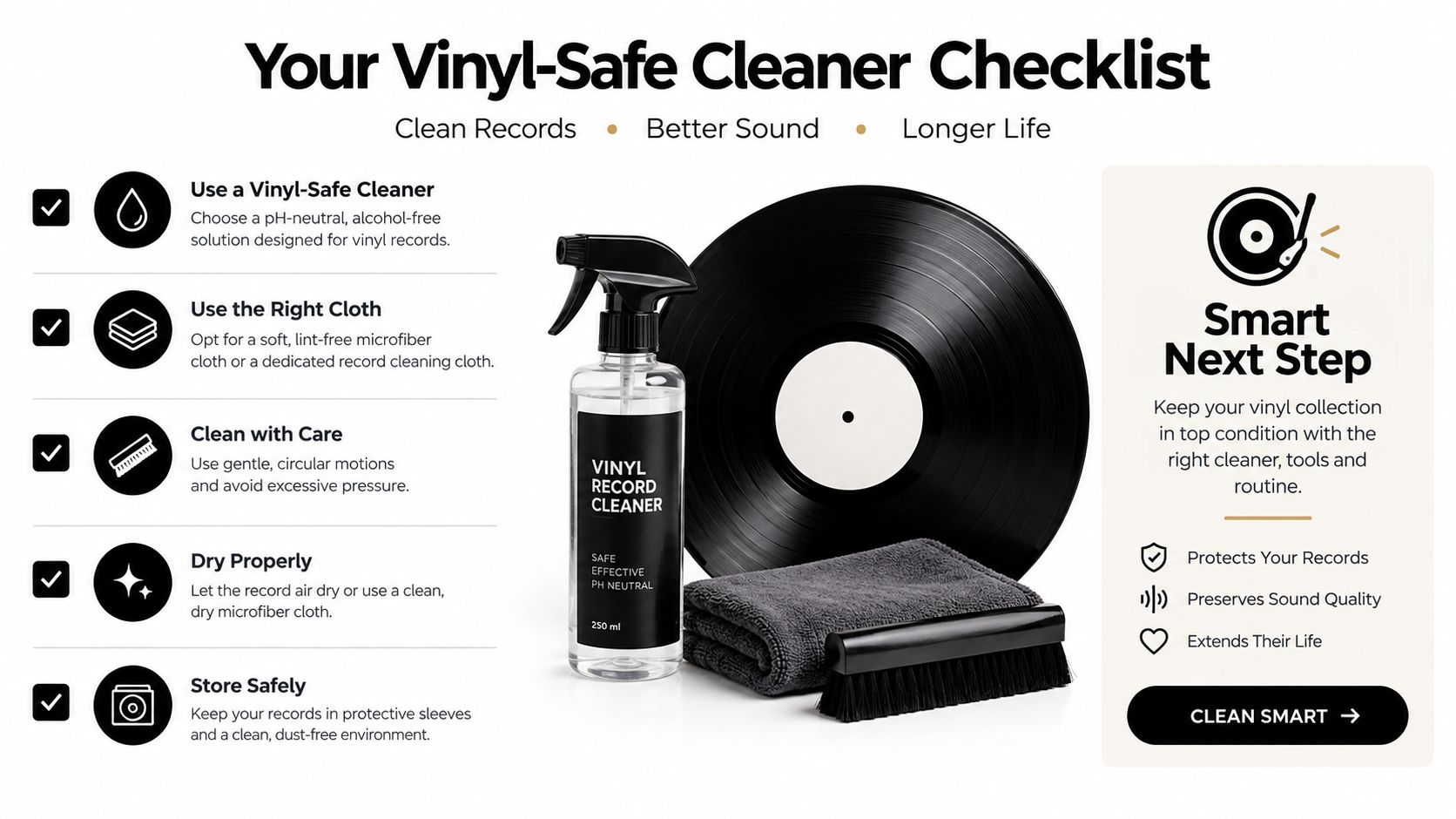
A good buying decision can fit on one short checklist. It starts with compatibility, then moves to the parts that physically touch the liner.
- Confirm the surface rating: The manufacturer should explicitly list vinyl liners or vinyl pool surfaces.
- Choose gentle contact: Prefer rubber, soft PVC, or PVA foam brushes over hard bristles or abrasive pads.
- Inspect the drive system: Smooth rubber wheels or broad, flexible tracks are preferable to sharp, hard contact points.
- Check force control: Suction or intake should be adjustable enough to prevent the cleaner from locking onto the liner.
- Match the cleaning mode: A floor-only setting may be the prudent starting point for a fragile liner or uncertain wall structure.
- Review the warranty: Confirm what the manufacturer covers and what it excludes. One cleaner warranty document describes coverage for manufacturing defects and wear and tear for two years, making warranty length and wording important parts of the purchase decision.
- Plan supervision: Watch the first full cycle and stop the machine at the first sign of snagging, discoloration, or wrinkle movement.
Two guardrails matter throughout the season: keep the water within the liner manufacturer's care guidance, and rinse away grit before running the cleaner. The best automatic pool cleaner vinyl liner choice is the one that combines gentle materials with a pool and liner that are ready for automated cleaning.
For side-by-side shopping, the automatic pool cleaner reviews can help narrow the options. A curated collection makes it easier to compare vinyl ratings, brush construction, movement systems, filtration, and warranty terms without treating every robot as interchangeable.
Granted Solutions brings together practical home and outdoor products, including pool-cleaning equipment selected for everyday problem solving. Visit Granted Solutions to compare automatic pool cleaner options, review useful product details, and choose equipment that fits the needs of the pool and its vinyl liner.
Leave a comment