

Bluetooth Tracker Key Finder Guide for 2026

The keys are somewhere in the house, but the clock is already working against the person holding the door handle. A hand sweeps under couch cushions, checks yesterday's jacket, and searches the entryway bowl before the familiar panic turns a simple commute into a scavenger hunt. A bluetooth tracker key finder can't stop keys from being misplaced, but it can turn that search into a phone tap, a sound, and a much shorter route to the answer.
That small difference matters because lost essentials tend to disappear in repeat locations, including jacket pockets, gym bags, desks, and bags left near the door. A tracker is most useful when it fits naturally into those routines. Readers looking to reduce household clutter can also find practical ideas in this guide to home organization products.
Table of Contents
- The Daily Lost-and-Found Problem You Already Know
- How a Bluetooth Tracker Key Finder Actually Works
- Key Features That Matter When You Compare Trackers
- Real-World Use Cases Beyond the Keyring
- Honest Trade-Offs and Common Frustrations
- Setup, Daily Habits, and Long-Term Care
- Choosing a Tracker Worth Buying and Gifting
The Daily Lost-and-Found Problem You Already Know
A missing key rarely creates a dramatic emergency. More often, it creates a string of irritating little delays. Someone places keys down while carrying groceries, drops them beside a laundry basket, or slips them into a coat pocket that won't be worn again until the next cold morning.
Without a tracker, the search depends on memory. The person retraces movements, checks likely surfaces, and listens for the faintest clue. With a tracker attached to the keyring, the phone can send a command to the device, and the device can play an audible alert when it's close enough to communicate directly.
That doesn't mean the tracker magically knows which couch cushion is hiding the keys. It acts more like a quiet helper in a room. The phone establishes contact, the tracker responds with a sound, and the listener follows the noise. If the keys are inside a gym bag or under a jacket, that sound can be more useful than another round of guessing.
Practical rule: A tracker works best when it's attached before the item goes missing, not after the search begins.
The same idea applies beyond keys. A purse left in a hallway, a backpack tucked into a car, or a remote control lost between cushions can all benefit from a nearby alert. The device earns its place through repeated, ordinary uses rather than one dramatic recovery.
That's why the purchase deserves more thought than a quick glance at advertised range. The tracker's radio connection, phone ecosystem, recovery network, battery, alert style, and privacy controls work together. A device with a strong direct signal may be a poor fit if the household uses an incompatible phone platform. Another tracker may work well in a home but offer limited help once an item travels beyond the owner's phone.
The right question isn't, “How far can this tracker reach?” It's, “What happens when the item is nearby, out of range, or found by someone else's phone?”
How a Bluetooth Tracker Key Finder Actually Works
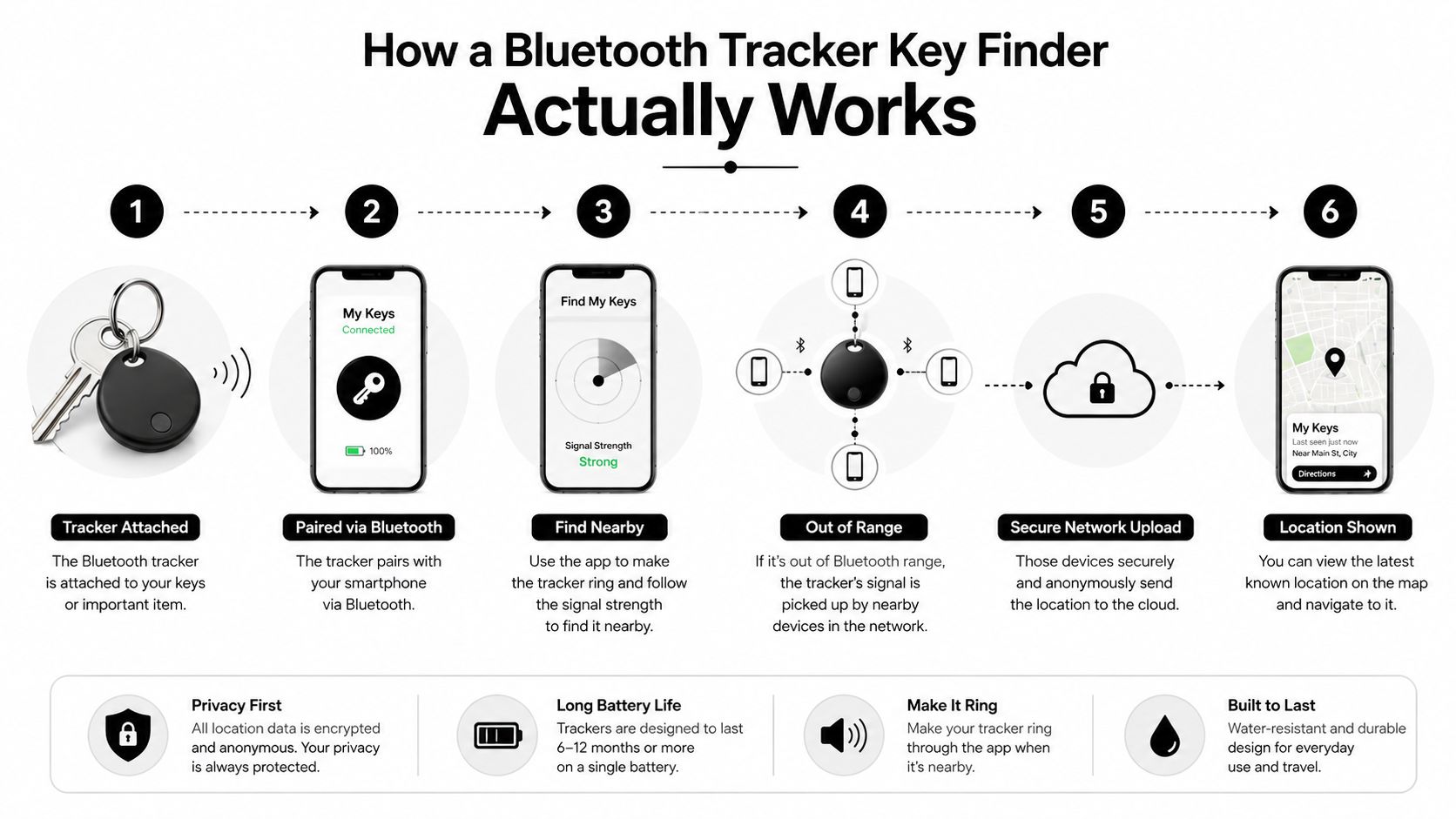
A Bluetooth tracker key finder uses Bluetooth Low Energy, often called BLE, to maintain a small, power-efficient radio connection with a paired phone. The tracker broadcasts a unique signal, and the companion app uses that connection to determine whether the device is nearby.
A simple analogy helps. Two people are calling to each other across a room. If the reply sounds loud, they're probably close. If it sounds faint, they're farther away or something is blocking the path. The phone makes a similar estimate from signal strength, but it doesn't measure distance with perfect precision.
The nearby search
When the keys are close, the app can usually trigger the tracker's speaker. The owner follows the chime rather than relying on memory. The direct connection is limited by radio conditions, not by the app alone.
Testing of consumer trackers found open-air direct Bluetooth connections ranging from roughly 51 to 387 feet, while product claims often cluster around 100 to 400 feet. The findings and the reasons for that variation are detailed in Bluetooth tracker range testing. Antenna design, transmit power, receiver sensitivity, line of sight, walls, furniture, and body blocking all affect the result.
A device claiming a longer open-space range may still struggle inside a crowded apartment. A tracker with a shorter claim may feel more dependable if its radio design handles indoor obstacles better.
The network search
The second layer begins after the keys leave the owner's direct Bluetooth range. Compatible trackers can use a crowdsourced finding network. When another participating device passes near the lost tracker, that nearby device may detect the Bluetooth signal and relay an updated location to the owner's account.
Apple says its Find My network includes more than a billion iPhone, iPad, and Mac devices, with location relays designed to remain anonymous and encrypted on Apple's AirTag overview. The network doesn't turn the tracker into a GPS device. Instead, it creates more chances for a nearby phone to notice the tag.
This distinction prevents a common misunderstanding. Bluetooth range controls the local search. Network density controls the possibility of a remote update. A buyer choosing a tracker is therefore choosing an ecosystem as much as a fob.
Key Features That Matter When You Compare Trackers
A tracker's specification sheet can look impressive until daily use exposes the compromises. Range, battery, alerts, protection, and software all shape the experience, but no single feature wins every situation.
Range is a behavior, not a promise
Open-air range gives a useful reference point, but it shouldn't be treated as an indoor guarantee. Concrete walls, metal cabinets, furniture, and a person's body can weaken the connection. Buyers should prioritize dependable nearby discovery over the largest printed number.
Battery design changes ownership
A replaceable CR2032 coin cell can be convenient because the tracker returns to service without a charging cable. Chipolo ONE Spot, for example, lists a 200-foot or 60-meter Bluetooth range, up to one year of battery life, and a replaceable CR2032 battery in its product specifications.
Rechargeable trackers reduce disposable battery handling, but they introduce another habit. The owner must remember to charge the device before the battery runs low. Guidance about wireless charging efficiency can help shoppers understand why charging convenience matters for devices used every day.
Alerts need to match the object
A loud chime matters for keys under a sofa. A visual indicator can help in a dark room, while phone notifications can warn that an item has been left behind. Vibration patterns may suit some devices, but they're less useful when the tracker is buried inside a bag.
Protection has limits
Water and dust ratings describe test conditions, not unlimited outdoor abuse. One published tracker example lists iOS-only compatibility, IP67 water resistance, and a replaceable CR2032 battery. IP67 means protection against submersion in up to 1 meter of water for 30 minutes, as explained in the device documentation at this IP67 tracker reference.
Apps can decide whether a household sticks with tracking
Shared access, separation alerts, location history, voice assistant support, and privacy controls may matter more than a minor difference in radio range. A family that can't share access easily may stop using the tracker, even if the hardware performs well.
| Feature | What It Means | What to Watch For |
|---|---|---|
| Range | Direct communication between phone and tracker | Indoor obstacles can reduce the usable distance sharply |
| Battery | How the device stays powered | Replaceable cells simplify ownership, while rechargeable models require charging |
| Alerts | How the tracker signals its location | A quiet alarm may disappear under cushions or inside luggage |
| Water resistance | Protection from rain, spills, and immersion | Ratings describe defined conditions, not permanent waterproofing |
| App functions | Sharing, alerts, network access, and controls | Phone compatibility and privacy settings vary by ecosystem |
Real-World Use Cases Beyond the Keyring
The best tracker changes with the object attached to it. Keys usually stay close to home, while a suitcase may cross cities before anyone notices it's missing. Treating every use case as a keychain problem leads to awkward purchases.
Keys favor sound and simplicity. A compact fob with a clear ring attachment, an audible alert, and easy nearby searching can be enough. Extra software matters less if one person owns the keys and the item usually disappears inside the home.
Wallets need a different shape. A card-style tracker avoids adding bulk to a wallet, and a slim design can matter more than a prominent speaker. The device also needs to remain easy to remove when the wallet is replaced.
Bags and backpacks benefit from durability. A school bag, work backpack, or camera case may spend time in cars, on floors, and outdoors. A secure attachment point, a casing suited to rough handling, and access to a broad finding network become more valuable than a tiny form factor.
Pets require care beyond the device itself. A tracker may help locate a pet nearby or provide a network-assisted update, but it doesn't replace an identification tag, a secure collar, or responsible supervision. Movement alerts and water resistance can help, yet buyers should confirm that the attachment won't irritate the animal or come loose.
Luggage pushes the decision further. A traveler may care about network coverage in unfamiliar places, a tamper-resistant housing, and settings that reduce unnecessary alerts during transport. A tracker can provide useful location information, but it doesn't guarantee recovery after loss.
A useful test: Ask what failure would look like for the specific item. If the item is buried nearby, sound matters. If it travels, network access matters. If it gets wet, protection matters.
Honest Trade-Offs and Common Frustrations
A tracker doesn't prevent loss. It gives the owner another way to search after the loss happens. That distinction sounds simple, but it changes how buyers should judge the product.
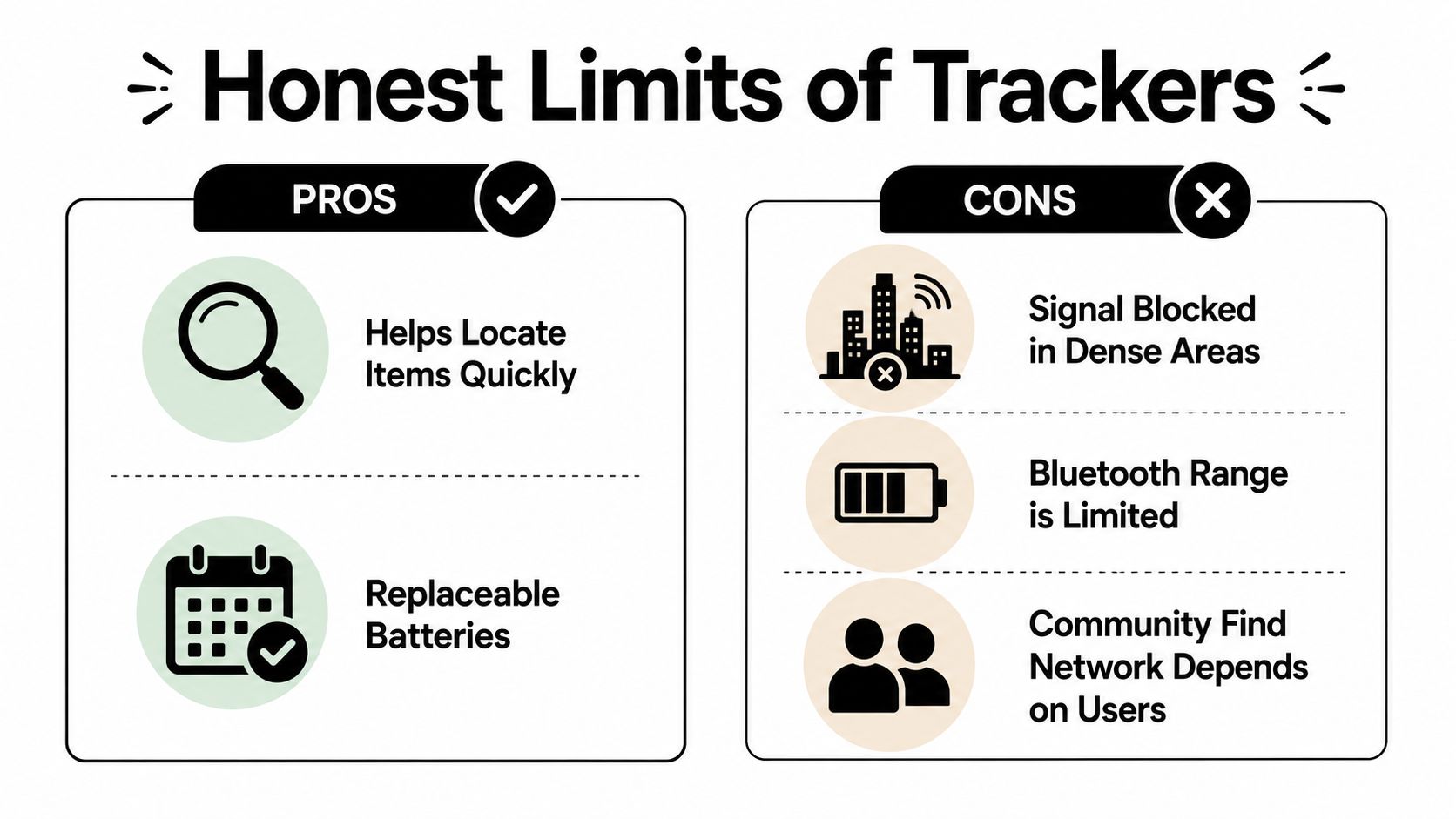
Direct Bluetooth communication can disappear behind thick walls, metal surfaces, and dense urban structures. A tracker may appear connected in an open room and then become silent when placed inside a vehicle, locker, or packed bag. The app may still show a last known location, but that information isn't the same as a live position.
Network dependence creates another gap. Apple-oriented devices make the most sense for people who already use compatible Apple hardware, while Android users need a tracker that works with their chosen network. A household with mixed phones can face friction if only one person can manage or share the tracker.
Batteries also create quiet failure points. A coin cell can last a long time, but an owner who ignores battery warnings may discover the problem during a trip. Rechargeable models create the opposite risk, since they need a charging routine rather than an occasional replacement.
Common frustrations buyers should expect
- Dead zones: Indoor materials and crowded environments can weaken the signal.
- Stale locations: A map update may reflect the last detected contact rather than the item's current position.
- Alert fatigue: Frequent separation notifications can lead users to mute or ignore them.
- Platform lock-in: A tracker designed for one ecosystem may not serve a mixed-device household.
- Privacy questions: A networked tracker broadcasts a detectable signal, so buyers should review unknown-tracker alerts, sharing controls, and data practices.
Privacy deserves particular attention because anti-stalking protections and cross-platform behavior differ between products. The Bluetooth tracker safety guide from SafeWise discusses the importance of ecosystem choice, anonymous sharing, encrypted location handling, and contact options such as QR codes.
Setup, Daily Habits, and Long-Term Care
A tracker only helps if it stays paired, attached, and powered. The first few minutes after opening the package determine whether the device becomes part of a routine or ends up in a drawer.
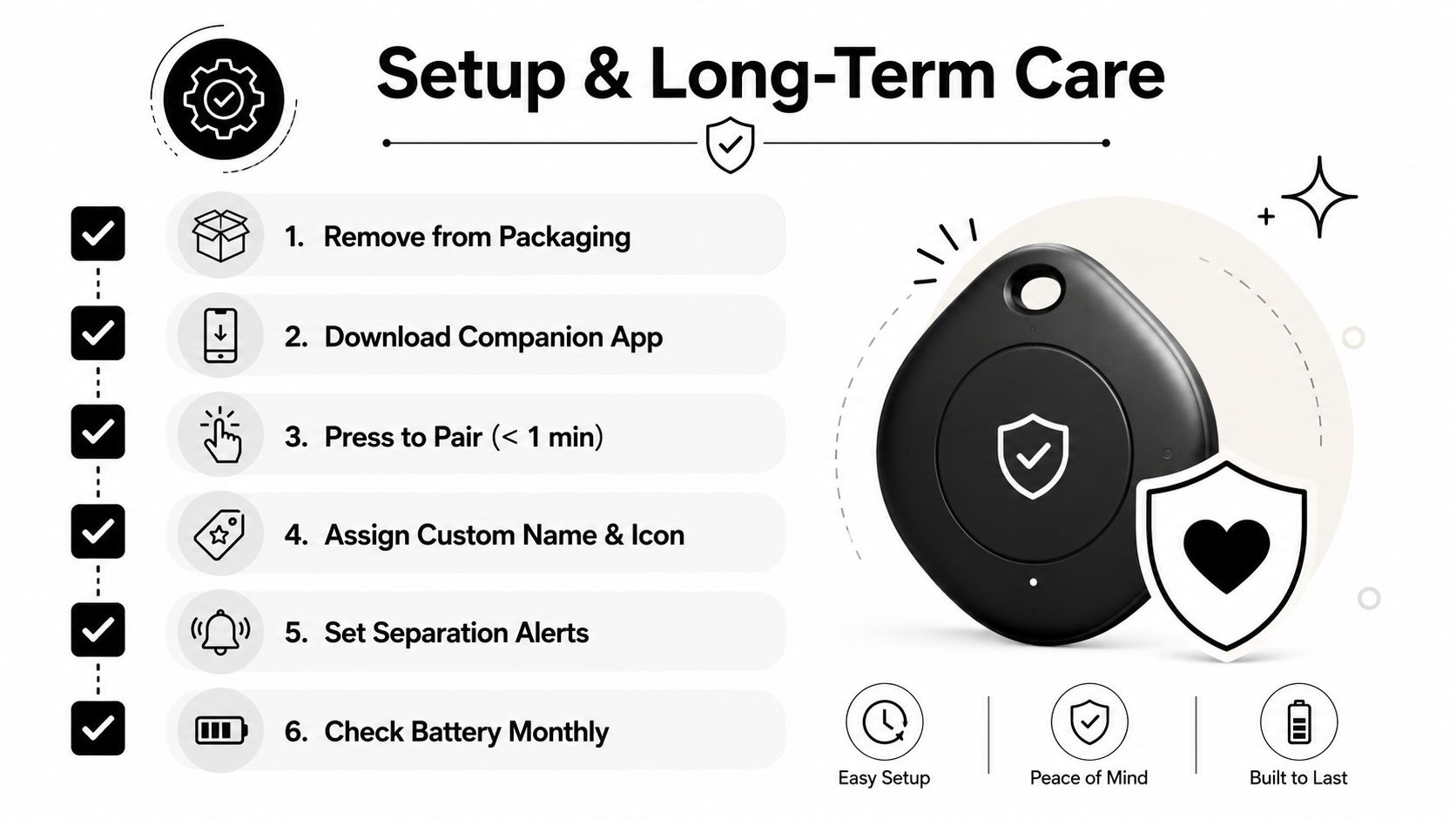
Start by installing the correct companion app and pairing the tracker according to the manufacturer's instructions. Pairing often takes less than a minute, but the exact process varies by brand and phone platform. The device should receive a clear name and icon, such as “Front Door Keys” or “Camera Bag,” instead of a vague label that becomes confusing when several trackers share one account.
Attach it where the signal and hardware can survive
A keyring loop suits keys, while an adhesive mount can work for a remote control or small household device. Bags may need a clip or a protected attachment point. The tracker should sit firmly enough that it won't fall off during ordinary movement, but it shouldn't interfere with zippers, pockets, or a pet's collar.
After attachment, the owner should test the complete chain. Open the app, trigger the sound, walk through the usual storage area, and check whether the item remains visible. A test catches pairing problems before the tracker is needed urgently.
Build a maintenance rhythm
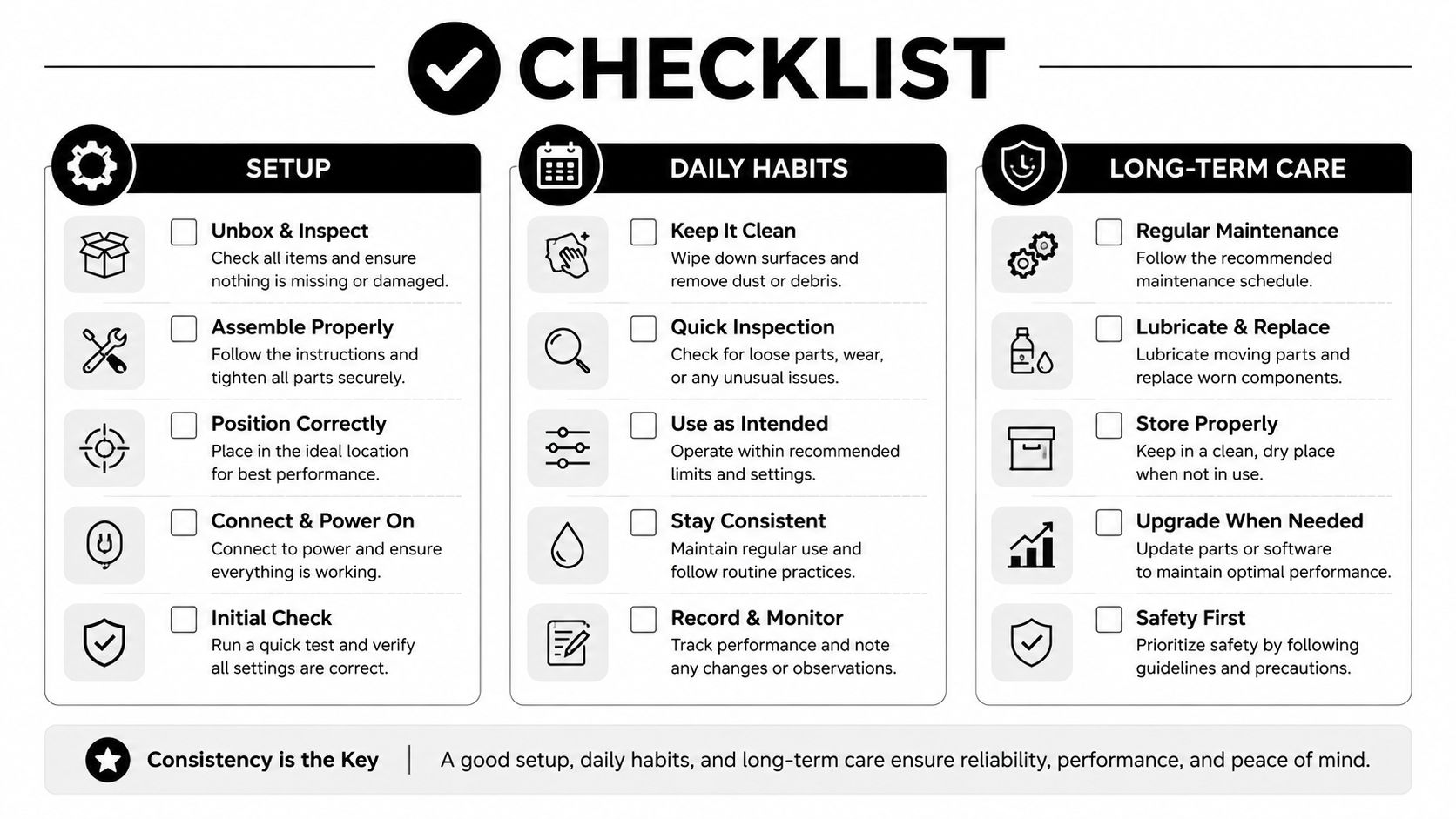
- Test the alert: Confirm that the sound remains audible in the place where the item usually rests.
- Check the battery: Review the app status and replace or recharge the power source before travel.
- Update the software: Install available firmware and app updates when the manufacturer provides them.
- Review sharing: Remove former household members and confirm who can access the tracker.
- Reset before gifting: Unpair the device and clear ownership details before handing it to someone else.
Clean battery contacts when replacing a coin cell, and retire damaged hardware instead of trusting it with an important item. Owners should also review the manufacturer's privacy controls before selling or transferring a tracker, since the next person shouldn't inherit access to an old account or location history.
Choosing a Tracker Worth Buying and Gifting
The most reliable buying decision starts with three questions: What will the tracker attach to? Who needs to help find it? How much does privacy matter? Those answers narrow the choice faster than comparing every specification.
For a keychain, a loud alert, sturdy loop, and replaceable coin battery make practical sense. A wallet calls for a slim card design. A bag or pet collar may need a more durable, water-resistant body and a secure attachment method. Luggage benefits from an ecosystem with useful coverage beyond the owner's immediate phone.
Phone compatibility should come before brand loyalty. An iPhone household can consider Apple Find My-compatible products. Samsung users may prefer a tracker built around Samsung's ecosystem. Mixed-device households should look for cross-platform support rather than assuming every Bluetooth tracker works equally well with every phone.
A simple gift checklist
- Phone platform: Confirm whether the recipient uses iPhone, Samsung Galaxy, another Android phone, or a mixed household.
- Attachment style: Choose a keyring, card, adhesive, clip, or collar-friendly format that matches the item.
- Battery preference: Ask whether the recipient prefers replacing a coin cell or remembering to recharge.
- Shared access: Check whether family members need permission to locate the same item.
- Privacy expectations: Review network participation, unknown-tracker alerts, and account transfer steps.
A tracker can make a thoughtful gift for a commuter, student, frequent traveler, parent, pet owner, or anyone who regularly searches for small essentials. It's especially useful when the gift matches an existing habit instead of adding another complicated system. More practical ideas for tech-focused presents are available in these tech gift ideas.
The market has moved well beyond novelty status. Apple's AirTag launch in April 2021 helped normalize affordable item trackers, and an industry estimate reported that the global installed base of smart trackers had surpassed 95 million units by 2023, including approximately 55 million Apple AirTags and 40 million Tile devices, according to smart tracker market data. Another forecast projects the global Bluetooth trackers market at USD 6.56 billion in 2025 and USD 17.82 billion by 2032, with a projected 15.35% compound annual growth rate, as reported by Bluetooth tracker market forecasts.
Those figures help explain the category's visibility, but they don't select the right product for an individual. A good bluetooth tracker key finder is the one that fits the owner's phone, item, recovery environment, maintenance habits, and privacy comfort level.
Granted Solutions brings together practical gadgets and everyday problem-solving accessories, including gift-friendly tech for keys, bags, home organization, pets, and travel. Visit Granted Solutions to browse the curated collection and choose a Bluetooth tracker that fits the recipient's phone platform and daily routine.
Leave a comment