

Deep Tissue Percussion Massager Guide

Your shoulders are locked up again after a day at the desk, your neck feels stiff on the commute home, and the knot between your shoulder blades has become familiar. That's the moment many people reach for a deep tissue percussion massager, hoping for fast relief without booking a massage appointment or dropping everything for a recovery session.
That appeal is easy to understand, because the category has moved from niche fitness gear to a mainstream wellness purchase. A market analysis estimated the global percussion massagers market at US$304.0 million in 2024 and projected it to reach US$436.6 million by 2030, with a 6.2% CAGR over that period, which shows just how firmly these tools have entered everyday life (market analysis of percussion massagers).
Table of Contents
- Why Everyone Seems to Be Reaching for a Massage Gun
- What a Deep Tissue Percussion Massager Actually Does
- What the Research Actually Says About Results
- A Safe Beginner Routine You Can Follow Tonight
- Who Should Skip a Massage Gun and Why
- How Percussion Massagers Compare to Foam Rollers and Vibrating Tools
- Choosing the Right Model for Your Needs
- Smarter Recovery Starts with the Right Tool
Why Everyone Seems to Be Reaching for a Massage Gun
A train ride, a long meeting, and another afternoon hunched over a laptop can leave even a healthy person feeling like their upper back has welded itself into place. That's the exact moment a deep tissue percussion massager starts to make sense, because it promises targeted relief in a few minutes, with no appointment and no floor space required.
The growth of the category matches that everyday need. The same market analysis that valued the global percussion massagers market at US$304.0 million in 2024 expects it to reach US$436.6 million by 2030, which points to steady demand from people who want recovery tools that fit into normal routines, not just gym bags (market analysis of percussion massagers).
The everyday use case looks different from the athlete story
Athletes still use these devices for pre- and post-session recovery, but that's no longer the whole story. Desk workers are buying them for neck tension, commuters are using them on tight hips and glutes, and parents are reaching for them after long days that never involved a workout but still left the body tense.
That shift matters because it changes the question. The question isn't whether the tool looks high-tech, it's whether it delivers useful relief without overdoing it or creating new soreness.
Practical rule: the best first use case is not “work every sore spot harder.” It's “find one tight muscle group, stay there briefly, and see how the body responds.”
The category's appeal is simple, but the misuse is common. People often treat a percussion gun like a blunt-force fixer, when it works best as a controlled, targeted tool.
What a Deep Tissue Percussion Massager Actually Does
A deep tissue percussion massager sends quick pulses into muscle and fascia, rather than vibrating against the skin. The motion is meant to mimic repeated, fast tapping, which is why many people describe it as feeling more like a therapist's hands than a buzzing handle.
A Mayo Clinic Store explanation notes that massage guns can produce up to 40 percussions per second (Mayo Clinic Store explanation). That helps anchor the idea in something concrete, because a tool striking tissue that fast is doing more than a gentle surface vibration.
The three specs that shape the feel
Percussions per minute tell you how fast the head moves. Amplitude tells you how far the head travels into tissue. Stall force tells you how much pressure the motor can handle before it slows down.
Those three numbers matter more than flashy marketing language. A faster device can feel more stimulating, a deeper amplitude can reach thicker muscle groups, and a stronger stall force helps the motor keep working when the user presses into tight tissue.

| Specification | What It Means | Typical Range |
|---|---|---|
| Amplitude | How far the head travels into tissue | 6 mm to 14 mm, with 10 mm to 16 mm often discussed as a practical zone |
| Percussions per minute | How fast the pulses land | 1,750 to 3,200, with some models going higher |
| Stall force | How much pressure the motor can keep up with | Varies by model, with stronger units holding speed better under pressure |
| Noise output | How loud the device feels in use | Some models are rated at <55 dB or ≤50 dB |
| Treatment time | How long a muscle group gets worked | Commonly 30 to 180 seconds in clinical and consumer guidance |
Why amplitude changes the experience
A larger amplitude generally feels deeper, which is why it can be useful for thicker tissue like the glutes, quads, or upper back. A smaller one can be easier to tolerate on neck and shoulder areas, where sensitivity tends to show up fast.
That's also why a percussion gun isn't the same thing as a vibrating wand. Vibration stays closer to the surface, while percussion is built to drive a more focused pulse into the tissue.
What the Research Actually Says About Results
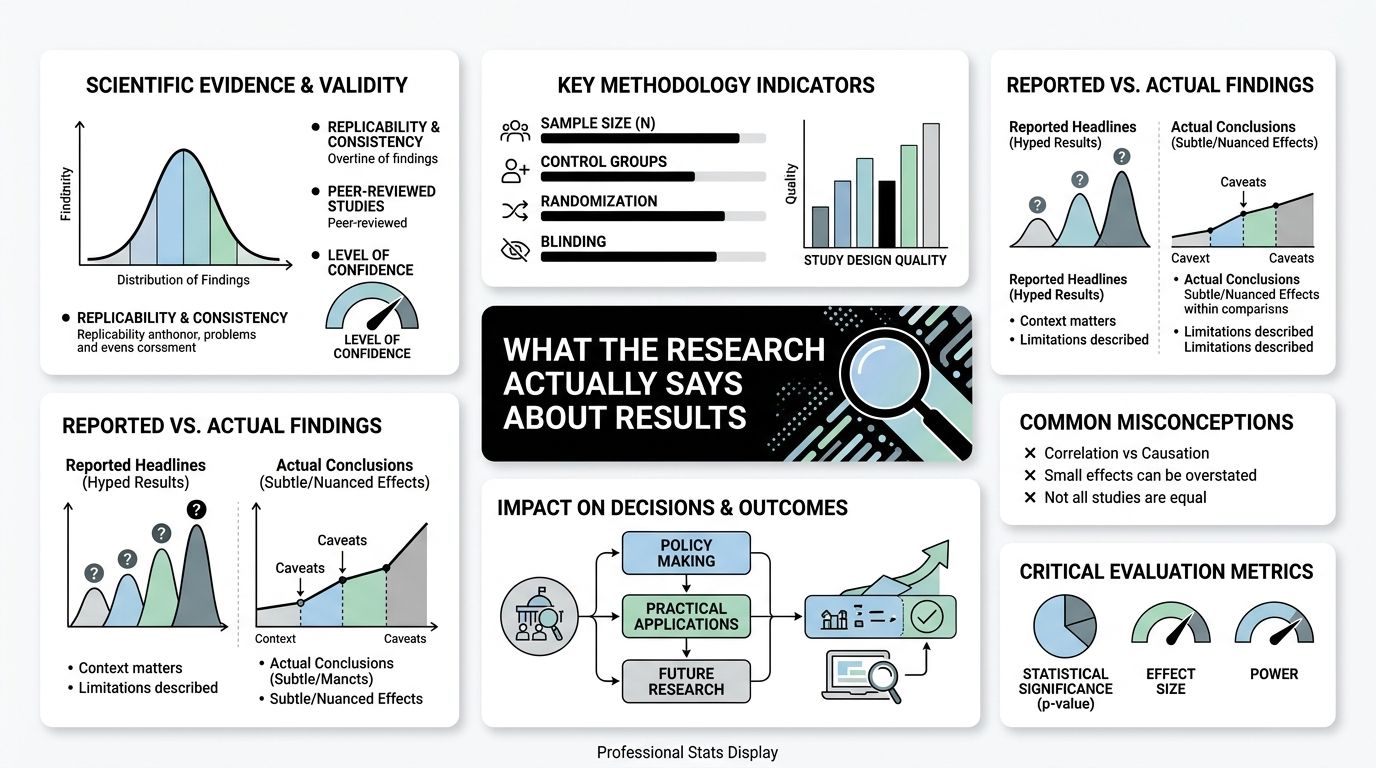
The science is more encouraging than the hype, but it's also more modest. A 2023 systematic review identified 13 studies and found that a single application can produce an acute increase in muscle strength, explosive strength, and flexibility, while multiple treatments are more often linked to reduced musculoskeletal pain (2023 systematic review).
That means the tool can have a real effect, but the effect is usually specific. It's better at helping with short-term range of motion and discomfort than at creating dramatic long-term transformation on its own.
What one session can do
Inside that evidence base, one controlled study found that maximum dorsiflexion range of motion increased by 5.4°, which was an 18.4% gain, after handheld percussive massage, and the authors reported no change in muscle strength in either the massage or control condition (2023 systematic review). That's a useful reminder that “feeling looser” doesn't always mean “getting stronger.”
A 2023 review also notes a practical split in how the tool is used. For recovery, the evidence points to more than 2 minutes per muscle group at less than 40 Hz, while for range of motion and flexibility, application should be 2 minutes or less per muscle group at more than 40 Hz (2023 review on recovery and flexibility).
Takeaway: the strongest case for a percussion massager is short-term relief, better movement feel, and targeted recovery support, not miracle-level performance gains.
That's the right expectation for a desk worker, too. A few minutes on tight upper traps after work may feel useful, but the device still works best as part of a broader routine that includes posture breaks, movement, and rest.
A Safe Beginner Routine You Can Follow Tonight
A first session should feel controlled, not dramatic. The safest way to start is to choose one muscle group, use the lowest setting, and let the head glide without digging in hard, because pressure is not the same thing as effectiveness.
A simple routine for tight shoulders or hips
Start with the round ball for larger muscle areas. Use the bullet only for a small, tight spot that feels especially knotted, and reserve the fork for areas around the spine without contacting bone.
Then follow this sequence:
- Start low and stay brief. Use the lowest speed for a short pass over one muscle group.
- Keep it on muscle. Avoid joints, bones, and the spine.
- Let the weight do the work. Hold the handle lightly and don't force the head into the tissue.
- Stop if the area gets more tender. Mild relief is fine, but rising pain is a sign to back off.
- Move on, don't chase soreness. One short pass is enough for a first try.
The research-backed timing rule is straightforward. For recovery, use more than 2 minutes per muscle group at less than 40 Hz, and for range of motion or flexibility, keep it to 2 minutes or less per muscle group at more than 40 Hz (2023 review on recovery and flexibility).
If a reader wants a simple accessory to pair with that routine, a basic option like this massage ball can help on days when a gun feels like too much for a small area.
The signs to stop
If the skin reddens sharply, the muscle feels bruised, or the area gets more irritated instead of looser, the session has gone too far. A good beginner routine should leave the body calmer, not beat up.
That's why “glide, don't grind” is the best mental cue. The device works through controlled percussion, not brute force.
Who Should Skip a Massage Gun and Why
Not every sore body is a good match for percussion therapy. That's the part many product roundups skip, especially when they're written for athletes and ignore people dealing with pain, chronic conditions, or ordinary desk-related tension.
A 2025 University of Utah Health guide says massage guns should be used on muscle, not joints or bones, and recommends keeping them away from surgical wounds, deep-vein thrombosis areas, pacemakers or implanted hardware, pregnancy, carpal tunnel syndrome, stress fractures, and acute inflammation (University of Utah Health guide).
The less obvious risk is overuse
Consumer Reports also warns that overuse can cause bruising and, in severe cases, rhabdomyolysis (Consumer Reports massage gun buying guide). That's a far more serious concern than the usual “just don't use it on your bones” advice.
The safer mindset is simple:
- Start low: Use the gentlest setting first.
- Go slow: Test one small area before expanding.
- Keep it short: Short sessions are enough.
- Avoid risky zones: Skip bones, joints, wounds, and any area with active inflammation.
Who should be especially cautious
People with implanted hardware, clot concerns, or pregnancy should not assume a massage gun is automatically harmless. The same goes for anyone with a numb, swollen, or unusually hot area, because percussion is not a substitute for medical evaluation.
A strong tool still needs judgment. The safest users treat it like a precision recovery device, not a full-body hammer.
How Percussion Massagers Compare to Foam Rollers and Vibrating Tools
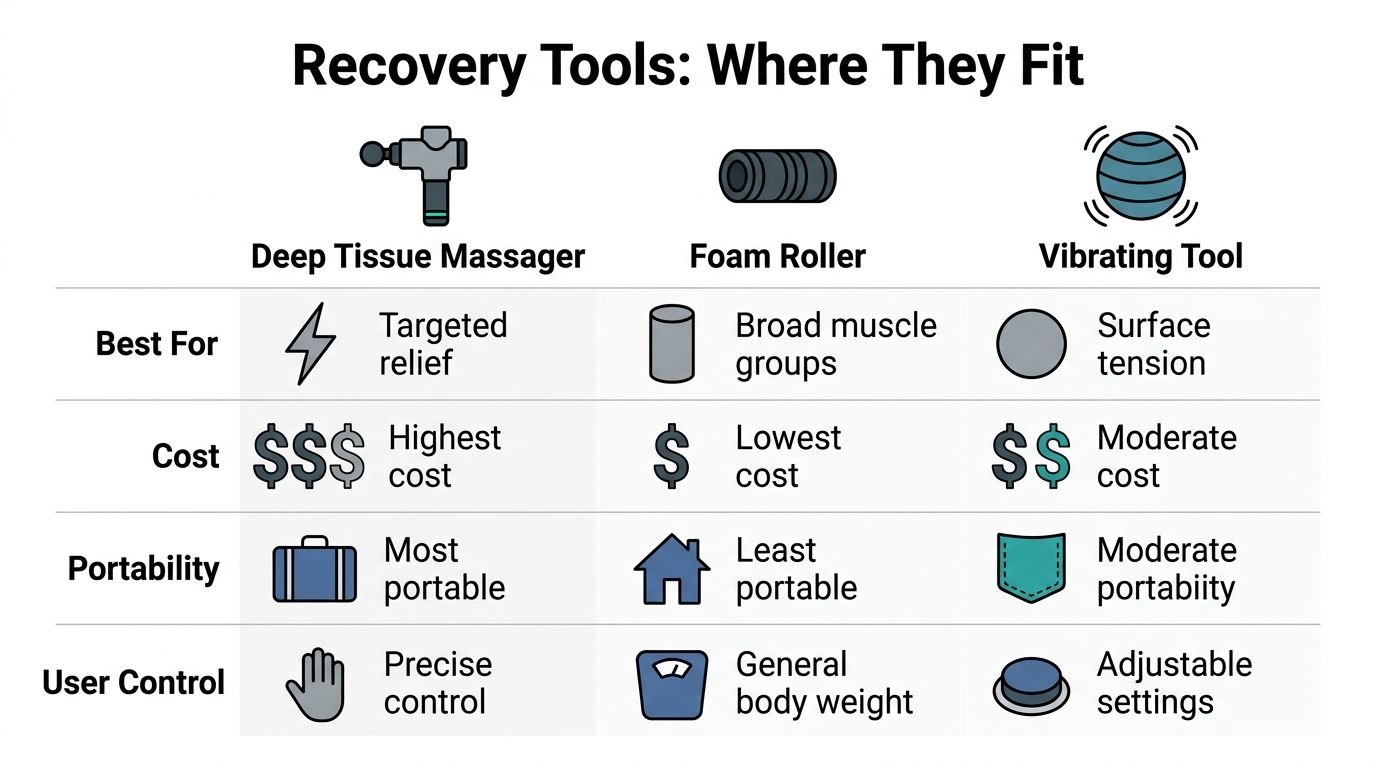
A percussion gun earns its place because it solves a different problem than the other common recovery tools. It's better for precision and awkward spots, while foam rollers and vibration tools still have real advantages in their own lanes.
Foam rollers are broad, not precise
A foam roller is useful when the goal is sweeping pressure across a larger area like the quads or calves. It's also cheap and easy to keep around, but it depends on body weight and floor space, which makes it awkward for the upper back, neck, and shoulders.
Vibrating tools feel gentler
Vibrating cushions and similar tools are usually more passive. They can be relaxing and convenient, but they rarely reach the same targeted feel as a percussion gun, especially when the user wants to work on a hard-to-reach knot.
The percussion gun sits in the middle
That middle position is the reason so many people keep one nearby. It's more targeted than a foam roller, more portable than a massage chair, and easier to use on the upper back than body-weight tools.
A portable neck and shoulder option can make a lot more sense for desk workers than a full-size floor routine, which is why some buyers pair a gun with a smaller recovery tool. A useful comparison point is this portable neck and shoulder massager, especially for people who need quick relief between meetings.
A percussion gun is often the best “between” option. It doesn't replace every other recovery tool, but it's the one most likely to fit a busy day.
For many people, the right answer is not picking one tool forever. It's choosing the tool that fits the body part, the setting, and the amount of effort available that day.
Choosing the Right Model for Your Needs
The best model is the one that matches the user, not the one with the loudest spec sheet. For a desk worker with neck tension, the sweet spot is usually a quieter, lighter device with enough control to stay comfortable in short sessions.
Specs that actually matter
A practical buying framework starts with amplitude, because that changes the depth of the feel more than almost anything else. Evidence-based guidance points to 10–16 mm amplitude and 1,750–3,200 percussions per minute as a useful zone for many users (evidence-based guidance on percussion massagers).
Then look at stall force. If the user wants deeper work on glutes, quads, or dense upper-back tissue, a model that can keep speed under pressure will usually feel more capable. If the goal is light daily tension relief, huge power isn't necessary.
Match the device to the job
- Desk worker or remote employee: Prioritize low noise, lower weight, and a fork attachment for upper-back comfort.
- Runner or gym user: Look for stronger amplitude and enough stall force to keep the head moving under firmer pressure.
- Shared apartment or office use: Lower noise matters, because a quieter device is easier to use consistently.
- Frequent traveler: Battery life and portability matter more than the deepest possible head travel.
A few market examples show how varied the category is. Some devices are rated around 3,200 to 3,800 percussions per minute, some report up to 3,500 pulses per minute, and some advertise noise levels as low as <55 dB or ≤50 dB (market examples of percussion massagers).
Keep the device in working order
A gun that's loose, dirty, or poorly charged won't feel better to use. Wipe down the attachments, check for loose heads, and charge it before storing it so the tool is ready when needed.
For readers comparing options, a general-purpose massage gun makes sense when the goal is quick, targeted relief at home without fussing over a complicated setup.
Smarter Recovery Starts with the Right Tool
A deep tissue percussion massager works best when the device matches the body, the speed stays reasonable, and the user respects the safety limits. That's the advantage, not hype, and not the promise of instant transformation.
For a desk worker, that might mean a quiet, lighter model used for short upper-back sessions after work. For someone recovering from training, it might mean more amplitude and stall force, still used within short, controlled windows.
The simplest checklist is still the best one, start low, stay on muscle, keep sessions short, and stop if the area gets more irritated. That's the kind of routine that makes a recovery tool feel useful instead of annoying.
Granted Solutions offers a practical place to compare wellness and recovery picks without the guesswork. If a deep tissue percussion massager, a massage ball, or another everyday problem-solver sounds like the right fit, visit Granted Solutions and browse the wellness collection for a simple, gift-ready option that fits real life.
Leave a comment