

Flashlight on Headband: A Practical Buying Guide

You're halfway through a repair when the light slips off the workbench. A runner turns toward a dark patch of trail and can't see where the next step lands. A camper needs both hands to filter water after sundown. In each situation, a handheld flashlight creates a second problem because the light moves with the grip instead of the eyes.
A flashlight on headband solves that basic frustration by keeping illumination pointed where the wearer looks. The best choice, however, isn't automatically the model with the biggest lumen figure. Beam shape, candela, runtime, weight distribution, and fit decide whether a head-mounted light feels useful or annoying after the first few minutes.
Table of Contents
- When a Flashlight on a Headband Just Makes Sense
- What a Headband Flashlight Actually Is
- Headband Flashlight Specs That Actually Matter
- Matching a Headband Flashlight to Your Use Case
- Fit, Comfort, and How It Feels on Your Head
- Battery, Charging, and Beam Choices That Save You Money
- Buying Checklist and Simple Care Tips
When a Flashlight on a Headband Just Makes Sense
A trail runner stops to inspect muddy paw prints on an unlit path. The dog pulls toward the brush, one hand holds the leash, and the other hand has to stay free for balance. A handheld torch swings away from the trail every time the runner looks down or turns their head.
A camper faces the same issue while filtering water beside a tent. One hand steadies the container, the other operates the filter, and a flashlight balanced between shoulder and chin keeps slipping. During a home repair, the problem becomes even more obvious. A DIYer trying to guide a wire through a ceiling joist needs both hands for the cable and tools, not a flashlight.

That's where a headband light earns its place. It follows the wearer's gaze, keeps both hands available, and reduces the awkward pauses caused by repositioning a handheld beam. Runners, campers, mechanics, electricians, and homeowners all use the same basic idea for different reasons.
Practical rule: If the task requires both hands and the light needs to follow the worker's eyes, a head-mounted light is usually the right starting point.
The concept has a long history. By 1908, electric headlamps had become standard equipment on the Peerless automobile, while electric headlamps had appeared as an option on the 1898 Columbia Electric Car. A historical overview of headlamps places those developments in the broader shift from experimental electric lighting toward practical everyday use.
Modern LED designs are smaller, easier to recharge, and better suited to outdoor recreation and repairs, but the central idea hasn't changed. Wearable light removes the conflict between seeing the work and holding the tool.
For camping beginners, a hands-free lighting setup for camping can be more useful than adding another handheld torch to a gear bin. The important decision is choosing the right configuration for the way the light will be worn.
What a Headband Flashlight Actually Is
A flashlight on a headband usually combines a separate torch with a textile cradle, elastic strap, or clip system. The lamp body sits in the cradle and can sometimes be removed, replaced, or repositioned. A fully integrated headlamp, by contrast, is designed as one unit, with the LED housing, battery system, controls, and strap built to work together.
Both designs provide hands-free illumination, but they make different compromises.
Modular versus integrated construction
A modular system makes sense for buyers who already own a compact flashlight or want to share one lamp body between a headband, belt clip, and handheld setup. It can also simplify replacement because the strap and torch are separate components.
An integrated headlamp generally balances more predictably because the manufacturer designs the housing and strap as one system. It may also seal more effectively against weather because there are fewer exposed attachment points. For running or frequent outdoor use, that tighter integration is usually preferable. For occasional repairs or emergency storage, modular flexibility can matter more.
The lineage runs through mining lamps, caving headlamps associated with brands such as Petzl, early outdoor running lights, and today's rechargeable work lights. The form has changed, but the use case remains familiar: light needs to travel with the person instead of sitting on a surface.
The parts buyers should recognize
Most systems include several familiar components:
- Headband: The elastic or textile structure that holds the lamp against the head.
- Cradle or bracket: The mount that secures a separate flashlight or lets an integrated housing tilt.
- Lamp body: The flashlight housing, LED, reflector, lens, switch, and electronics.
- Battery compartment: This may sit inside the front housing, in a rear pod, or in a separate removable pack.
- Top strap: An overhead band that limits bounce and keeps front-heavy lights from sliding down.
A detachable flashlight-on-headband setup is practical when flexibility matters. An integrated headlamp is the stronger choice when stable balance, weather sealing, and simple operation matter more than swapping components.
Headband Flashlight Specs That Actually Matter
A bright headband flashlight can still disappoint on a trail or job site. Lumens measure total light output, but they do not show how that light is distributed. A wide flood beam lights a nearby work area evenly. A tight beam concentrates light farther ahead. Two lamps with the same lumen rating can perform very differently outdoors.
Read candela alongside lumens. Under ANSI/PLATO FL1, beam distance is the point where illumination drops to 0.25 lux, calculated from peak beam intensity through the inverse-square law. The ANSI FL1 standard document explains the measurement framework.
A beam with 10,000 candela reaches about 200 meters, while 40,000 candela reaches about 400 meters, assuming the stated standard and conditions. Flood lighting suits close work and feels more comfortable at short range. A spot beam helps with trail navigation and identifying distant objects. For most buyers, a mixed or adjustable beam handles more situations than either extreme.
The numbers worth reading
Runtime requires the same scrutiny. ANSI FL1 runtime is commonly measured until output falls to 10% of the initial measurement. That means a long runtime claim may describe a low setting rather than sustained maximum brightness. The detailed explanation of headlamp runtime claims explains why the tested mode matters more than the largest hour figure.
| Spec | What It Means | Typical Range | Watch Out For |
|---|---|---|---|
| Lumens | Total light output | Qualitative range from low task modes to powerful high modes | Peak output may last briefly |
| Candela | Concentrated beam intensity | 10,000 cd reaches about 200 m; 40,000 cd reaches about 400 m | High lumens do not guarantee long throw |
| Beam pattern | How light spreads | Flood, spot, or mixed | Pure spot can feel harsh for close work |
| Runtime | Time until output reaches the standard cutoff | Low modes can last far longer than high modes | Check the tested brightness setting |
| Water protection | Resistance to dust and water | Listings commonly specify IP66, IP67, or IP68 | “Waterproof” without an IP rating says little |
Treeline Review's headlamp testing guide reports roughly 100 to 200 hours on low settings and about 2 to 4 hours on high brightness, though results depend on the model and test method. Low output supports long-duration tasks. High output is better reserved for short periods when you need intense illumination.
Weight distribution also affects real performance. A front-heavy lamp bounces during running and presses against your forehead during longer work sessions. A rear battery pod can improve balance, but it adds another component and cable to manage. Check the total worn weight, not just the lamp body.
IP ratings deserve a close look. IP66 means dust-tight protection and resistance to powerful water jets. IP67 and IP68 indicate stronger water resistance, with immersion limits depending on the manufacturer's conditions. A rugged headlamp listing may also specify shock resistance up to 2 meters, a useful safeguard on a job site or in a packed emergency kit.
Matching a Headband Flashlight to Your Use Case
A night runner, weekend camper, and DIY worker don't need the same headlamp. The runner cares about bounce and peripheral visibility. The camper needs efficient low modes and a flexible beam. The repair user needs impact resistance, dependable charging, and a mount that stays put while leaning over a workbench.
| Use Case | Lumens Range | Beam Type | Weight Target | Must-Have Feature |
|---|---|---|---|---|
| Night running | 200 to 400 lumens | Balanced flood or mixed beam | Under about 80 g | Stable strap, reflective detail, or rear safety light |
| Weekend camping | 300 to 600 lumens | Mixed spot and flood | Moderate and comfortable | Red mode and efficient low-output runtime |
| DIY and job-site work | 800 lumens or more when distance matters | Adjustable or mixed beam | Balance matters more than minimum weight | Impact resistance, outdoor water protection, and secure hard-hat compatibility |
Night running
A running light should prioritize movement over headline brightness. A stable mid-level setting usually works better than a short turbo mode because it provides consistent trail awareness without creating unnecessary bounce or glare. A balanced flood beam helps reveal roots, uneven ground, and nearby obstacles.
A rear safety light or reflective strap adds visibility from behind, especially where the headlamp's front beam doesn't help approaching pedestrians or vehicles. The best design stays centered while the runner turns, checks the ground, or changes pace.
Buy this if: the strap remains stable during head movement and the beam covers the near trail evenly.
Skip if: the housing is front-heavy, the mount wobbles, or the brightest mode is the only usable mode.
Weekend camping
Camping calls for range in both beam and brightness. A mixed spot/flood pattern handles trail walking while still lighting a cooking area, tent entrance, or pack. A red mode can preserve night vision and reduce the harsh glare that makes campmates unhappy.
The most useful camping light also has a low setting for reading maps, organizing gear, and moving around inside a tent. Readers planning a broader setup can also compare useful camping gadgets that complement, rather than replace, a headlamp.
Buy this if: it offers a mixed beam, red mode, and a low setting suitable for extended camp tasks.
Skip if: it only offers a powerful white beam and has no practical low-light control.
DIY and job-site work
A repair light needs a secure mount more than extreme throw. Impact-resistant housing, a reliable switch, and water protection at IPX4 or better suit messy household jobs and outdoor work. A model that works with hard-hat clips or strong elastic straps is more useful than one that only fits a bare head.
Rechargeable systems reduce the need to keep spare disposable cells nearby, but the battery must support the intended shift or task cycle. A work light should also tilt smoothly without collapsing when the wearer looks down.
Buy this if: the housing feels durable, the mount stays fixed, and the battery system fits the workday.
Skip if: the lamp depends on a delicate clip or the charging port is exposed to dust and moisture.
Fit, Comfort, and How It Feels on Your Head
A headband flashlight earns its place only when you forget you are wearing it. On a night run, a loose housing bounces with every step. At a job site, a tight strap turns into a pressure point before the task is finished. Bright output cannot fix either problem.
Start with strap width and support. A wider band spreads load across more of the head than a narrow elastic cord, especially when the lamp sits forward on the brow. The front band should hold the housing firmly without squeezing the forehead. An overhead crown strap adds control and stops the lamp from tipping forward.
Balance before brightness
Front-heavy designs pull downward, forcing the wearer to compensate with the neck. A rear-mounted battery pod can balance the front optics during running or long outdoor work, but it adds bulk, heat, and another contact point. A compact front lamp may feel better for short repairs, while a balanced two-part design usually suits movement.
Judge the whole system, not the lamp body alone. Check where the battery, hinge, and housing sit, because mass concentrated above the eyes feels heavier than the same mass spread across the headband. The Nitecore NU31 specifications illustrate why published total weight should include the bracket and headband, not just the light itself.
Look for a sliding buckle, an overhead strap, and enough adjustment to keep the housing above the brow. The beam should remain aligned when you look down. Rough elastic can catch hair, and a hard plastic edge can create a hotspot against the skin.
A practical fit test
A product page cannot reveal every comfort problem. Test the lamp in conditions close to its real use.
- Shake test: Move your head side to side, look down, and nod. The beam should stay aligned while the strap remains in place.
- Sweat test: Wear it during light movement. Check whether the band absorbs moisture, pulls hair, or becomes slippery.
- Two-hour test: Keep it on long enough for pressure points to appear. Ten comfortable minutes prove very little.
A lamp that disappears during wear beats a brighter model that demands constant adjustment. Choose stable weight distribution and a secure fit before chasing the highest ANSI FL1 brightness figure.
Battery, Charging, and Beam Choices That Save You Money
Choose the beam pattern and battery system first, then compare lumen output. Peak brightness matters only when the beam reaches the right area and the lamp can sustain useful output. A narrow beam wastes light on close repairs, while a battery that dies halfway through a task costs more in interruptions than a lower-output model.
Rechargeable lithium-ion systems suit regular use, especially with USB-C charging. You can top up the lamp from a wall charger or power bank and avoid buying disposable batteries repeatedly. The tradeoff is clear: the built-in cell, charging port, and replacement process depend on the manufacturer's design.
Swappable lithium-ion cells, such as 18650 formats, make longer trips easier when you carry charged spares. AAA-powered models are simpler to replenish while traveling because replacement cells are widely available. They also add recurring purchases, storage needs, and weight. Choose rechargeable for routine use, replaceable batteries for uncertain access to power, and swappable cells for extended field work.
Beam pattern is the daily-use decision
A pure flood beam is the right tool for close work. It spreads light across a broad area, so you can cook, unpack gear, or repair equipment without aiming your head precisely.
A pure spot beam sends concentrated light farther. It works well for trail navigation and checking distant objects, but its bright area can feel cramped during repairs or other close tasks.
An adjustable or dual-beam lamp covers both jobs. Use the broad setting for setup and the tighter setting for walking. That flexibility often provides more practical value than a higher peak-lumen figure.
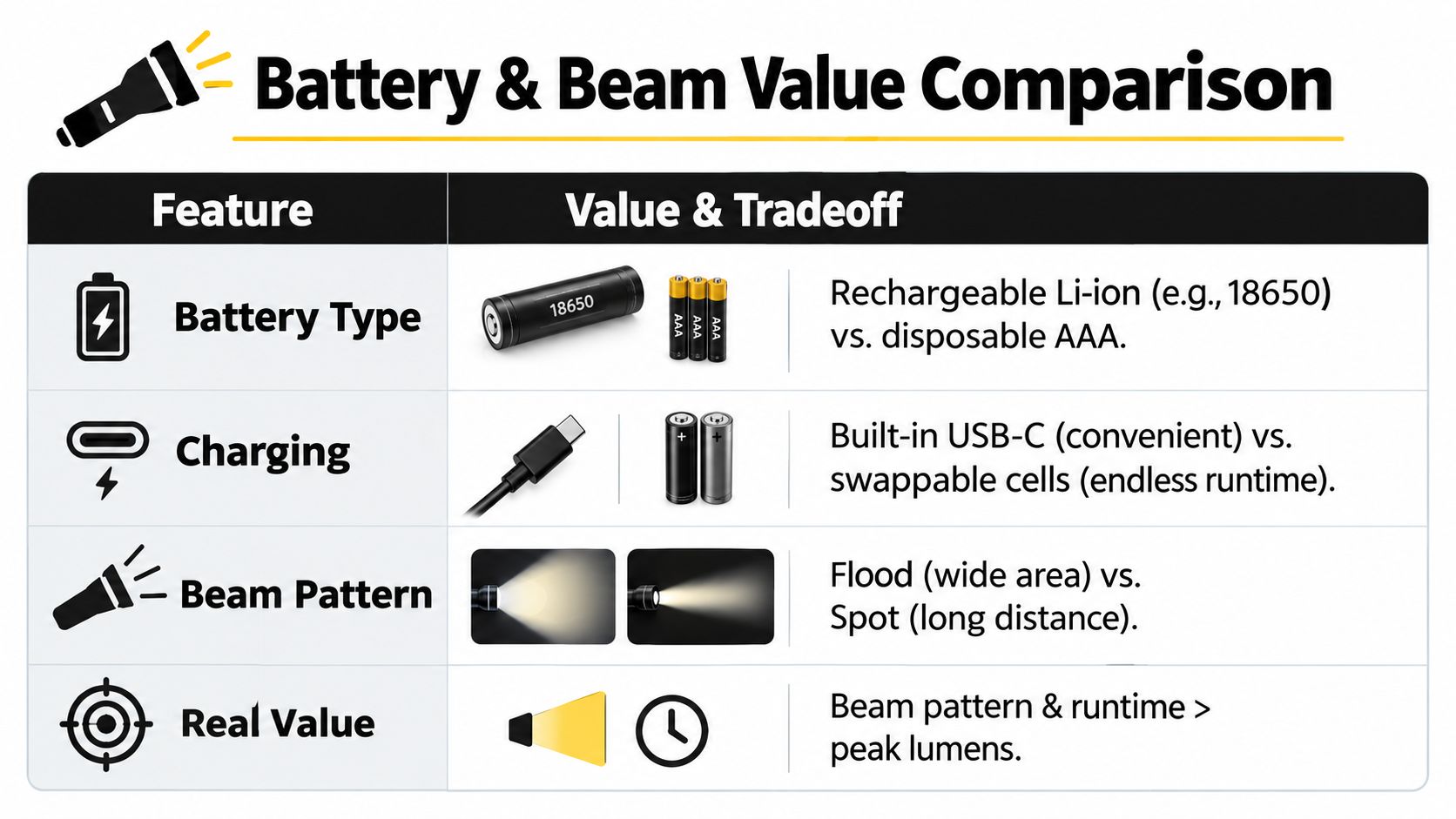
Read runtime claims through the ANSI FL1 standard. Runtime ends when output falls to 10% of its initial level, so a claimed 50-hour runtime may apply to low mode while high mode lasts far less. The cutoff makes comparisons more consistent, but it does not promise equally bright light throughout the stated runtime.
Value check: A comfortable mixed beam with dependable medium-mode runtime usually beats a heavier lamp selected only for its maximum lumen number.
USB-C charging helps if the lamp is used often. Cost per use matters more than the checkout price. A rechargeable model spreads its purchase cost across repeated sessions and reduces battery waste. An AAA model can remain the better choice for occasional emergency use or remote travel, where replacing cells matters more than charging access.
Use the same test when comparing affordable technology accessories. Count how often you will wear the lamp, whether you can recharge it between uses, and whether carrying spare cells is practical. Buy the system that fits those conditions, not the package with the biggest lumen claim.
Buying Checklist and Simple Care Tips
A good purchase starts before the checkout page. The buyer should identify the actual task, then confirm that the lamp's beam, battery, fit, and protection rating support it. Peak brightness belongs near the bottom of the checklist, not the top.
Pre-checkout priorities
- Match the beam to the task: Choose flood for close work, spot for distance, and mixed or adjustable beams for varied use.
- Read the runtime mode: Confirm whether the published ANSI FL1 runtime applies to low, medium, or turbo output. Runtime ends when light output reaches 10% of the initial measurement, so mode context matters.
- Check water protection: Outdoor buyers should look for IPX4 or higher when rain and splashes are likely. Higher listed ratings such as IP66, IP67, and IP68 provide stronger protection, but immersion conditions still depend on the manufacturer.
- Inspect the fit system: Look for a wide strap, useful adjustment points, and a mount that doesn't slide during head movement.
- Assess total weight: Include the bracket, strap, and battery pod. A light front housing can still feel heavy if the balance pulls forward.
- Choose the battery deliberately: Replaceable AAA cells suit travel and emergency replacement. Built-in lithium-ion suits USB-C convenience and routine charging.
- Check the charging port: A covered USB-C port is more practical for outdoor use than an exposed connector.
- Look for impact resistance: Job-site and camping users should favor durable housings and a stated shock rating where available.
Care that extends usefulness
A clean lens maintains the intended beam pattern. A microfiber cloth removes dust and fingerprints without the scratches that rough fabric or paper towels can create. The housing should be fully dry before charging, especially after rain or cleaning.
The strap deserves routine inspection. Elastic loses tension, buckles can loosen, and a stretched band increases bounce. After exposure to saltwater or mud, the wearer should clean the housing according to the manufacturer's instructions and reseat any accessible O-rings correctly.
Long-term storage also needs attention. A rechargeable lithium-ion headlamp is better stored at roughly 40% to 80% charge than left completely full or empty for an extended period. The light shouldn't remain in a hot car, where heat can damage electronics, shorten battery life, and weaken strap materials.
Common buying mistakes are easy to avoid:
- Chasing peak lumens: Maximum output is often a short-duration mode, not the setting used for most tasks.
- Ignoring rear battery boxes: Counterbalance can help, but a bulky pod may bounce during running.
- Overlooking low modes: Camp chores and reading need controlled light, not maximum glare.
- Trusting “waterproof” without a rating: An IP designation gives buyers something concrete to compare.
- Skipping the movement test: A lamp that stays still on a shelf may shift during work, running, or climbing.
The right flashlight on headband depends on personal use, surroundings, and tolerance for weight, charging routines, and beam limitations. A practical gear collection should make that comparison easier by separating outdoor, repair, fitness, and everyday options instead of treating every headlamp as interchangeable.
Granted Solutions brings together practical gadgets, outdoor accessories, home tools, and gift-worthy products selected for everyday problem-solving. Visit Granted Solutions to compare useful gear and find a headband flashlight that fits the way the recipient works, travels, exercises, or camps.
Leave a comment