

How to Choose Air Purifier: A Practical 2026 Guide

You're standing in the aisle or scrolling a product page, and the same problem keeps showing up. One purifier looks powerful, another looks sleek, a third promises “cleaner air” without telling you what it can handle. That's how people end up buying a machine that runs all night and still leaves the room feeling stale, or a unit that eats through filters faster than expected.
The fix isn't guesswork. How to choose air purifier comes down to room size, filtration type, placement, and the cost of living with the machine after the box is opened. Pick those pieces in the right order, and the marketing fluff gets a lot easier to ignore.
Table of Contents
- Why So Many Air Purifiers Disappoint Buyers
- Sizing the Purifier to Your Room the Right Way
- Matching the Filter Stack to Your Pollution Problem
- Choosing by Lifestyle Allergy Pet Smoke and Smart Home Profiles
- Placement Rules That Change Real Performance
- Calculating Real Cost Over Five Years
- Your Final Decision Checklist Before You Buy
Why So Many Air Purifiers Disappoint Buyers
The letdown shows up quickly. The purifier is running, the fan is humming, and the bedroom still smells stale, or the filter light comes on sooner than expected and turns a “simple” purchase into another monthly expense.
The problem usually starts with the purchase decision, not the machine. Indoor air exposure matters because people spend most of their time indoors, so a purifier that is too small, too loud, or badly placed will not do much in the rooms that matter most. California consumer guidance also points buyers toward price, square footage cleaned, delivery rate, and noise level as the features worth comparing, which is exactly why room fit comes before everything else.
The buying order that actually works
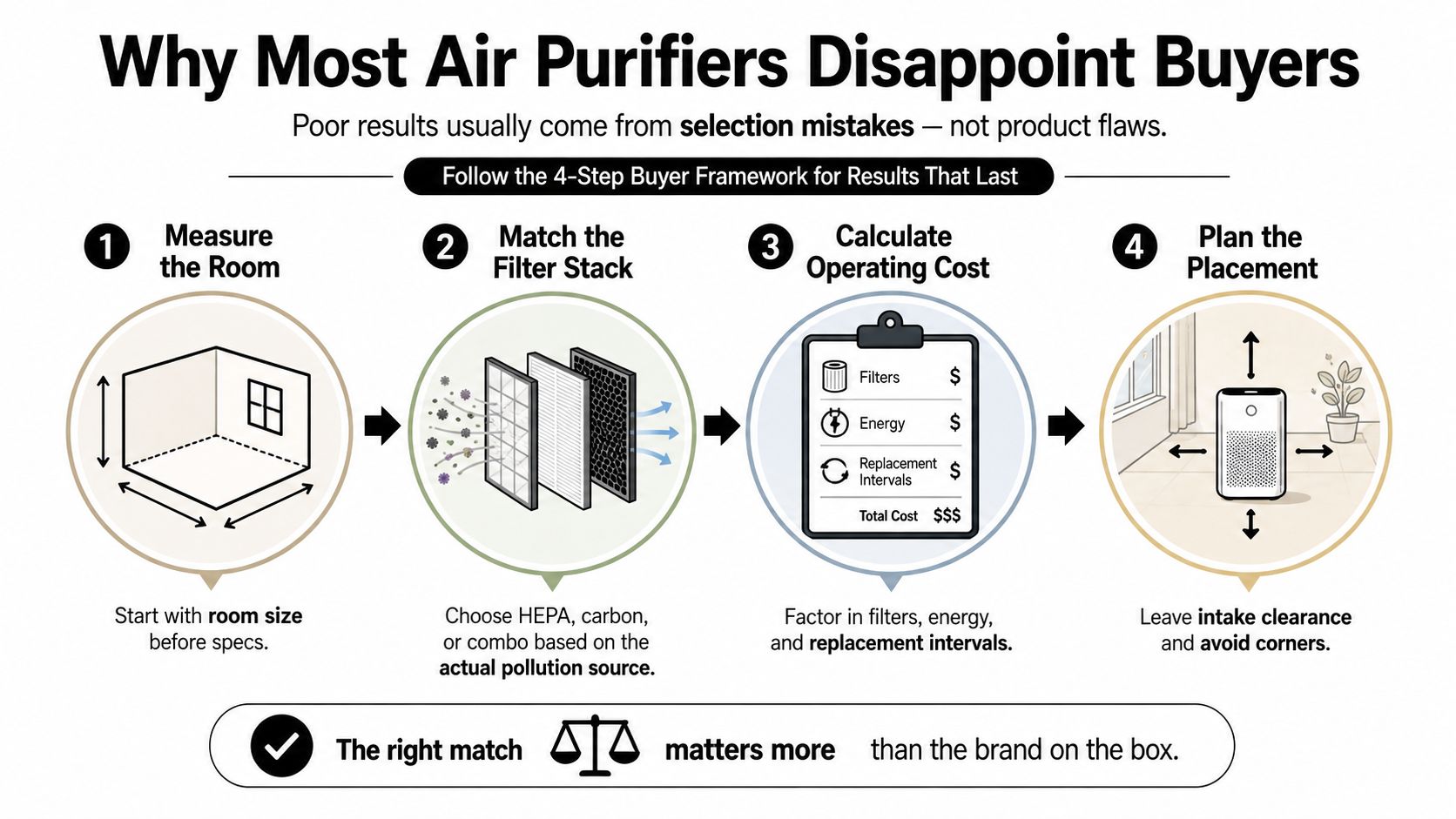
Treat the purchase like a system, not a single gadget. Start with room size, then filter stack, then operating cost, then placement.
Practical rule: if the purifier cannot match the room, the rest of the specs are decoration.
Filter choice matters too, but only after the size question is answered. A purifier built for the wrong space can look strong on paper and still underperform in real use, which is why the more useful approach is to match the unit to the room and the pollution source first, then compare maintenance and noise. If you want a practical checklist for improving the air in the rooms you use every day, home air quality improvement guidance is a better starting point than marketing copy.
The hard truth is simple. Most disappointing purifiers were never “bad.” They were the wrong match for the room, the pollution source, or the buyer's patience for noise and maintenance.
Sizing the Purifier to Your Room the Right Way
Buyers waste money here first. A purifier can look impressive on the box and still miss the room if the clean-air delivery does not match the space it has to handle.
Start with the room, not the product page
Measure the room's length and width, then multiply to get square footage. After that, check the purifier's CADR against the room size instead of trusting broad coverage claims. A useful rule of thumb is that CADR in CFM should be at least two-thirds of the room's square footage, so a 300-square-foot room needs roughly 200 CFM of CADR. That gives you a real sizing check, not a marketing guess (Live Science example and guidance).
Room size should also be judged against the purifier's stated recommended room size, but do not let that label do all the work. The safer read is simple. CADR tells you how much clean air the unit can move, while the room rating only helps if it lines up with your actual space.
Use ACH so you don't underbuy
CADR alone can still leave you short if the unit does not turn the air over fast enough. For general use, guides commonly target at least 4 ACH, and 5 ACH for tougher rooms like those dealing with smoke or allergy pressure (IAQ Works guide).
That matters because Air Changes per Hour depends on room volume, not just floor area. High ceilings, a bigger-than-average room, or running the purifier on a quiet setting can all drag real performance below what the packaging suggests. If you want the purifier to do real work instead of just humming in the corner, size for the air you have in the room.
Read the label like a buyer, not a marketer
Look for AHAM-verified CADR when you can. It gives you a cleaner performance check than a vague claim about room coverage, and it is harder for a listing to hide behind fancy language. If a box says “covers 400 square feet” but the CADR does not support your room volume and target ACH, skip it.
A practical way to keep the buying process honest is to match the purifier to the room first, then cross-check whether the unit fits your noise tolerance, placement, and long-term use. For example, if a smaller unit looks attractive on price but cannot keep up with a bedroom or open living area, you will just end up running it too hard or too softly to matter. The next step is to compare real placement and operating behavior, not just the headline spec. air purifier ionizer risks and tradeoffs
If the listing will not clearly show CADR and room fit, assume the numbers were chosen for the ad, not the room.
Matching the Filter Stack to Your Pollution Problem
Filter choice should follow the problem, not the brochure. A purifier built for dust isn't automatically the best answer for cooking smells, and a deodorizing model won't necessarily capture the fine particles that matter most.
HEPA is the core, not a buzzword
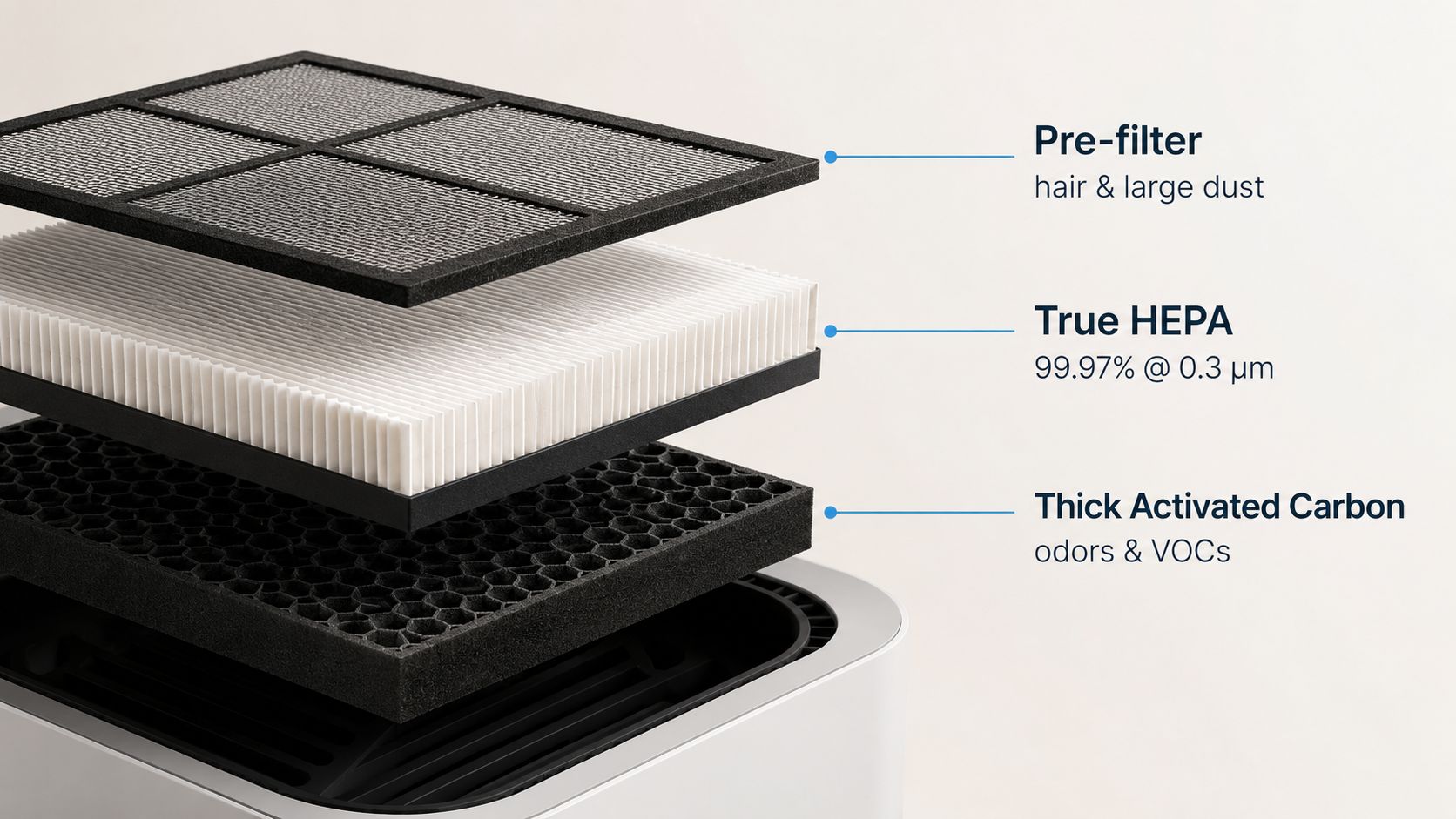
A True HEPA filter is the baseline buyers should insist on. The important thing is the word True, because “HEPA-type” is a downgrade that doesn't deserve the same trust. If the unit can't clearly state True HEPA, it's safer to pass.
A standard HEPA setup is the right answer for pollen, dust, and pet dander. It's the cleanest default choice when the room problem is mostly particles, not gases.
Carbon belongs only when odors or gases matter
Activated carbon earns its place when the issue is cooking smells, smoke, VOCs, or similar odor and gas concerns. The label alone doesn't tell the full story, though, because the amount and thickness of carbon matter more than a generic mention on the box. Thin token carbon layers usually don't do much.
For that reason, a HEPA-plus-carbon unit makes sense for wildfire smoke, kitchen odors, or a home with lingering smells from a smoker. A heavier carbon bed is the better pick when odor control matters, not just particulate capture.
Skip the flashy extras unless they earn their keep
UV-C and ionizer add-ons often sound advanced, but they're usually more marketing than buying reason. Some ionizer designs can produce ozone, so any model using that feature should disclose ozone output clearly. If it doesn't, that's a red flag.
The clean buying rule is simple. Choose verified HEPA first, add carbon only for odors or gases, and skip ionizers unless ozone output is clearly disclosed. For shoppers comparing options with that lens, the ionizer air purifier overview is a useful reminder that extra features should solve a real problem, not just pad the spec sheet.
Choosing by Lifestyle Allergy Pet Smoke and Smart Home Profiles
Specs only matter when they fit a real household. A purifier that's perfect in a dusty guest room can be a weak pick in a pet home, and a quiet model can still be the wrong one if smoke is the main complaint.
Allergy homes need quiet power
For allergy-sensitive bedrooms, the winning formula is True HEPA, a 5 ACH target, and a sleep mode that's quiet enough to stay on. Noise matters here because the best purifier is useless if it gets shut off every night.
A purifier that scares people out of using it is a bad buy, no matter how good the CADR looks.
Pet homes need intake that won't clog
Pet owners need a pre-filter that can handle hair before it reaches the main filter. That keeps the HEPA layer from loading up too fast, and it helps preserve airflow over time. A carbon layer is worth it when litter-box odor or wet-dog smell is part of the mix.
For shoppers building a pet-friendly setup, the top air purifiers for pets angle makes sense because intake design and odor control matter together. Splurge on intake design and carbon, save on flashy smart features if the home problem is mainly fur.
Smoke and cooking demand heavier odor control
Smoke is the profile where oversizing becomes smart, not wasteful. A larger unit can run at a lower, quieter speed while still keeping up, which helps when the goal is steady removal instead of occasional cleanup. Cooking fumes and wildfire smoke both justify stronger carbon treatment than dust alone.
Splurge on a larger, better-sealed unit, save on decorative features. If smoke is the priority, the purifier should work hard without sounding like it's trying to.
Smart-home buyers should pay for useful automation
App control, scheduling, and air-quality sensors are worth considering if the purifier will live in a bedroom or office and needs to run on a routine. Those features are helpful when they make continuous use easier, not when they just add another app to the phone.
Splurge on sensors and scheduling, save on oversized branding. For tech-friendly homes, convenience only matters if it supports the habit of leaving the purifier on.
Placement Rules That Change Real Performance
A correctly sized purifier can still underperform if it's shoved into a corner or blocked by furniture. Air needs a clear path in and out, and room layout can erase the performance you paid for.
Bedrooms and living rooms need different setups
In a bedroom, place the purifier across from the door, off the floor, and away from the headboard. That helps the unit pull air through the room instead of recirculating the same pocket near the bed.
In a living room, central placement usually works best, as long as the intake stays open and the outlet isn't aimed straight into a wall. Kitchen use is different again, the purifier should sit off the cooking zone but close enough to catch the residue that drifts out into the room.
Clearance matters more than most buyers think
Leave at least a foot around the intake and outlet so the machine can breathe. Keep it away from curtains, couch backs, and tight corners, because those block flow and cut into the purifier's real cleaning ability.
Closed doors can also reduce the air a purifier can circulate through the room, which is why people often overestimate performance in bedrooms with the door shut. Raising the unit off a thick carpet helps too, since a blocked intake can drag the whole system down.
Continuous use only works if you can live with it
The evidence summarized in recent reviews shows that continuous use beats intermittent use, while night-only operation leaves more exposure on the table (air purifier statistics and review summary). That means bedroom placement has to be paired with a quiet sleep mode, not just a strong motor.
A purifier that gets switched off because it's annoying has already lost.
Three placement mistakes that wreck value:
- Corner placement: It starves the intake and wastes airflow.
- Blocked clearance: Furniture, curtains, and walls choke performance.
- Wrong room habits: Leaving it off at night or hiding it behind the bed cuts the benefit you paid for.
Calculating Real Cost Over Five Years
Sticker price is the smallest number in the whole deal. The cost comes from filters, electricity, and whether the unit is quiet enough to stay on without being kicked off every night.
Build the ownership cost around the filter schedule
A practical ownership calculation starts with purchase price, then adds filter swaps and power use. Consumer guidance notes that purifiers typically cost over $100, and buyers should factor in replacement filters and energy rating because those shape the long-term bill (Medical News Today).
A useful screen is to remove models with less than 12 months of filter life when possible, especially for heavy-use homes. That's because replacement frequency can turn a cheap-looking unit into an expensive habit.
Don't ignore noise when you model cost
A too-loud bedroom unit doesn't just annoy people, it gets turned off, and that kills the value of the CADR number. That's why a quiet sleep mode is a cost issue, not just a comfort feature.
Best practice: if the bedroom unit won't stay on all night, the purifier's advertised performance doesn't matter much.
Compare the buying styles, not just the sticker
| Profile | Unit Price | Avg Filter Cost | Total 5-Year Cost |
|---|---|---|---|
| Budget | Lower upfront | Higher swap pressure | Often more expensive than it looks |
| Balanced | Mid-range | Predictable annual replacement | Usually the safest value choice |
| Premium | Higher upfront | Lower stress if filters last longer | Can win if noise and uptime are better |
That table is the right way to shop. A cheaper purifier with frequent filter swaps can end up costing more than a better-built one with steadier upkeep, especially in rooms where it has to run daily.
Your Final Decision Checklist Before You Buy
A good purifier purchase should survive a quick checklist without hand-waving. If any answer is vague, the model probably isn't the right one.
Screenshot-worthy buy check
- Room math first: Measure the room and match the purifier's CADR to the actual space.
- True HEPA only: Don't settle for “HEPA-type.”
- Carbon only when needed: Add it for odors, smoke, or gases.
- ACH target set: Aim for 4 ACH for general use and 5 ACH for tougher air concerns.
- Noise tested: Make sure the sleep mode is something the household can tolerate.
- Filter schedule known: Check how often replacements are needed.
- Placement planned: Decide where the unit will sit before buying it.
That's the cleanest way to buy with confidence. It keeps the decision grounded in room fit, real filtration, and the practical details that determine whether the purifier gets used.
For shoppers who like solving one home problem at a time, the same logic applies across smart plugs, sleep gear, air monitors, and other useful household upgrades. The best purchases are the ones that make daily life easier without adding maintenance drama.
Granted Solutions carries practical home and wellness picks that fit the same no-nonsense standard as a smart purifier buy. Browse the Granted Solutions home improvement and wellness collections, then check Trending Now and Best Sellers for practical, gift-worthy upgrades that make a cleaner indoor setup easier to build.
Leave a comment