

Lumbar Support Cushion for Recliner: How to Choose Right

The chair is tilted back, the footrest is up, and the lower back still feels strangely unsupported. A cushion that felt comfortable at the start of the evening may slide, flatten, or press in the wrong place once the recliner changes angle. That's why choosing a lumbar support cushion for recliner use requires more than checking a product photo and picking the thickest option.
Recliners create a moving support problem. The seat, backrest, pelvis, and lumbar curve change position together, so a cushion must maintain useful contact as the chair opens. Shape, density, dimensions, grip, and placement all matter more than a familiar office-chair label.
Table of Contents
- Why a Recliner Changes Lumbar Support Needs
- Measuring Your Lumbar Curve and Recliner Seat
- Cushion Types, Materials, and Firmness Compared
- Fitting and Positioning the Cushion in Your Recliner
- What the Evidence Says and When a Cushion May Not Help
- Care, Cleaning, and When to Replace the Cushion
- Choosing the Right Lumbar Cushion for Your Recliner
Why a Recliner Changes Lumbar Support Needs
A person settles into a recliner expecting the backrest to carry the body. Upright, the lower back may touch the cushion naturally. As the chair tilts, the pelvis rolls backward, the seat angle changes, and a gap can appear between the small of the back and the upholstery. The cushion that worked near upright may no longer meet the lumbar curve once the backrest opens.
That differs from a desk chair, where the support usually sits against a fairly fixed posture. A recliner sacrifices some lumbar contour to make room for the moving backrest and footrest. Thick, soft upholstery can feel pleasant at first but still leave the most important part of the lower back without targeted support.
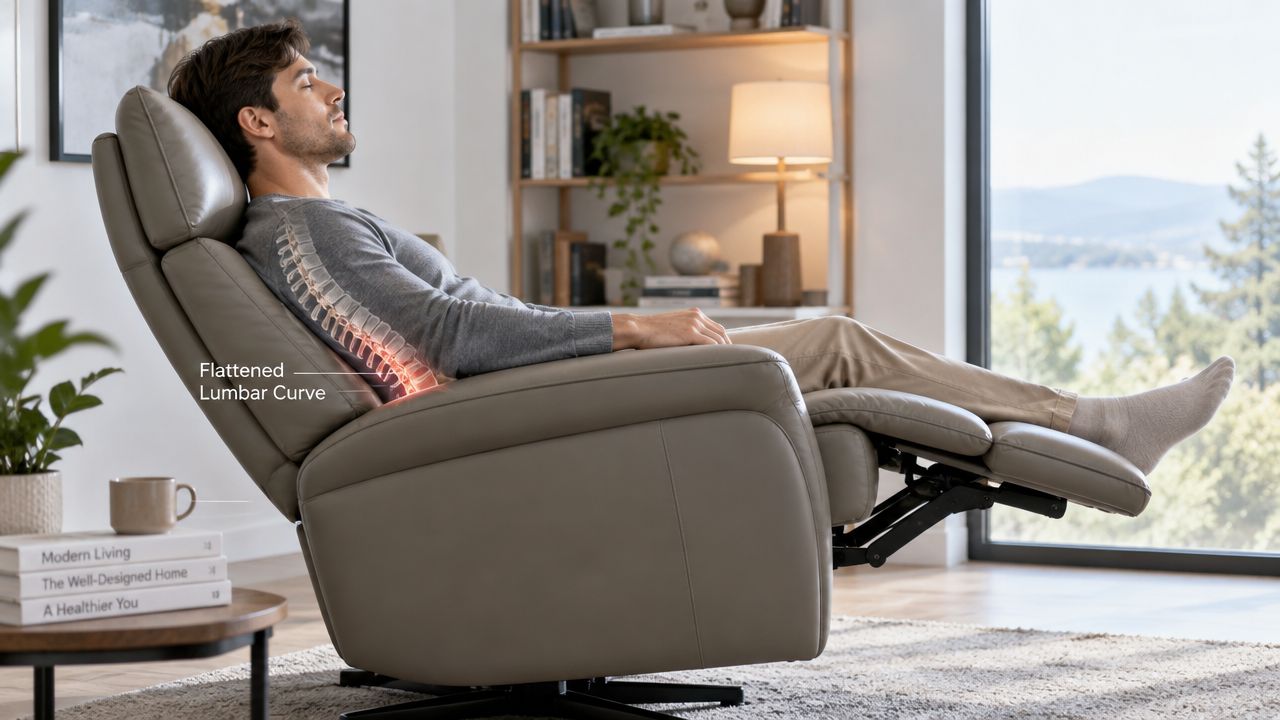
The angle changes the pressure pattern
As the chair reclines, the body spreads pressure across the seatback rather than staying stacked over the pelvis. A cushion that's too thick can push the torso forward, while one that's too shallow may lose contact entirely. A broad cushion can also press against the ribs or shoulder blades if its thickest point sits too high.
Practical rule: A recliner cushion should fill the lower-back gap without forcing the body into a stronger curve than the chair naturally allows.
An office-style guide to ergonomic office chair lumbar support can help explain neutral sitting, but recliner shoppers need to apply that principle differently. The best choice is shaped for movement, secured against slipping, and sized to the specific backrest.
Measuring Your Lumbar Curve and Recliner Seat
Guessing usually produces the wrong cushion. Before comparing foam types, measure the space the cushion needs to occupy while the recliner is supporting the intended sitting position.
Build a simple size profile
- Set the usual position: Sit with the hips fully back and adjust the recliner to the position used most often. A person who watches television semi-reclined should measure there, not only with the chair fully upright.
- Find the lower-back gap: Use a flexible tape measure, or place a rolled towel in the space behind the lower back and measure its depth. Take the reading around the level of the navel, where the cushion's thickest section will make contact.
- Check the available width: Measure the flat or usable width of the recliner backrest. The cushion should support the lumbar area without spreading so far that its edges push into the side bolsters.
- Mark the vertical target: Measure from the seat surface to the center of the lumbar curve. This tells the user where the cushion's apex should sit. A cushion that aligns with the upper back won't support the intended area.
Use dimensions as a filter
Compact examples include 12"H x 13"W x 4.3"D, 14"W x 13"H x 4.5"D, and 15.7" x 14.2" x 2.7" thick, as shown in these lumbar cushion size examples. A narrower cushion can suit a compact recliner, while a wider model may fit an oversized backrest better.
A size such as 12 x 13 inches may work for a narrow back, whereas a larger recliner may need more coverage. The measurement matters more than the label. If the cushion pushes the head forward or contacts the shoulder blades, it's too tall, too thick, or positioned too high.
Cushion Types, Materials, and Firmness Compared
Material determines how a cushion reacts when the recliner opens. The most useful distinction isn't just soft versus hard. It's whether the fill keeps its shape, rebounds after pressure, and remains in contact with the lumbar gap during movement.
A practical comparison looks like this:
| Material | Density / Fill | Firmness | Behavior at Recline | Best Recliner Type |
|---|---|---|---|---|
| Memory foam | High-density memory foam, commonly 4 to 7 lbs per cubic foot for recliner support, according to this recliner cushion material guide | Medium to firm | Conforms gradually, but lower-density foam can flatten under sustained pressure | Manual push-back and mixed-use recliners |
| High-resilience foam | Resilient foam with a springier structure | Medium-firm to firm | Recovers quickly as the angle changes and resists compression | Lift recliners and frequent daily use |
| Contoured molded foam | Shaped foam with a fixed lumbar profile | Usually medium-firm | Maintains a defined curve, but a mismatch can create pressure | Wall-hugger recliners with predictable back geometry |
| Buckwheat or latex fill | Loose buckwheat hulls or resilient latex | Adjustable to firm | Buckwheat shifts as the chair moves, while latex keeps a stable shape | Buckwheat for adjustable preference, latex for cooler-feeling support |
Match the construction to the chair
A manual push-back recliner usually benefits from a medium-firm memory foam cushion with a grippy back. The user changes the angle by shifting body weight, so the cushion must conform without sliding forward.
A wall-hugger model needs a compact profile that doesn't interfere with the backrest's clearance. A molded cushion can work well when the measured lumbar height matches its contour, but it shouldn't be chosen solely because the shape looks orthopedic.
A lift recliner deserves special attention to rebound and stability. High-resilience foam is often the safer construction when the chair moves frequently or the user relies on consistent support during transfers. Zero-gravity recliners need a cushion that stays attached as the seat and back move together.
The ergonomic lumbar support pillow guide offers broader context, but recliner buyers should prioritize angle behavior over office-chair styling. Buckwheat can provide a customizable feel, yet its hulls may shift noisily. Latex rebounds well and feels less heat-trapping than memory foam, but its springier response may feel too active for someone who wants pressure relief.
Fitting and Positioning the Cushion in Your Recliner
A good cushion can fail within minutes if it starts in the wrong place. Position it while sitting upright, with the hips all the way back and the feet supported. The thickest portion belongs in the small of the back, near the beltline, not between the shoulder blades.
The top edge should sit below the shoulder blades. If it reaches the middle back, the cushion is likely too tall or too high. If the lower edge presses into the sacrum, move it upward slightly before changing the cushion itself.
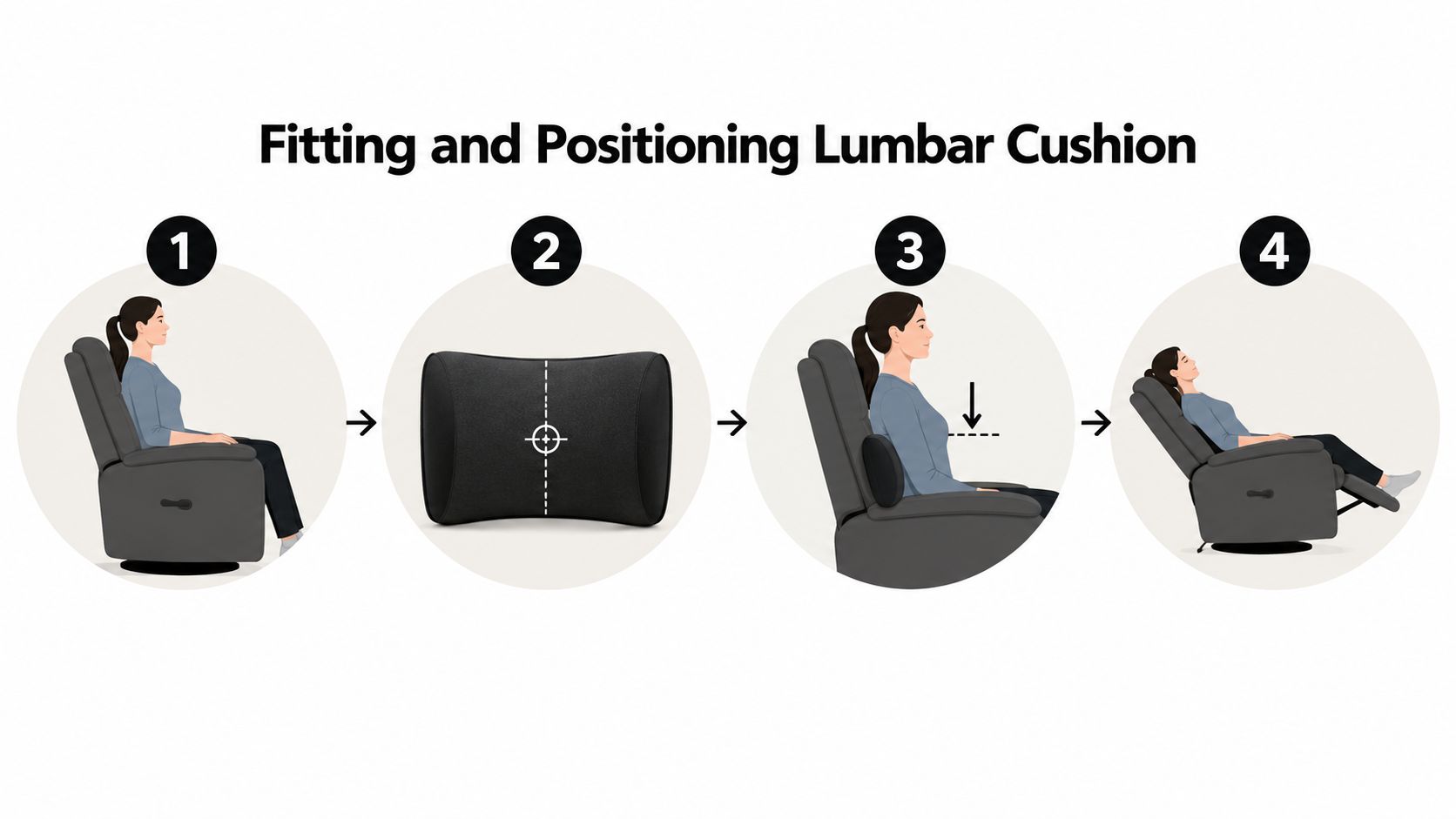
Test the moving chair
A strap should wrap securely around the recliner back without catching the handle or lever. Any loose length should be tucked away. For cushions without straps, a non-slip mat between the cushion and upholstery can reduce forward movement, while a rubberized back panel offers a cleaner permanent solution.
Test three positions:
- Upright: Confirm that the cushion fills the natural gap without pushing the torso forward.
- Half-recline: Check whether the cushion stays centered as the backrest opens.
- Full recline: Watch for pressure at the sacrum and see whether the cushion has lost contact with the lumbar area.
At full recline, the lower-back curve often becomes flatter. Many cushions work better after shifting down one to two inches, but the correct position is the one that fills the gap without creating pressure. A cushion that rides forward when the footrest opens needs more grip, a better strap, or a different shape.
The right position feels supportive at every tested angle, not just comfortable during the first minute.
What the Evidence Says and When a Cushion May Not Help
Lumbar support isn't a universal fix. A Cochrane evidence review on lumbar supports found that supports aren't clearly better than no intervention for preventing or treating low-back pain. That doesn't make a cushion useless. It means comfort and function depend heavily on the chair, the user, the fit, and the cause of discomfort.
A randomized sitting trial with 28 male participants found that a lumbar pillow with a posterior pelvic cut-out shifted lumbar posture 2.88° toward neutral, while thoracolumbar posture shifted by −2.42°. The study also reported improved center-of-pressure results, but subjective comfort didn't change, as detailed in the clinical posture study. Objective alignment can improve without an immediate feeling of relief.
Know when to pause
A cushion should be treated as a comfort aid, not a treatment for a diagnosed spinal condition. It won't repair a disc problem, reverse spinal narrowing, or correct significant scoliosis. People with an acute injury, recent surgery, or nerve symptoms extending down the leg should seek clinical guidance before relying on a new support.
The same caution applies when a cushion creates sharp pressure, increasing numbness, or symptoms that worsen as the chair reclines. A pregnant user may need a shorter, softer profile that avoids pressure around the pelvis, but personal medical guidance should take priority.
The most useful trial is gradual. Start with modest support, test the chair through its normal positions, and keep only the setup that reduces strain without forcing the body into an exaggerated arch.
Care, Cleaning, and When to Replace the Cushion
A lumbar cushion lives against upholstery, clothing, skin, and dust, so its cover deserves regular attention. Most removable zippered covers can be washed in cold water on a gentle cycle, then tumble-dried on low or line-dried. Following the care label matters because heat can shrink the cover and compress the foam inside.
The foam core usually shouldn't go into a washing machine. Spot-clean it with a mild detergent solution, use limited moisture, and allow it to air-dry completely before returning it to the cover. Trapped moisture can encourage mildew and degrade foam.
Keep the shape stable
- Vacuum the cover: Regular vacuuming removes dust and skin particles before they work into the fabric.
- Avoid direct sun: Prolonged sunlight can discolor the cover and harden foam.
- Protect the zipper: Close the zipper before washing and avoid forcing the cover over a compressed core.
- Rotate the cushion: If the design allows it, occasional rotation can distribute pressure more evenly.
Replacement should be based on performance, not appearance alone. Press the center with a palm and watch whether the material rebounds within a few seconds. Permanent indentations, a cover that no longer holds the core firmly, or a cushion that bottoms out under normal use all signal that support has declined.
For daily users, the commonly cited useful-life range is eighteen to thirty months, while lighter users may extend service to three years, according to this lumbar cushion care and replacement guide. Those figures are practical expectations, not guarantees. Heat, body weight, recliner angle, and foam quality can shorten or extend the working life.
Choosing the Right Lumbar Cushion for Your Recliner
The best purchase starts with the chair's routine. A two-seat television recliner used upright for part of the evening and fully reclined later needs a cushion that grips the upholstery, handles angle changes, and doesn't push the torso forward. A medium memory foam profile around 4 inches can suit mixed use, provided the measured gap supports that depth.
A lift recliner used mostly in a semi-reclined position may favor firmer, springier foam that holds its contour as the chair moves. Someone who dislikes heat may prefer latex, while a light, occasional user may need only a modest polyester-filled cushion. Those are use-case choices, not universal rankings.
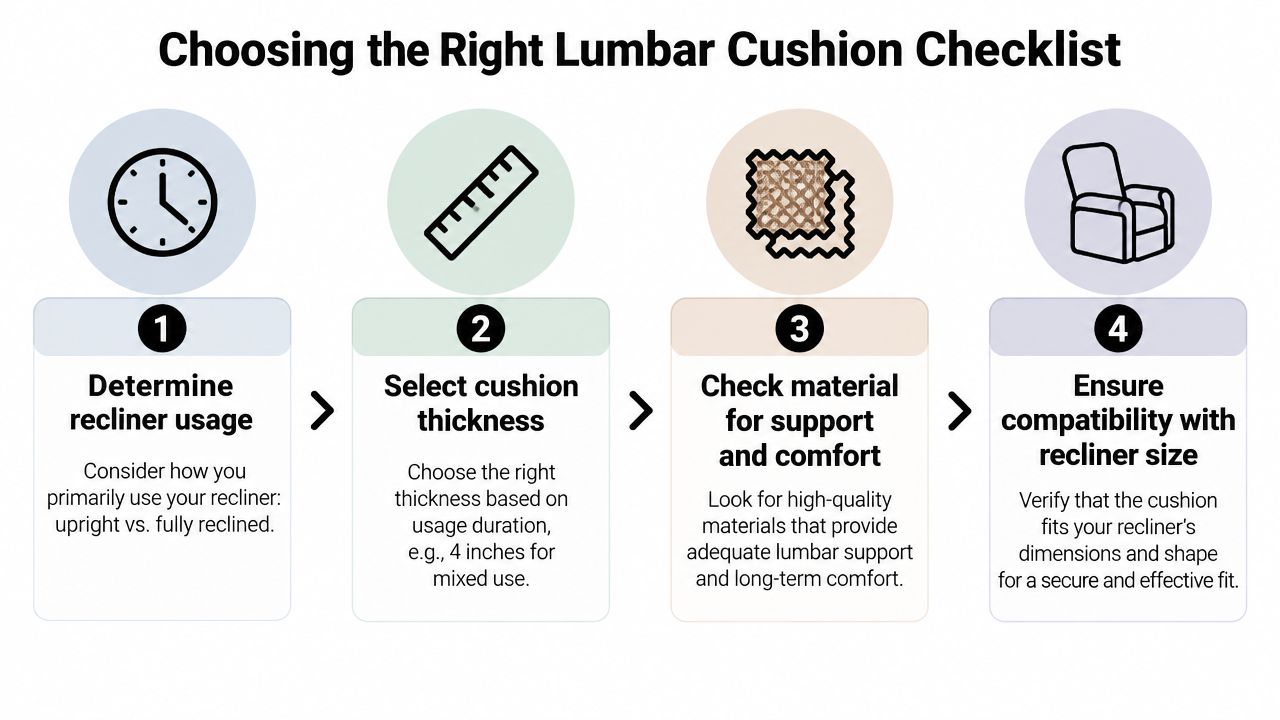
Use this buying sequence
- Measure before shopping: Record the lumbar gap, usable back width, and vertical location of the curve.
- Choose behavior: Select memory foam for contouring, high-resilience foam for rebound, molded foam for a close shape match, or latex for a cooler, springier feel.
- Check movement control: Look for straps, a rubberized panel, or a compatible non-slip solution.
- Review maintenance: A removable cover makes cleaning easier, especially for daily use.
- Confirm the return terms: A cushion can look ideal online and still be wrong for a particular recliner angle.
A product such as an orthopedic memory foam seat cushion and lumbar pillow can be considered only after dimensions and recliner mechanics have been checked. The label matters less than whether the cushion stays centered, maintains its shape, and feels neutral through the chair's full range.
The global back support cushion market was estimated at $1.84 billion in 2025 and projected to reach $3.17 billion by 2034, with a reported compound annual growth rate of 6.2% in the market report from Dataintelo. Lumbar cushions represented 32.5% of the product segment in that report, which reflects established demand, but it doesn't remove the need to fit the product to the individual recliner.
Granted Solutions curates practical home and wellness products, including ergonomic options for people who spend long periods in recliners or need more comfortable everyday seating. Visit Granted Solutions to compare problem-solving products, review fit-focused details, and choose a cushion that matches the chair's movement rather than just buying the thickest one.
Leave a comment