

Smart Cutting Board Guide for Easier Everyday Cooking

The chicken is halfway sliced, the vegetables are waiting in a second bowl, the recipe needs a precise amount of seasoning, and the kitchen timer is buried under a dish towel. A traditional cutting board handles the chopping, but it doesn't organize the rest of the work. That leaves the cook switching between a scale, phone, timer, and several surfaces while trying to keep raw and ready-to-eat foods apart.
A smart cutting board approaches meal prep as a workflow problem. Depending on the design, it can combine a prep surface with weighing, timing, connectivity, storage, or sanitation-focused features. The point isn't to turn dinner into a laboratory. It's to reduce small interruptions that create mess, guesswork, and avoidable hygiene mistakes.
The category suits busy home cooks, meal-prep households, gadget enthusiasts, and anyone buying a practical kitchen gift. It also deserves a realistic look, because sensors and Bluetooth don't replace washing, separate boards, or sensible food handling. The most useful model is the one that makes good habits easier without creating more maintenance than it saves.
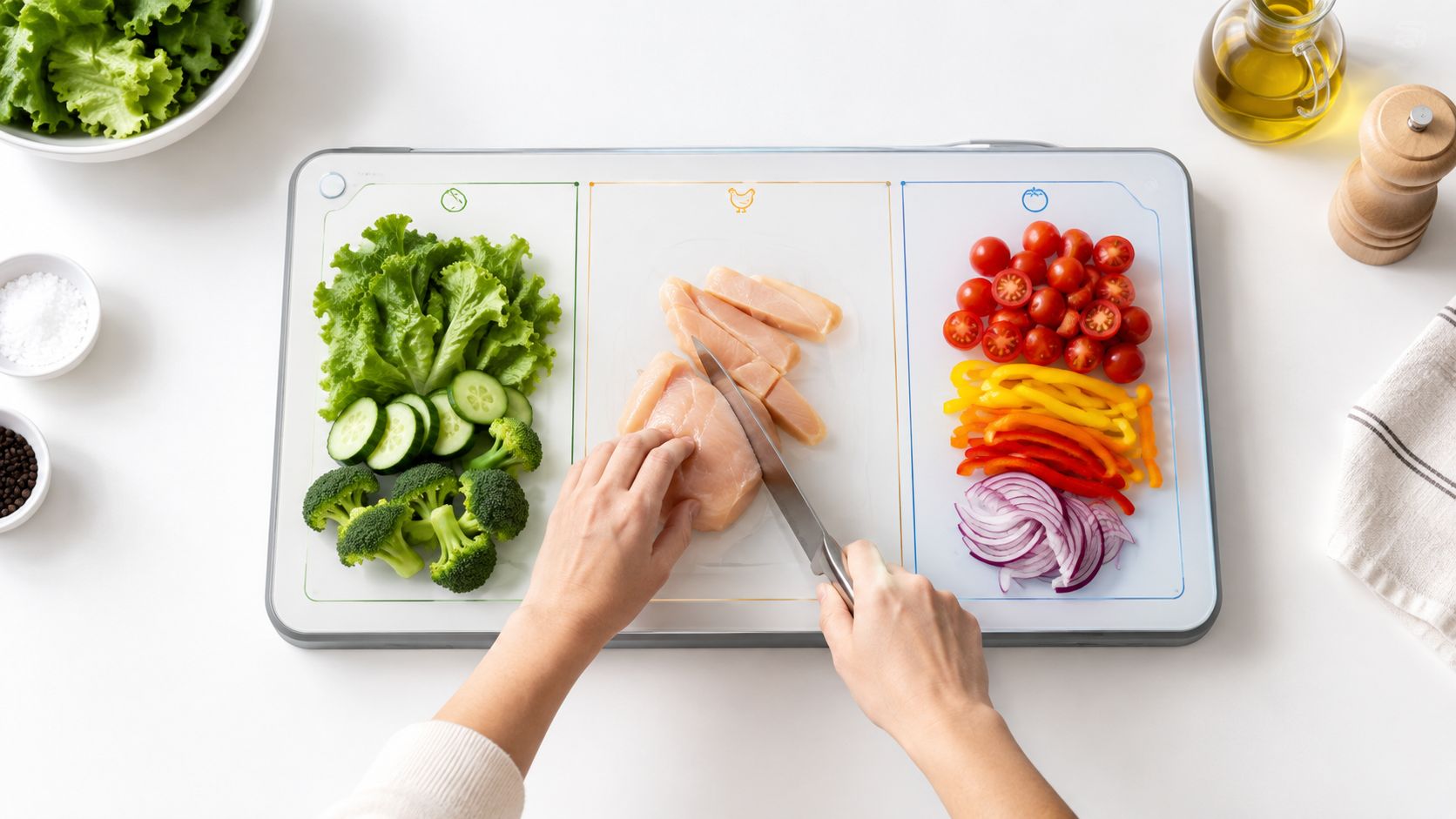
This guide explains what the product category really includes, how the main technologies work, where the benefits show up during everyday cooking, and which tradeoffs deserve attention before buying.
Table of Contents
- Introduction to Smarter Everyday Meal Prep
- What a Smart Cutting Board Really Is
- Core Features and Technologies Explained
- How Smart Cutting Boards Improve Daily Use Cases
- Pros Cons and What to Realistically Expect
- Setup Maintenance and Buying Considerations
- Final Takeaways and Your Next Step
Introduction to Smarter Everyday Meal Prep
A weeknight dinner often creates a chain of tiny decisions. The cook weighs ingredients in one place, chops in another, checks a recipe on a phone, starts a timer, and then realizes the same surface was used for raw chicken and vegetables. None of these tasks is difficult alone. Together, they make the counter feel crowded and increase the chance that a step gets skipped.
A standard board is still excellent at its primary job, cutting and chopping. Its limitation is that it doesn't support the surrounding workflow. A smart version can place several useful functions closer to the food, so the cook spends less time moving ingredients between tools and more time following a clear sequence.
The everyday problem behind the gadget
Consider a cook preparing chicken, peppers, and rice. A built-in scale can help weigh the chicken directly on the board. A timer can track a preparation interval without requiring a separate kitchen device. A connected design may send information to a phone or recipe app, while separated surfaces or organized storage can make the switch from raw food to produce more obvious.
These features matter most when they remove friction. A scale isn't valuable merely because it has a digital display. It becomes useful when it prevents another bowl from entering the workflow. A timer isn't impressive because it is built into bamboo or plastic. It earns its place when the cook can start it without leaving the prep area.
Practical rule: The best kitchen technology reduces decisions during cooking. It shouldn't create a second project involving complicated setup, fragile components, or difficult cleaning.
Food safety remains the foundation. The Academy of Nutrition and Dietetics cutting-board guidance emphasizes separate boards for raw foods and produce, along with washing and sanitizing practices. A smart cutting board can support that system through clear organization or sanitation-oriented features, but it can't make basic cleaning unnecessary.
The Granted Solutions approach to practical gadgets fits this distinction. Useful home technology should solve an ordinary problem in a way that feels simple enough for daily use. Readers comparing kitchen devices can also explore practical home gadget ideas to see how convenience features fit into broader household routines.
What a Smart Cutting Board Really Is
A smart cutting board is best understood as a cutting surface paired with a small kitchen assistant. The board still provides a stable place to slice, dice, and portion food. Embedded electronics or integrated design features add measurement, timing, communication, or feedback around that basic task.
The comparison becomes clearer with a familiar kitchen example. A normal board is like a notebook page. It gives the cook a surface but doesn't calculate anything. A smart board is closer to a notebook with a built-in ruler, clock, and connection to a phone. The added tools don't replace the cook's judgment. They make common information available at the moment it's needed.
What makes it genuinely smart
A board doesn't become smart because it uses an attractive material, has a dark finish, or includes a storage groove. A smart design usually performs at least one active function through electronics or connected controls.
The main categories include:
- Integrated sensors: The board can detect weight, contact, placement, or physical changes.
- Connectivity: Bluetooth or another wireless connection can link the board with a phone or app.
- Guidance: Timers, displays, alerts, or feedback can help the cook follow a process.
- Workflow design: Multiple surfaces, compartments, sanitation features, or storage options can make task changes clearer.
The patent record shows that this idea has moved beyond a passing novelty. Arcelik AS filed an international application titled “A smart cutting board with improved operational performance,” identified as PCT/EP2018/058323, with patent records dating the filing to March 30, 2018. The application was later published as WO2018202375A1 in 2018 in the international patent record.
A later U.S. publication titled “Smart cutting board,” US20220094200A1, shows continued patent activity in 2022. Multiple filings across jurisdictions suggest an emerging product class rather than one isolated concept. Related designs also explore universal design, modular construction, and integrated functionality.
The difference from a premium standard board
A premium standard board may offer better stability, attractive construction, or a surface chosen for knife comfort. Those qualities can matter without any electronics. A smart board adds another layer, measurement or guidance, and that layer should solve a problem the household has.
The simplest test is practical: if the electronic functions stopped working, would the remaining board still be useful? A sound design should remain a capable prep surface while offering convenience on top.
Core Features and Technologies Explained
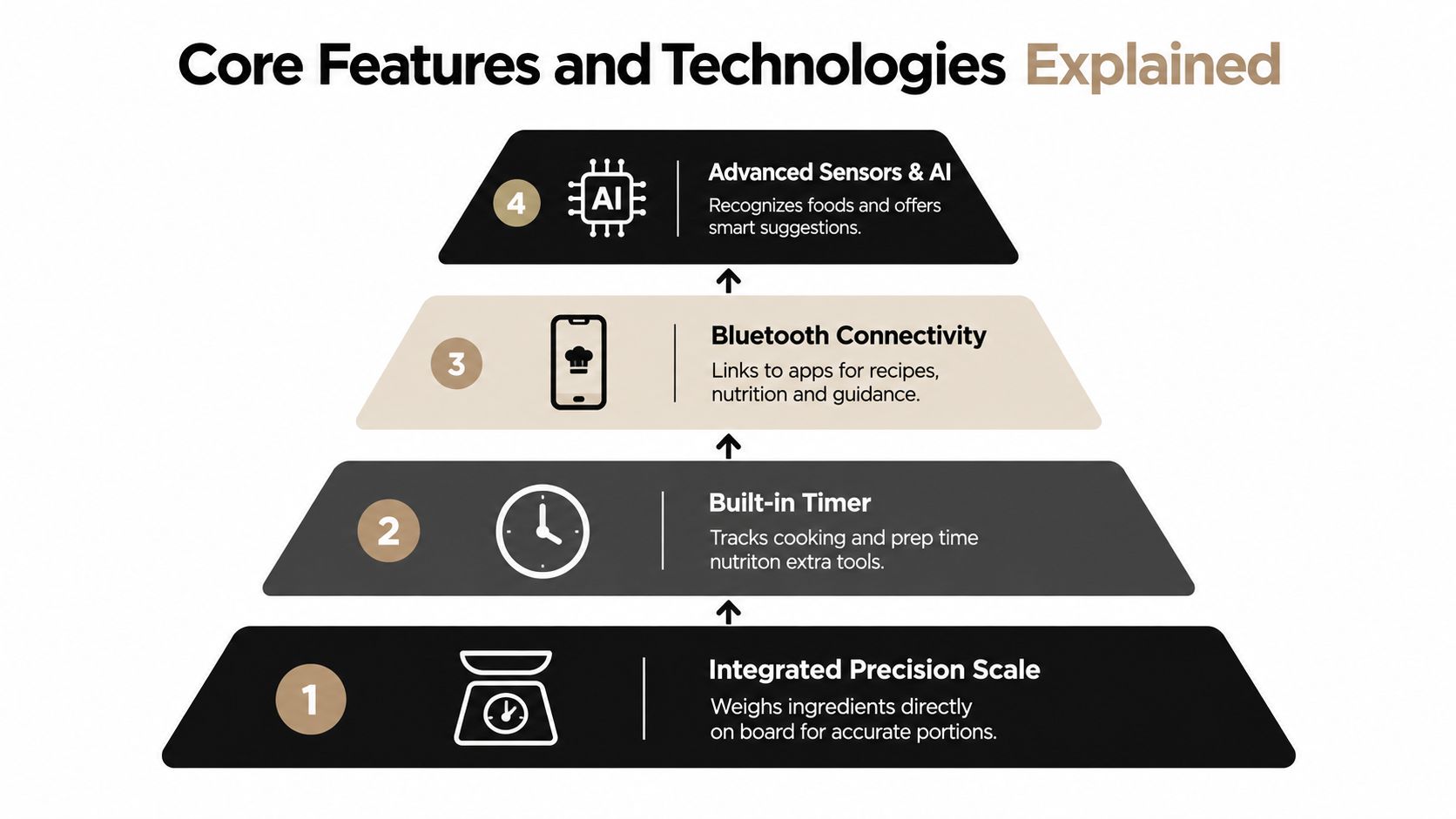
A smart cutting board earns its place by organizing preparation, not by collecting sensors. Buyers should match each feature to a kitchen problem: measuring ingredients, keeping tasks separate, tracking time, or reducing counter transfers. The strongest designs work like a prep station with built-in tools, while still leaving hygiene decisions to the cook.
Measurement starts with the integrated scale
One reported high-spec design combines a main bamboo board, a secondary silver-ion antibacterial board, a heat-conducting defrosting tray, and an integrated weighing scale. The scale is described as accurate to 0.1 g, supports up to 3 kg, and displays grams, pounds, ounces, and milliliters in the product description.
This arrangement turns the board into a portioning station. Ingredients can be weighed where they are prepared, reducing transfers into extra bowls and helping cooks repeat a recipe more consistently. A milliliter setting may assist with some liquid measurements, although the user should confirm how the particular model handles density and liquid modes.
The scale suits cooks who follow quantities, prepare planned portions, or want fewer containers around the work area. Someone who measures by eye and rarely repeats recipes may gain less from it. The feature is useful when it removes a step, not because it appears on the specification sheet.
Timers and wireless connections
A built-in timer handles a small interruption that occurs often in meal preparation. The cook can track a preparation interval without touching a phone with wet hands or finding a separate timer. Its practical value depends on readable feedback, simple controls, and a surface that can be cleaned around those controls.
Bluetooth may connect the board with a phone or companion app for recipes, tracking, or guidance. Buyers should check whether the app remains supported, whether the board keeps working without a connection, and what information the system shares. Connectivity should support the cooking routine rather than become another task to configure.
Power design also affects everyday use. The reported concept uses 4 AAA batteries and Bluetooth 4.0, showing how embedded electronics can operate without a permanent charging cable in the product description. Battery access, water protection, and replacement cost still matter, especially in a work area exposed to splashes and frequent cleaning.
Surfaces, sanitation, and sensing
Multiple surfaces can organize food preparation by task. A bamboo main board, a separate antibacterial surface, and a defrosting tray may keep ingredients from moving onto unrelated plates or countertops. That separation can make cross-contamination risks easier to manage, but no material by itself removes the need for proper washing and food handling.
Some concepts add UVC treatment. One smart chopping-board design incorporates 254 nm UVC light and reports germ or bacteria reduction claims of up to 99.9% to 99.99% after about one minute of exposure in independent design coverage. Those figures apply to that concept and its stated exposure conditions. They should not be read as a replacement for cleaning, and buyers should examine how safely the light operates around people and food.
Sensors can also record physical behavior. Research on a smart cutting tool used two surface acoustic wave strain sensors on the top and side of the tool shank to measure strain in the published research paper. The example concerns a cutting tool rather than a household board, but it shows how embedded sensors can capture force or stress instead of serving only as decorative technology.
The same rule applies when comparing connected kitchen products with smart home energy management. A feature deserves attention when it changes a routine, clarifies a task, or reduces a transfer. Otherwise, it may add maintenance without solving prep chaos.
How Smart Cutting Boards Improve Daily Use Cases
The clearest benefit appears when several small tasks happen at once. A traditional board handles cutting, while a smart model may combine cutting with weighing, timing, and organization. The comparison isn't about replacing a dependable board with a complicated machine. It's about deciding whether fewer tool changes justify the added care.
Weeknight cooking
A cook preparing a stir-fry can weigh protein directly on the surface, move it to its designated area, and prepare vegetables separately. The board's timer can track a preparation interval while the recipe remains visible on a phone. That arrangement won't make chopping itself faster, but it can reduce interruptions and counter clutter.
Meal preparation brings the same advantage. Portioning ingredients on the board may make repeated meals more consistent, particularly for households following a planned recipe routine. A scale that supports multiple units can help when recipes use different measurement systems, provided the board's controls are easy to operate.
Families, guests, and shared kitchens
Cooking with children often requires clearer boundaries. Separate surfaces or color-coded areas can show which foods belong where, while a timer gives young helpers a visible task to follow. The board doesn't replace adult supervision, but it can make the sequence easier to understand.
For hosts, organization is the attraction. A board that moves from preparation to serving, or stores a knife and related accessories, can help keep the counter presentable. Buyers should still confirm that a surface designed for serving is also appropriate for the food being prepared and can be cleaned thoroughly afterward.
The sanitation question
UVC sanitation is one of the most discussed smart-board features because it addresses the transition between tasks. A design that disinfects a knife or surface at the prep station may help a cook remember to pause between raw and ready-to-eat work. That convenience is potentially meaningful because busy cooks sometimes skip tool changes when the next ingredient is already waiting.
The limitation is just as important. The Academy of Nutrition and Dietetics guidance emphasizes separate boards, hot soapy water, and sanitizing after raw meat, poultry, or seafood. Active sanitation should support that routine, not replace it. A smart cutting board improves the workflow only when the user still follows the cleaning and separation steps.
A board can make the safe choice more convenient. It can't make an unwashed surface safe by assumption.
As a gift, the product fits people who enjoy kitchen technology, repeat meal preparation, or organized countertops. It may be less suitable for a minimalist cook who values a simple board that can be washed without thinking about batteries, displays, or app support.
Pros Cons and What to Realistically Expect
The category sits between kitchen tool and connected gadget. That creates genuine convenience, but it also introduces failure points that a standard board doesn't have. A balanced decision starts by separating useful functions from features that sound impressive but rarely affect daily cooking.
Market coverage places smart chopping boards in a measurable commercial niche. One estimate valued the global category at about USD 50.7 million in 2022 and projected roughly 25 million units in 2024 in the market report. Another forecast projects growth from about USD 155.06 million in 2026 to USD 325.88 million by 2032, with a projected 12.98% CAGR in the industry forecast. The forecast is a projection, not a guarantee of adoption.
Benefits worth paying attention to
An integrated scale can improve portion consistency. A timer can remove one separate device from the counter. Bluetooth may help cooks who want recipe-linked guidance, while modular surfaces can make raw and produce tasks easier to separate.
The category also has an identifiable engineering history. Patent activity dating to the late 2010s, followed by a U.S. publication in 2022, indicates continued development. Yet current concepts still cluster around narrow functions such as self-cleaning, weighing, and knife storage, so buyers shouldn't assume every model offers a complete connected cooking system.
| Aspect | What to Expect |
|---|---|
| Measurement | Direct weighing can reduce bowl swapping and support repeatable portions. |
| Timing | A built-in timer can keep prep information close at hand. |
| Hygiene support | Separate surfaces or UVC concepts may encourage cleaner transitions, but washing remains necessary. |
| Connectivity | Bluetooth may add recipe or tracking functions, depending on app support. |
| Maintenance | Electronics, batteries, seals, and displays can make cleaning more involved. |
| Durability | Water exposure, knife marks, and repeated use can challenge both the board and its electronic components. |
| Value | The product makes more sense when the household uses its core functions often. |
The central tradeoff is simple. A smart board may create a calmer prep station, but it can cost more, require power, and demand more careful cleaning than a basic board. The strongest buyers are those with a repeated workflow problem, not those buying technology for its own sake.
Setup Maintenance and Buying Considerations
A smart cutting board earns its place through the routine around it. Set it up before a busy meal: install the specified batteries, confirm that the display responds, and pair Bluetooth only when a phone connection supports a function you plan to use. Battery types and connectivity versions vary by model, so the included manual should guide the first setup rather than assumptions based on another product.
Test the full workflow while the counter is clear. Weigh a dry ingredient, start the timer, inspect the surface boundaries, and check how the electronics are protected when you clean the board according to the manufacturer's directions. A feature that feels convenient during a calm test may be awkward with wet hands, food scraps, or several ingredients competing for space.
A short setup check can reveal whether the board organizes prep or adds another device to manage.
Cleaning should remain ordinary
The FDA advises using one cutting board for fresh produce and another for raw meat, poultry, and seafood. It also advises washing food-contact surfaces, including cutting boards, with hot soapy water after preparing each food item and before moving to the next in its food-safety guidance.
That guidance provides a practical buying filter. Food-contact areas should be easy to reach, wash, and dry. Check whether the electronic base can be removed, whether the board is dishwasher-safe, and whether seams could hold moisture. UVC may support the workflow, but it does not replace washing or separate surfaces for different food tasks.
Bamboo also deserves attention because the surface affects knife feel and care. A shared knife-edge longevity study reported that bamboo boards began dulling knives by around 2,000 cuts, with differences between long-grain and end-grain bamboo in the test. It also reported BESS sharpness values of 165 for bamboo long-grain and 210 for bamboo end-grain in the published knife study. These findings describe that test, not every bamboo board.
Maintenance habit: Keep the electronic base dry, wash food-contact surfaces promptly, and store the board so air can circulate around damp areas.
A practical buying checklist
- Choose the surface first: Confirm that the board gives the household enough room for normal ingredients and suits the knives in use.
- Check the scale: Review the supported weight, displayed units, and stated precision. Precision matters less if the controls are difficult to operate.
- Inspect separation: Distinct surfaces, grooves, or color cues can organize raw and ready-to-eat tasks during the same meal.
- Review power needs: Battery operation can be convenient, while rechargeable designs reduce disposable-battery handling. Both require an accessible way to manage power.
- Test cleaning requirements: Read the instructions before buying, especially if dishwasher use affects your routine.
- Consider storage: A larger board needs a stable, dry place. Integrated knife storage can reduce clutter, but it adds surfaces that also need cleaning.
- Match the price to use: A household that weighs ingredients often may value an integrated scale more than one that cooks without measurements.
For shoppers comparing practical kitchen technology with other household upgrades, a guide to affordable tech gadgets offers useful context. Choose the model whose most-used feature addresses a recurring annoyance, while its cleaning, power, and storage demands fit the way your kitchen already works.
Final Takeaways and Your Next Step
A smart cutting board is most useful when viewed as a workflow organizer, not as a miracle appliance. Its best contributions are modest but practical: weighing ingredients where they are cut, keeping timing close to the prep area, making food boundaries clearer, and reducing the number of tools scattered across the counter.
The category has credible signs of technical development, including patent activity from the late 2010s and continued U.S. publication activity in 2022. It has also become a measurable commercial niche, but the available designs remain varied. That means buyers should judge the actual construction and routine rather than assuming every product offers the same connected experience.
The strongest match is a cook who values measured recipes, meal preparation, organized surfaces, or kitchen gadgets that remove repeated steps. A simple board may remain the better option for someone who wants effortless hand washing, no batteries, and no app connection. Neither choice is automatically superior.
Three checks can keep expectations realistic:
- Prioritize the feature used most often, such as a scale or clear task separation.
- Treat sanitation technology as support, not a substitute for separate boards and hot soapy water.
- Inspect maintenance before purchase, including power, seams, surface care, and storage.
A thoughtful smart cutting board can make everyday cooking feel less scattered without turning the kitchen into a connected-device showcase.
Granted Solutions curates practical kitchen gadgets and problem-solving home products for busy households, gift shoppers, and tech-friendly cooks. Visit Granted Solutions to browse useful kitchen and gadget picks with free shipping and a 30-day return policy.
Leave a comment