

Types of Tape Measures Explained for DIY Success

A tape measure usually gets blamed only after the mistake shows up. A shelf sits slightly crooked. A curtain rod lands too narrow for the window. A room plan looks right on paper but doesn't fit once the furniture arrives.
Most of those problems don't happen because measuring is hard. They happen because people grab the wrong tape for the job.
A soft sewing tape bends around curves beautifully, but it's a poor choice for laying out straight cabinet lines. A pocket tape is perfect for quick wall measurements, but it isn't always the best tool for a long outdoor run. A laser tool can make room measuring easier, yet it still can't replace a physical tape when the project needs contact, edges, or curves.
That's why understanding the different types of tape measures matters. The best choice depends on material, distance, and tolerance, not just whatever happens to be in the junk drawer. For readers comparing practical home tools, these DIY home improvement tool basics pair well with a closer look at measuring tools specifically.
Table of Contents
- Introduction Why Choosing the Right Tape Measure Matters
- How Tape Measures Work and What Makes Them Different
- The Four Main Types of Tape Measures You Should Know
- Accuracy Materials and Blade Features That Affect Results
- How to Choose the Right Tape Measure for Your Project
- Laser Digital and Specialty Tapes When to Upgrade
- Find Your Perfect Tape Measure at The Granted Solutions
Introduction Why Choosing the Right Tape Measure Matters
A measuring mistake often starts small. Someone marks a wall for floating shelves with a soft, flexible tape that bows in the middle. The shelves go up, the spacing looks slightly off, and now the whole wall feels wrong.
That same kind of frustration shows up in dozens of home projects. Cutting blinds, planning a gallery wall, checking a sofa against a doorway, or laying out a backyard path all sound simple until the measuring tool works against the job instead of helping it.
One tool name, several very different tools
People often say “tape measure” as if it means one thing. It doesn't. The common pocket tape in a case is just one member of a bigger family. There are long steel tapes for distance work, cloth or fabric tapes for flexible measuring, and laser-based tools that speed up long straight-line readings.
That mix is where confusion starts. A buyer sees different materials, lengths, blade widths, hooks, reels, and digital features, then has to guess what matters.
Practical rule: The right tape measure should match the shape of the object, the length of the measurement, and how exact the result needs to be.
Why the wrong choice creates real problems
A tape can be too floppy, too short, too rough for delicate work, or not accurate enough for a precision task. Even when the measurement looks close, small differences can stack up across a project. That's why trim, cabinetry, and modular installs often punish “close enough” thinking more than rough outdoor work does.
A better approach is simpler than most buying guides make it seem. Instead of memorizing categories, it helps to sort the types of tape measures by job:
- Straight indoor measuring often favors a retractable pocket tape.
- Long outdoor distances usually call for an open-reel or long tape.
- Curves and body shapes fit cloth or fabric tapes.
- Fast room scans make laser and digital tools useful.
The sections below build that decision process step by step, so readers can stop guessing and start choosing the right tape with confidence.
How Tape Measures Work and What Makes Them Different
Every tape measure solves the same basic problem. It gives a marked length that can move from the tool to the object being measured. What changes is how the tape is built, how stiff or flexible it is, and how easy it is to control.
This visual helps make the parts easy to spot.
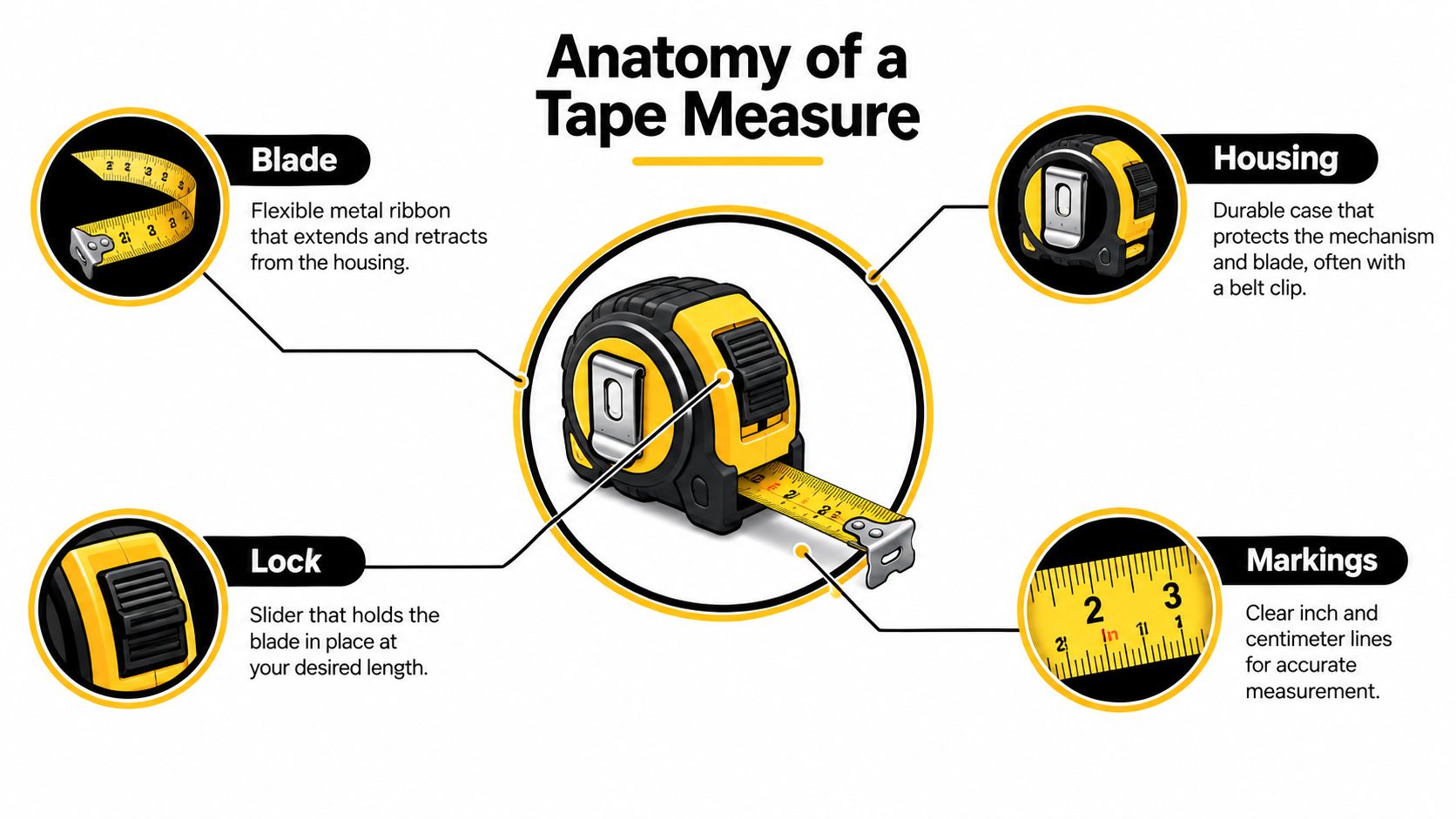
The basic parts
Once the names of the parts are clear, knowing the feel of a pocket tape makes shopping easier.
- Blade: The long strip with measurement marks. On many pocket tapes, this is a slightly curved metal ribbon that resists buckling.
- Housing: The case that protects the coiled blade.
- Lock: The slider or button that holds the blade in place.
- Markings: The printed scale in metric, imperial, or both.
A simple analogy helps here. The housing is like the garage, the blade is the car, and the lock is the parking brake. If the blade isn't stiff enough for the task, or the lock slips, the measurement gets harder to trust.
What actually separates one tape from another
When people compare types of tape measures, four differences matter most.
Material
Material changes both flexibility and precision. Steel tapes are the common precision option and can achieve better than 1 in 10,000 accuracy under proper conditions, which is about 3 mm error over 30 m, while fibreglass tapes are lighter and rust-free but are typically suited to about 1 in 1000 precision, or roughly 30 mm over 30 m, according to an engineering surveying reference on steel and fibreglass tapes.
That difference sounds technical, but the practical version is simple. Steel usually wins when accuracy matters more. Fibreglass often wins when weather, moisture, or corrosion resistance matters more.
Mechanism
Some tapes retract into a case. Others wind onto an open reel. That isn't just style. It changes how the tool behaves on the job.
A retractable tape is fast, compact, and ideal for daily indoor use. An open-reel long tape is easier to manage over bigger distances because the user can walk it out smoothly without fighting a spring-loaded housing.
A tape measure isn't just a length. It's a delivery system for the measurement.
Length
Length determines reach, but it also affects convenience. A compact tape works well for furniture, framing, and room details. A long tape is better when the user needs site distances, fence lines, or outdoor layout.
Unit system
Markings also matter more than many buyers expect. Some tapes show only inches or only centimeters. Others combine both. For households that mix flat-pack furniture, sewing, decor, and renovation projects, clear dual markings can reduce mistakes.
Why this matters before buying
Cased tape measures are the standard format many recognize. They use a retractable blade inside a plastic or metal case and are commonly marked in imperial or metric units for everyday DIY and home use, as noted in The Spruce's overview of common cased tapes.
That familiar format is useful, but it shouldn't be the automatic choice for every project. Once buyers understand the parts and the design choices, the next step is much easier. Matching the tape to the task starts to feel obvious instead of confusing.
The Four Main Types of Tape Measures You Should Know
A tape measure works a lot like shoes. One pair handles everyday errands well. Another is better for hiking, and a third is the right pick for formal events. Tape measures work the same way. The best choice depends on what you are measuring, how far you need to reach, and how exact the result needs to be.
For most home users, four types cover nearly every job: retractable pocket tapes, long steel or open-reel tapes, cloth or fabric tapes, and laser measures. The useful shift is to sort them by task, not just by category name.
Retractable pocket tapes
This is the everyday workhorse.
A retractable pocket tape is the right fit when the material is flat or fairly straight, the distance is short to medium, and the cut or placement needs to be repeatable. That includes checking a bookshelf opening, marking a stud location, measuring trim, or seeing whether a washing machine will fit through a doorway.
The big advantage is control. The hook catches an edge, the blade stays straight over a short span, and one person can usually measure alone without much fuss. For indoor DIY, this is often the first tool to reach for.
It helps to picture its sweet spot clearly:
- Material: boards, walls, cabinets, appliances, furniture
- Distance: short to medium spans
- Tolerance: good for general DIY, layout, and cut lists
If you are measuring a sofa curve or the width of a room from one wall to the other, another type usually does that job better.
Steel and long band tapes
These are for distance first.
A long steel tape or open-reel tape makes more sense when the span gets large and the layout is mostly straight, such as fence lines, garden beds, driveway planning, or basic property measurements. It is less about convenience and more about reach.
Some buyers wonder why this type exists when a pocket tape already measures length. The answer is handling. A compact tape is easy in a kitchen or workshop. Over long outdoor runs, that same spring-loaded format becomes awkward. An open reel feeds out and winds back in a more controlled way, especially on uneven ground.
Steel tape measures also have a long industrial history. Wired's historical note on steel tape development summarizes how steel tapes developed into trusted tools for surveying, engineering, and other long-range measuring jobs.
Choose this type when the job looks more like laying out a line than checking the size of an object.
Cloth and fabric tapes
These handle shape better than straightness.
A cloth or fabric tape is the right tool when the material bends, curves, wraps, or compresses a little. That makes it useful for sewing, upholstery, cushions, lamp shades, body measurements, and craft projects.
A rigid blade wants to draw a straight path from point A to point B. A soft tape follows the actual surface. That difference matters. If you are measuring the circumference of a dining chair seat cushion, a pocket tape can fight you the whole way. A fabric tape settles around the edge and gives a more realistic number for the material you are cutting.
Use it for:
- Material: fabric, foam, curved decor, body dimensions
- Distance: short spans
- Tolerance: good for fit and wraparound measurements
It is a poor match for marking lumber or setting cabinet spacing, because it does not hold a straight line on its own.
Laser measures
Laser measures fit a narrower role than many buyers expect, but they are excellent in that role.
They work best when the material is fixed in place, the distance is long, and the measurement is a straight line through open space. Room length, ceiling height, hallway width, and wall-to-wall planning are classic examples. Instead of reading tiny marks at the far end of a blade, the user points, clicks, and reads the number.
That saves time on room planning and repeat checks. It can also reduce reading errors over longer spans.
Laser tools do have limits. They cannot hook onto an edge, wrap around an object, or mark a cut line on a board. For many DIY jobs, a laser measure is a helper, not a replacement.
Types of Tape Measures at a Glance
| Tape Type | Best For | Best Match by Task |
|---|---|---|
| Retractable pocket tape | Everyday DIY and home projects | Flat materials, short to medium spans, repeatable measuring and marking |
| Steel or long band tape | Outdoor layout and long runs | Straight-line distance over larger areas such as yards, fences, and site work |
| Cloth or fabric tape | Sewing, upholstery, crafts | Curved, soft, or wraparound surfaces where a rigid blade will not sit properly |
| Laser measure | Interior distance checks and room planning | Long straight indoor spans where speed and easy readout matter |
A better way to compare the four
A simple decision framework makes the choice easier:
- What is the material like? Flat boards and walls favor pocket tapes. Curves and soft surfaces favor fabric tapes. Open air across a room favors laser measures.
- How far are you measuring? Short object measurements are different from fence lines or room-length spans.
- How exact does the result need to be? For marking cuts, the tool has to stay steady and reference an edge well. For room planning, quick distance capture may matter more.
That is why no single type is best overall. Zoro's task-based tape measure selection guide also frames tape choice around the job itself, which is the most practical way to buy.
The short version is simple. Pocket tapes handle most home projects. Long steel tapes handle outdoor distance. Fabric tapes handle curves. Laser measures handle long, straight interior spans quickly.
Accuracy Materials and Blade Features That Affect Results
You can get two different readings from two tape measures on the same shelf board, even when both say the same length. That usually comes down to three things: accuracy class, material, and blade design.
For a quick wall check, a small difference may not matter. For cabinet parts, shelf pin spacing, or trim that has to meet cleanly, it does.
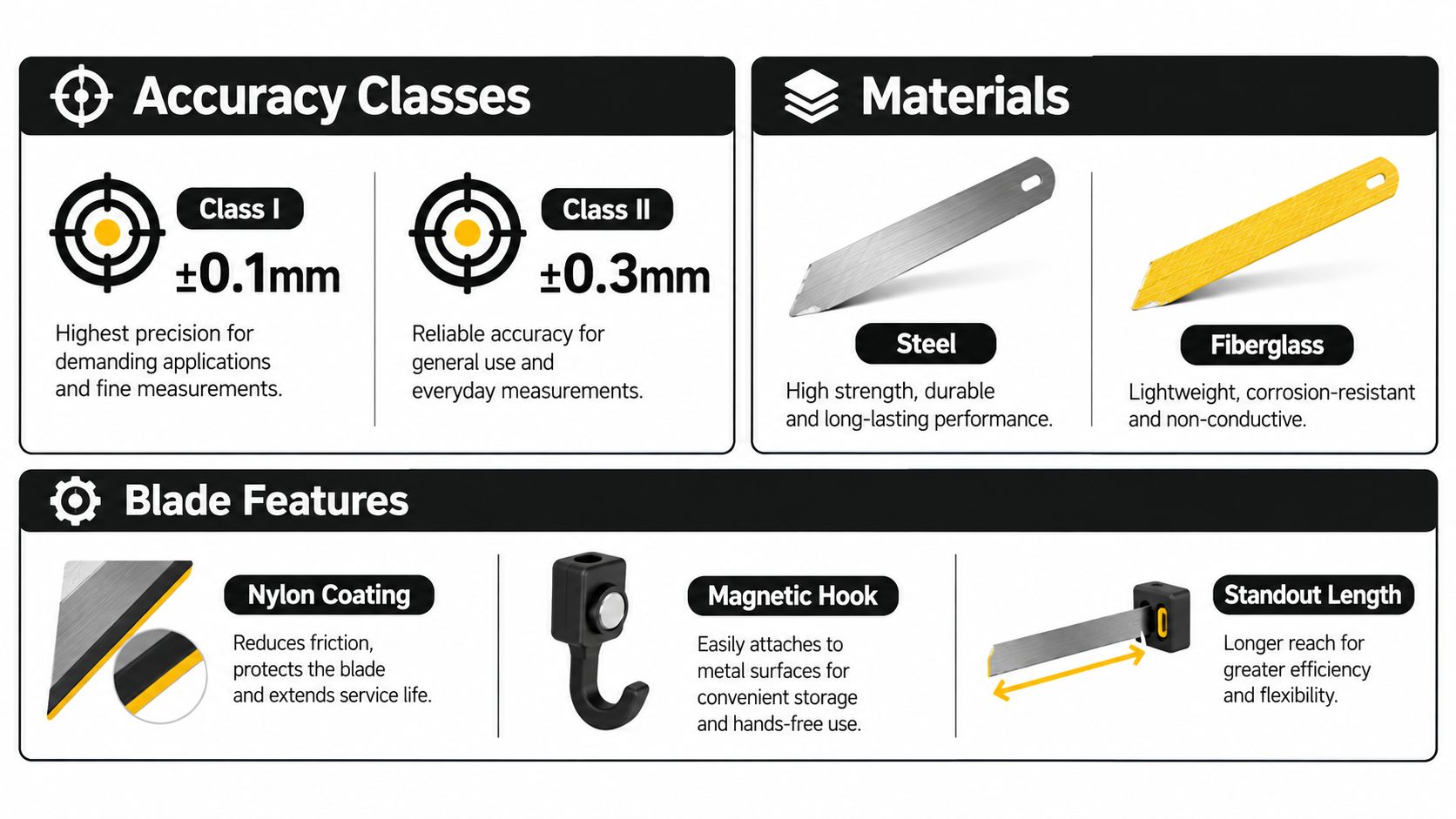
Accuracy classes matter more than most people think
For accuracy-sensitive work, retractable tapes are often grouped into European accuracy classes. Over 10 m, the maximum errors are about 1.1 mm for Class I, 2.30 mm for Class II, and 4.60 mm for Class III, according to the Wikipedia overview of tape measure accuracy classes.
Those numbers become more important when one measurement gets repeated across a project. A single cut on a utility shelf may hide a small miss. A row of upper cabinets will not. Small errors can stack like laying tile with one spacer slightly off each time. By the end, the drift is easy to see.
For home users, the practical takeaway is simple. If the project has a tight tolerance, such as trim, built-ins, or anything that must line up across several parts, a better accuracy class is worth paying attention to.
Steel and fibreglass behave differently
Blade material affects more than durability. It changes how the tape behaves in use.
Steel is the usual choice for tighter measuring work because the blade stays more stable and is less likely to stretch under normal use. That makes it a good fit for indoor woodworking, trim, and other jobs where parts need to match closely.
Fibreglass is often the better pick outside, especially around moisture, dirt, or rough handling. It resists rust and handles jobsite abuse well. The tradeoff is that it is usually better suited to layout, landscaping, or general distance checking than close-fit finish work.
A simple way to sort this out is by task. If you are marking cuts on hardwood or fitting a cabinet between two walls, steel makes more sense. If you are measuring a fence run after rain or checking distances around a yard, fibreglass is often the more practical choice.
Blade width changes how easy the tape is to use
Blade width affects standout, which is how far the blade can extend before it folds over. Wider blades are usually stiffer, so they stay up longer when you are measuring alone.
That matters on real projects. If you are checking the width of a room without a helper, measuring up to curtain rod height, or reaching across a sheet of plywood, a wider blade is easier to control. It wobbles less and collapses less often.
The exact distance varies by model, coating, and blade shape, but the pattern is consistent. Wider blades usually give you more unsupported reach. Narrower blades are often lighter and easier to pocket, but they can feel fussy on longer spans.
Small features can change the result
Some details look minor until you start using the tape every day.
- Hook movement: The end hook should slide slightly to account for inside and outside measurements. If it feels loose in a sloppy way rather than a controlled way, accuracy can suffer.
- Blade coating: Coatings help protect printed markings from wear. That matters if the tape will rub against concrete, framing lumber, or rough masonry.
- Blade curvature: A more curved blade usually stands out better because the shape adds stiffness, much like a folded paper edge is harder to flop than a flat sheet.
- Readability: Clear numbers and marks reduce mistakes, especially when measuring in awkward light or overhead positions.
A practical checklist for better results
Match these features to the job, not just the display tag:
- Tight tolerance work: Choose better accuracy and a steel blade.
- Wet or rough outdoor work: Choose fibreglass or another corrosion-resistant option.
- One-person measuring across open space: Choose a wider, stiffer blade.
- Frequent use on abrasive materials: Choose a durable coating and easy-to-read markings.
That is the pattern behind tape measure performance. The best tape is not the one with the most features. It is the one whose material, blade shape, and accuracy fit the surface, distance, and tolerance of the job in front of you.
How to Choose the Right Tape Measure for Your Project
Most buyers don't need every kind of tape. They need the one that fits the next job without creating extra hassle. The easiest way to decide is to match the tool to four questions: How far is the measurement, is it straight or curved, what material exposure is involved, and how exact does it need to be?
That framework turns a cluttered product search into a quick decision.
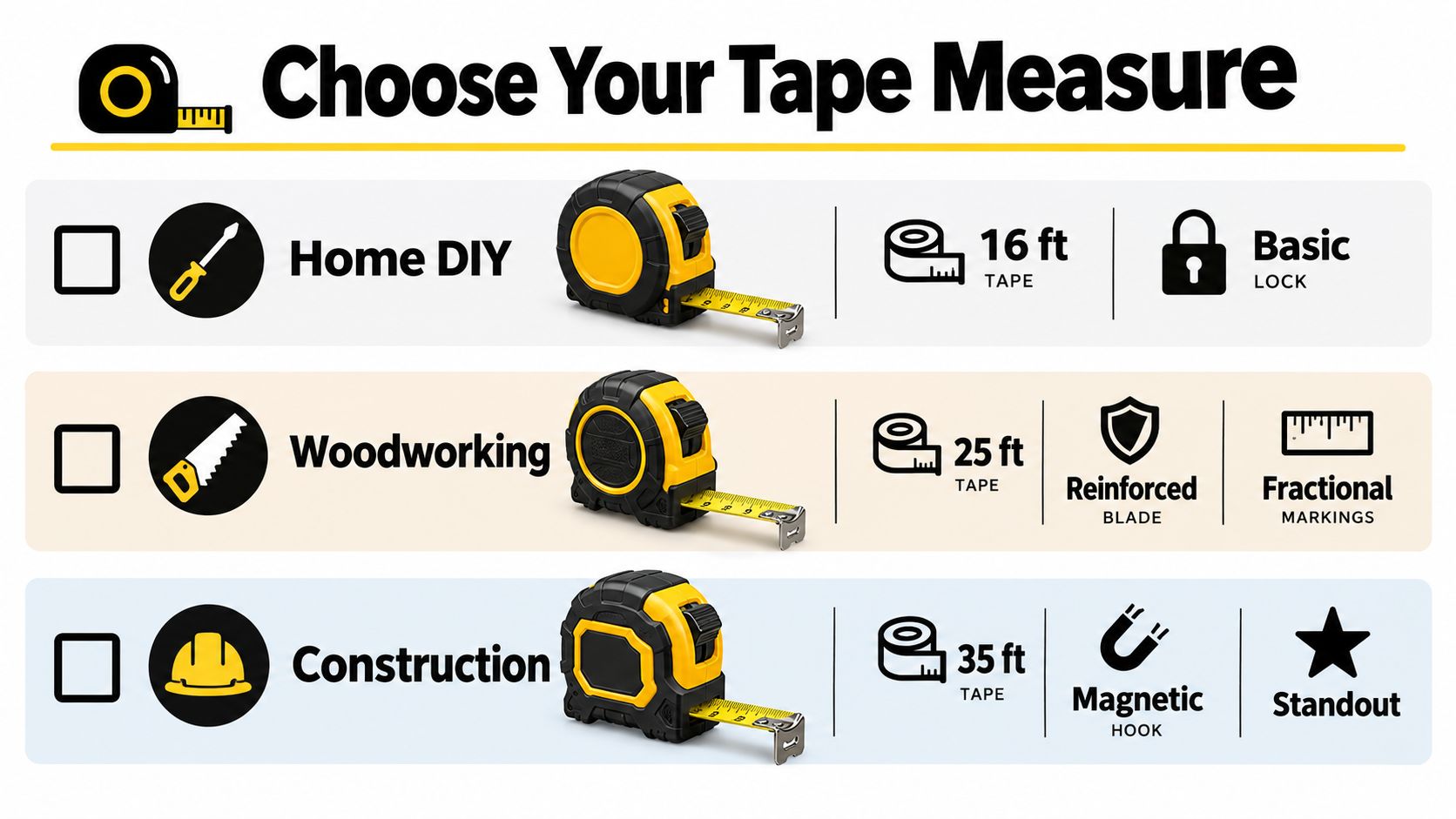
Common home projects and the best match
A few real-world examples make the choice clearer.
For measuring a room, a retractable pocket tape works well when checking wall lengths, door openings, or furniture placement. A laser tool becomes handy when the room is large and the goal is a fast straight-line reading from one wall to the next.
For hanging shelves or art, a pocket tape is the best fit because the hook catches edges and the blade lays directly against the wall. That contact matters when marks need to transfer cleanly to painter's tape or pencil lines.
For sewing, crafting, or upholstery, a cloth or fabric tape wins immediately. Curves, hems, cushions, and body measurements need flexibility, not blade stiffness.
For landscaping or outdoor layout, a long tape makes more sense than a short pocket tape. It's easier to walk out a garden bed, path, or fence line with a tool meant for distance.
For electrical work near damp conditions or corrosive exposure, many buyers prefer fiberglass because task-based tool guides point to it for electrical and saltwater-related environments. Readers comparing workshop tools may also find compact cutting tools useful alongside measuring gear, such as this look at a compact circular saw for DIY projects.
A simple buying checklist
Before choosing among the types of tape measures, this quick checklist helps:
- Distance first: Short indoor jobs suit compact retractable tapes. Long site-style runs call for long tapes or a laser.
- Shape matters: Curves need cloth or fabric. Straight layout usually needs a rigid blade.
- Environment counts: Damp, rust-prone, or rough outdoor settings may favor fiberglass or open-reel designs.
- Tolerance decides the class: Finish work needs tighter accuracy than rough spacing or garden layout.
When buyers often overbuy
A common mistake is choosing the biggest or most technical-looking tape “just in case.” That often adds bulk without solving the actual task. A large construction tape can feel clumsy for craft storage, small decor work, or quick household checks.
Another mistake is assuming digital automatically means better. Digital tools are useful when they fit the task, but they don't erase the need for a basic physical tape.
The best tape measure is the one that makes the next project easier, not the one with the longest feature list.
A smart toolkit usually includes one reliable pocket tape and, depending on the household, either a soft sewing tape or a long-distance measuring option. That combination covers most jobs without overcomplicating the toolbox.
Laser Digital and Specialty Tapes When to Upgrade
You measure a living room for flooring, then switch to marking shelf brackets, then need the circumference of a planter. One tool will feel fast in one job and awkward in the next. That is the right way to judge an upgrade.
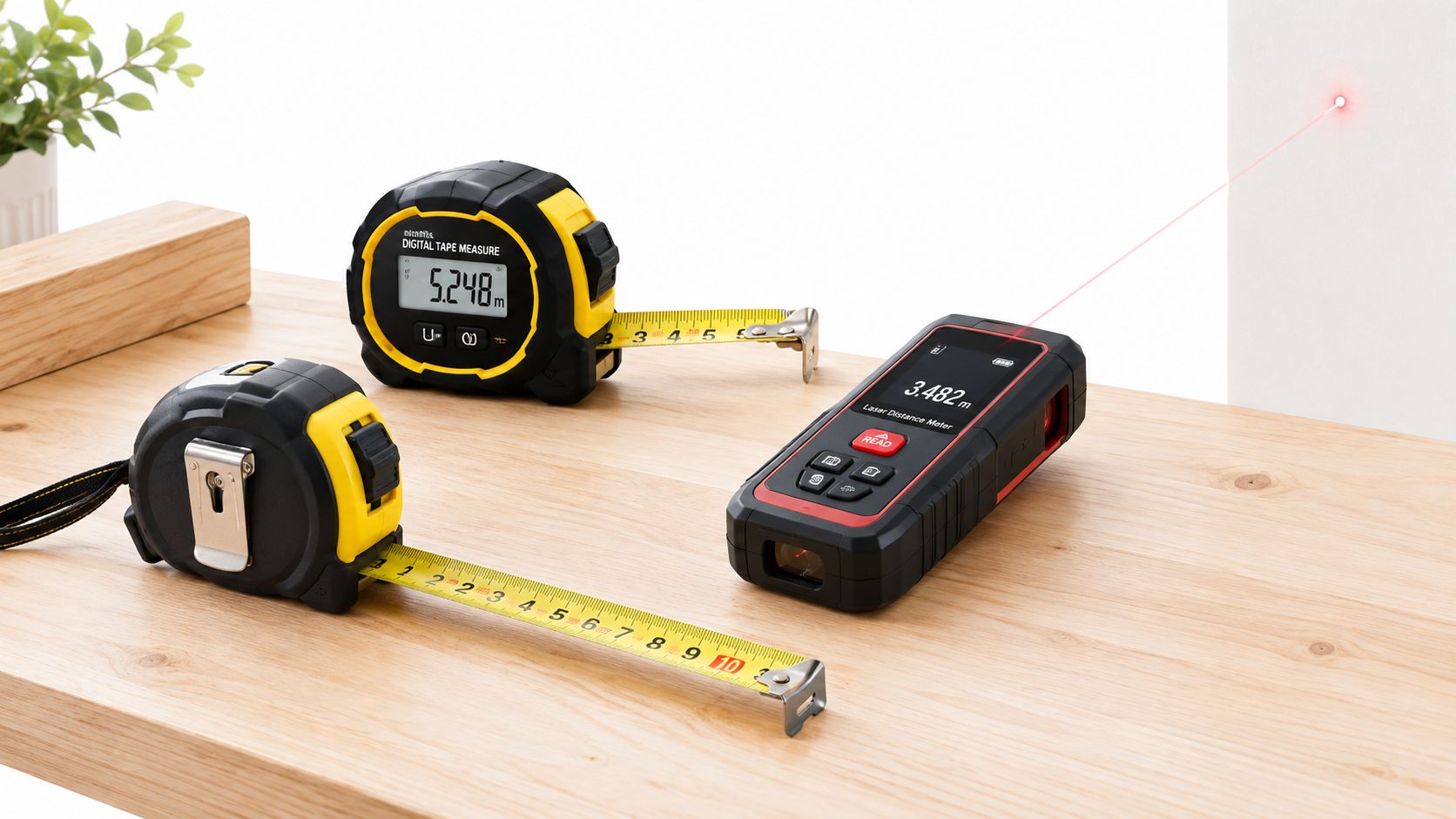
Laser, digital, and specialty tapes work best as problem-solvers for specific tasks. A standard tape still handles many household measurements well, but some jobs ask for more speed, easier reading, or a different way to contact the material.
Match the upgrade to the job
A laser measure fits long, straight distances where contact is awkward. Measuring wall-to-wall across a furnished room is the clearest example. Instead of stretching a blade over chairs or asking for a second pair of hands, you point, click, and get a reading. It works best when the surface is flat, the path is clear, and you need quick room-size checks more than edge-to-edge contact on a board or pipe.
Digital tapes help most when reading tiny printed marks slows you down. If glare, dim light, or eyesight makes a standard blade frustrating, a display can reduce reading mistakes. The measuring method is still physical. The screen makes the result easier to confirm.
Specialty tapes solve narrower problems:
- Magnetic tapes: Useful for steel studs, ductwork, appliance framing, and other metal surfaces where a hook tends to slip.
- Self-adhesive tapes: Handy on workbenches, table saw fences, jigs, and shop stations where the same reference point gets used again and again.
- Diameter or circumference tapes: Better for pipes, round posts, and containers where a straight blade does not tell the full story.
- Wheel measures or long-open reel tools: Better for property lines, fence runs, and outdoor spacing where distance matters more than fine finish accuracy.
Where physical tapes still win
Physical tapes are still the better choice for contact-based work. Cutting trim, checking cabinet depth, measuring a cushion, or wrapping around a curved object all depend on touching the material directly.
A laser gives distance through line of sight. It does not hook an edge. A digital display shows a number clearly. It does not make a floppy fabric item behave like a rigid board. That difference trips up many buyers.
A simple rule helps. If the object has an edge, curve, thickness, or surface you need to physically reference, start with a traditional tape. If the job is a long, straight span through open space, a laser starts to earn its place.
Signs an upgrade is actually worth it
Upgrade when the same measuring pain keeps showing up in real projects:
- You measure rooms often: A laser saves time on flooring, paint estimates, window spacing, and furniture layout.
- You work around metal regularly: A magnetic hook makes solo measuring less fussy.
- You repeat the same bench setup: A stick-on scale speeds up workshop cuts and stops constant repositioning.
- You misread blades in low light: A digital display can make finish measurements easier to verify.
Industry buying guides increasingly treat laser, digital, magnetic, and traditional tapes as separate tools for separate tasks, not as one-to-one replacements, as explained in China Stationery's overview of measuring tape types and newer specialized designs.
The practical upgrade path is simple. Keep a dependable physical tape for direct measuring. Add a laser if you often measure open spaces. Add a specialty tool only when a repeated task keeps wasting time.
Find Your Perfect Tape Measure at The Granted Solutions
You are in the middle of a project. One job is hanging curtain rods across a window. Another is checking a curved chair seat for a new cushion. A third is spacing pavers across the yard. The best tape measure for those jobs is not the one with the biggest case or the longest blade. It is the one that matches the material, the distance, and how exact the result needs to be.
That simple filter clears up a lot of buying confusion.
For rigid materials and edge-to-edge measuring, a standard retractable tape usually makes the most sense. For fabric, body measurements, or anything that bends, a flexible tape follows the shape instead of fighting it. For long outdoor spans, a long tape gives you reach without forcing a short blade past its comfort zone. For open rooms where you need a fast wall-to-wall number, a laser can save time, but it still works best as a partner to a physical tape, not a full replacement.
A good shopping question is, "What am I measuring most often?" Someone building garage shelves needs a different tool than someone sewing curtains or planning fence posts. In the same way you would not use a chef's knife to turn a screw, it helps to match the measuring tool to the job instead of buying by looks alone.
The smartest takeaway for shoppers
Start with three checkpoints:
- Material: Is it rigid, soft, curved, or far away?
- Distance: Are you measuring a drawer, a sofa, or a room?
- Tolerance: Does the job need rough planning accuracy or precise cut-mark accuracy?
That framework keeps the choice practical. A homeowner marking stud locations and shelf lengths usually needs a dependable pocket tape. A crafter or seamstress needs flexibility more than standout. A person measuring rooms often may want a laser for speed, then a regular tape for trim, furniture, and any spot where a hook and blade give better physical reference.
Where practical tool shopping gets easier
If you are building a home toolkit or replacing a worn-out tape, it helps to browse a focused home improvement tool collection instead of sorting through random options with features you may never use.
Tape measures also make solid gifts because they solve a real problem. New homeowners use them for blinds, shelves, and furniture placement. Renters use them for wall art and storage planning. Workshop users reach for them on nearly every cut. A useful measuring tool earns drawer space by getting used.
The right tape measure will not do the project for you. It will make your marks clearer, your cuts more trustworthy, and your tool kit better matched to the work you do.
Granted Solutions offers practical tools, home essentials, and problem-solving gadgets that make everyday projects simpler, including smart picks for measuring, organizing, and upgrading a workspace or home setup. Shoppers get free shipping, secure checkout, and a 30-day return policy, which makes it easier to buy useful gear with confidence. Explore Granted Solutions to find a tape measure or home improvement tool that fits the way the next project works.
Leave a comment