

What Is a Portable Power Station and Why You Need One

A storm knocks out the electricity just as the refrigerator starts warming, the Wi-Fi router goes dark, and a phone battery drops toward empty. A gas generator can handle substantial loads, but it brings noise, fuel, fumes, and ventilation concerns. A power bank is quieter and easier to carry, yet it usually stops at USB charging and can't run household appliances.
That middle ground is where a portable power station fits. It's a rechargeable battery system with built-in AC outlets, USB ports, DC outputs, an inverter, and battery-management controls in one movable unit. The right model can keep essential electronics operating during an outage, provide power at a campsite, or support a remote workspace without an engine running nearby. Anyone comparing home backup options can also find useful planning ideas in this guide to smart home energy management.
Table of Contents
- When the Power Goes Out or You're Miles from an Outlet
- Understanding How Portable Power Stations Work
- Key Specifications That Actually Matter
- Real-World Use Cases and Applications
- Calculating Runtime for Your Devices
- Battery Chemistry and Long-Term Value
- Safety Certifications and Travel Limitations
- Your Portable Power Station Buying Checklist
When the Power Goes Out or You're Miles from an Outlet
A blackout changes the value of electricity immediately. A refrigerator needs continued power to protect food, a router keeps communication available, and a phone may be the only way to receive updates. Someone camping in a remote area faces a different version of the same problem. Camera batteries, laptops, lights, and portable coolers still need energy, but a wall outlet isn't available.
A portable power station solves that gap by storing electricity before it's needed. Unlike a gas generator, it runs without noise and produces no exhaust while operating. Unlike a small power bank, it can offer household-style AC power alongside USB and DC connections.
Practical rule: “Portable” describes the form factor, not what the unit can legally or conveniently carry on an aircraft.
The category emerged as a distinct consumer product in the early 2010s, after earlier setups commonly combined separate batteries and inverters. A frequently cited milestone is Goal Zero's Yeti 400 in 2013, a sealed lead-acid unit that brought AC outlets, USB ports, and solar input together in one enclosure, as described in this history of portable power stations.
Why the category changed
The technology moved from roughly 45-pound lead-acid boxes with about 200 cycles to approximately 10-pound LiFePO4 units rated for about 4,000 cycles and charging in about an hour, according to the same historical summary. Bluetti's AC200P, introduced in 2020 with a 2,000Wh LiFePO4 battery, also reflected the shift toward higher-capacity, longer-life designs.
That progression matters for buyers. A portable power station is no longer just an improvised emergency battery. It's an integrated off-grid power system whose usefulness depends on the interaction between storage capacity, inverter output, charging options, battery chemistry, and safety controls.
Understanding How Portable Power Stations Work
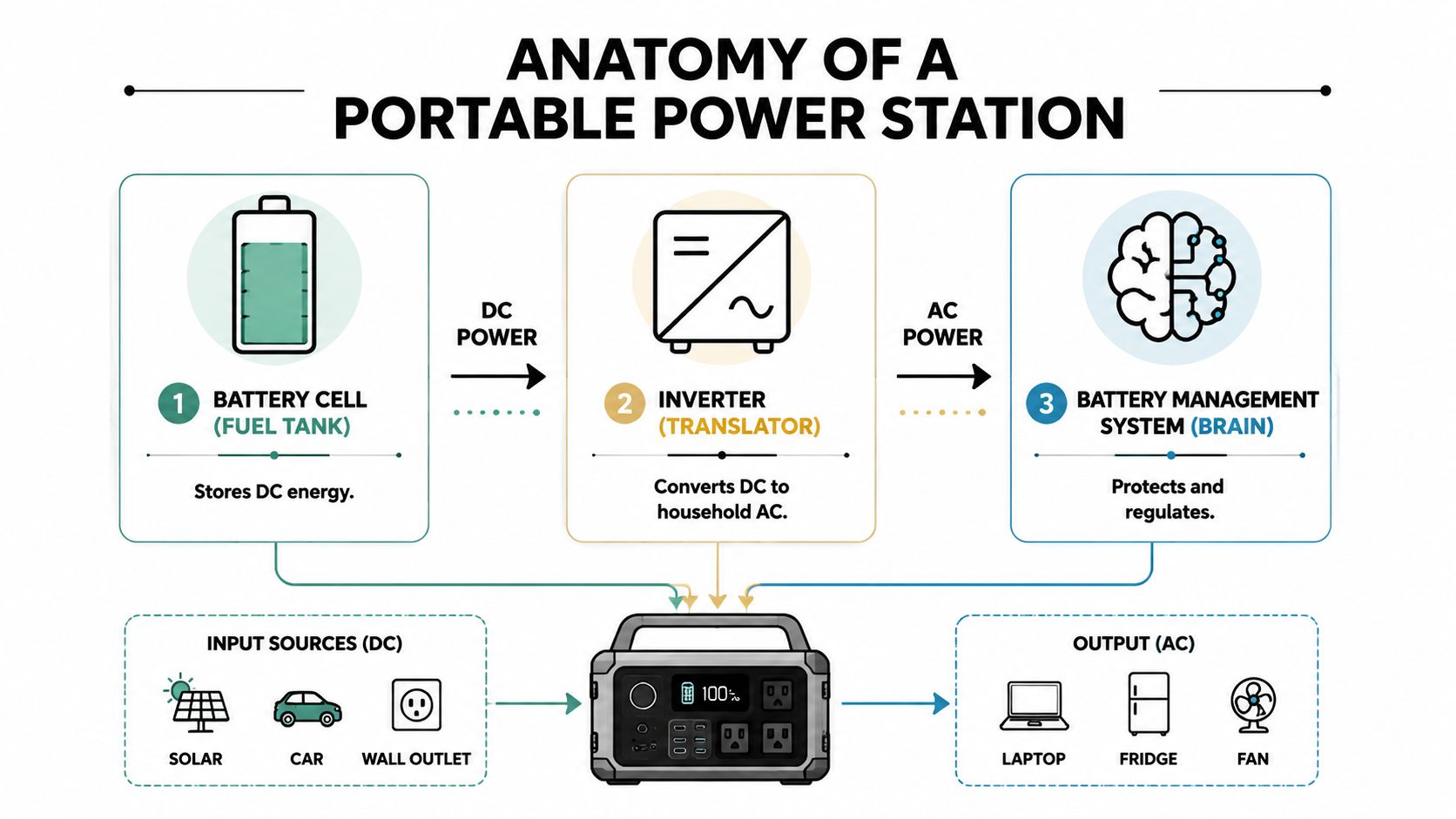
A simple way to understand a portable power station is to follow the electricity through the device. Energy enters through a charging input, sits in the battery, passes through management electronics, and leaves through the output best suited to the connected device.
The internal battery acts like a fuel tank, except it stores energy as direct current, or DC. Most current products use either lithium-ion or LiFePO4, also called lithium iron phosphate. Battery chemistry affects weight, service life, charging behavior, and long-term value.
The inverter works like a translator. Household appliances usually expect alternating current, or AC, while the battery stores DC. The inverter changes the battery's DC electricity into AC electricity for the built-in outlets. A pure sine wave inverter is especially useful for sensitive electronics because it supplies a cleaner, more consistent waveform.
What the ports do
The output panel determines what the station can power directly.
- AC outlets connect appliances, chargers, monitors, and other household electronics.
- USB-A and USB-C ports handle phones, tablets, cameras, and compatible laptops. USB-C Power Delivery can be more convenient than using an AC adapter.
- 12V DC outputs resemble car power ports and suit accessories such as portable coolers, air pumps, and some lighting equipment.
A charge controller manages electricity entering the battery from a wall outlet, vehicle adapter, or solar panel. The battery-management system monitors conditions and helps regulate charging, discharge, temperature, and electrical protection. Buyers don't need an electrical engineering degree, but they should understand that the advertised battery size alone doesn't describe the complete system.
Key Specifications That Actually Matter
Three specifications dominate everyday performance: watt-hours, watts, and cycle life. Each answers a different question.
Watt-hours, or Wh, measure stored energy. They describe the size of the battery's fuel tank. A higher Wh rating generally allows longer operation, assuming the connected device uses the same amount of power.
Watts, or W, measure output capability. This is the size of the electrical pipe. A station with substantial Wh capacity but a modest inverter may run a laptop for a long time but fail to start a high-demand appliance.
The third specification, cycle life, describes how many full charge and discharge cycles the battery can complete before reaching a stated remaining-capacity threshold. Verified guidance commonly places LiFePO4 units around 3,000 to 6,000 cycles to approximately 80% remaining capacity, while older lithium-ion and NMC designs are often rated around 500 to 1,000 cycles, based on battery-life guidance for portable power stations. Ratings are usually measured under controlled conditions, so actual results depend on temperature, charging speed, depth of discharge, and storage habits.
| Tier | Capacity (Wh) | Output (W) | Cycle Life | Best For |
|---|---|---|---|---|
| Compact | 200 to 500 | Device-dependent | Chemistry-dependent | Phones, cameras, lights, small electronics |
| Mid-size | 500 to 1,000 | Device-dependent | Chemistry-dependent | Camping, laptops, routers, coolers |
| Large | 1,000 to 2,000 or more | Device-dependent | Chemistry-dependent | Extended backup and larger appliances |
The planned examples need careful interpretation. A 1,000Wh and 1,000W station may suit weekend camping if the connected devices stay below the inverter's continuous rating. A 2,000Wh and 2,000W unit offers more flexibility for outage essentials, but it still may not run every high-draw appliance for long.
Real-World Use Cases and Applications
The best portable power station depends on the job, not the largest number on the product page. A household preparing for outages has different priorities from a camper carrying the unit between a vehicle and a campsite.
| Use Case | Recommended Capacity | Critical Features | Example Devices |
|---|---|---|---|
| Home outage support | Higher-capacity unit | Pure sine wave output, multiple AC outlets, solar input | Refrigerator, router, lights |
| Car camping | Mid-size unit | Manageable weight, USB-C, 12V output | Portable cooler, laptop, fan |
| Remote work | Capacity matched to daily load | Clean AC output, USB-C, quiet operation | Laptop, monitor, router |
| Emergency preparedness | Capacity matched to essential devices | Solar compatibility, battery protection, expansion options | Lights, communications equipment, small electronics |
For home backup, watt-hours matter because refrigerators and communication equipment may need support across an extended interruption. The inverter's continuous output and surge capability matter just as much, especially for appliances with compressors or motors.
Camping favors a different balance. A smaller, lighter unit with USB-C and 12V ports may be more practical than a heavy model with unused AC capacity. Readers building a broader outdoor kit can compare portable essentials in this camping gear guide for beginners.
Remote workers should look for stable output and ports that match the laptop, monitor, phone, and networking equipment. Emergency kits benefit from solar charging because stored energy can be replenished away from the grid, although solar availability and charging-input limits still affect the result.
Bigger isn't automatically better. A lighter station that recharges conveniently and matches the actual load can be more useful than a high-capacity unit that rarely leaves storage.
Calculating Runtime for Your Devices
Runtime becomes much easier to estimate after separating capacity from load. Start by recording the wattage of every device that may run at the same time. The wattage often appears on a product label, charger, or technical specification sheet.
Add the loads, then divide the station's capacity in Wh by the combined device wattage in W. A basic estimate is:
Runtime = battery capacity in Wh ÷ device load in W
One practical guide recommends applying an 85% working-capacity estimate before dividing by the load to account for conversion losses, as explained in this LiFePO4 power station calculation guide. For example, a 500Wh station connected to a 60W laptop and a 10W fan has a combined load of 70W. The simple calculation is about 7.1 hours, while an 85% usable estimate produces a shorter planning figure.
Watch for startup demand
A refrigerator or pump may use one amount while operating and a higher amount briefly during startup. That's why the station needs both a continuous output rating and a surge rating. A unit can have enough capacity for a device's running load but still shut down if it can't handle the initial spike.
Inverter efficiency depends on the design, load, and thermal management. Independent testing cited efficiency around 85% to 92%, including one lab-validated example of 92.4% AC-to-DC conversion at 80% load, according to this portable power station efficiency overview. Running high-draw appliances such as heaters or microwaves can drain a battery quickly, even when the inverter can technically support them.
A reliable estimate uses the device's actual wattage, accounts for conversion loss, and leaves room for battery aging. The same method can determine whether a compact station suits a short camping trip or whether a larger unit is needed for repeated outage support.
Battery Chemistry and Long-Term Value
Battery chemistry affects more than portability. It determines how often the station can be cycled, how the unit handles frequent use, and how long the purchase may remain useful.
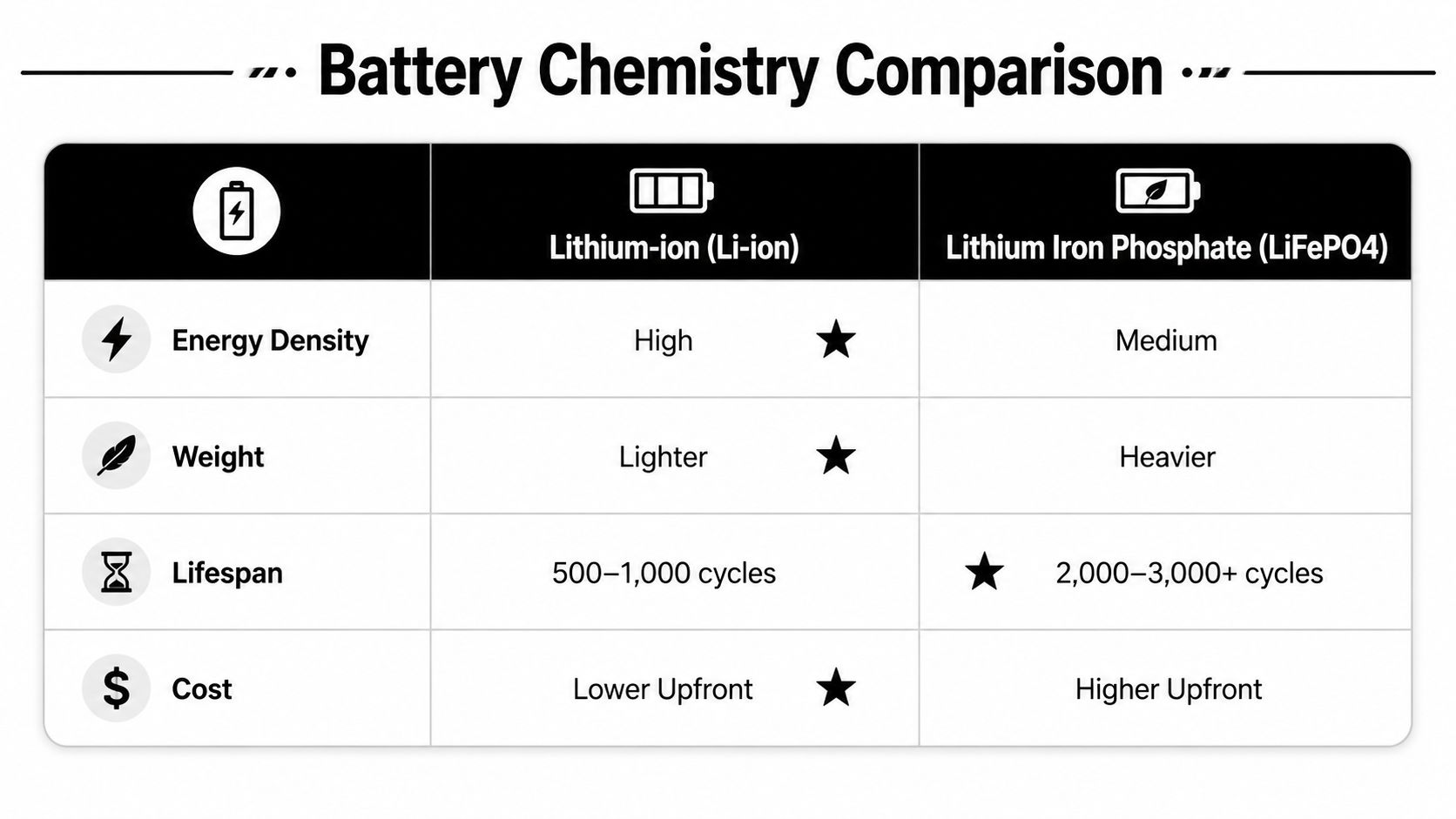
Standard lithium-ion and NMC designs are often lighter and compact because they provide strong energy density. Their cycle-life ratings commonly fall around 500 to 1,000 cycles, while LiFePO4 models are often rated around 2,500 to more than 4,000 cycles before capacity declines to approximately 80%, according to this LiFePO4 portable power station comparison.
Match chemistry to usage
Occasional users may value a lighter lithium-ion unit and a lower initial purchase price. Someone who cycles a station frequently for home backup, van travel, work, or off-grid use may place greater value on LiFePO4's longer rated service life.
Cycle ratings aren't a guarantee of a particular calendar lifespan. Manufacturers and testing sources use controlled conditions, including specified charge rates and temperatures. Higher charging rates can reduce cycle life by about 15%, according to the portable power station battery-life guide. Storage temperature, deep discharges, and poor-quality chargers also affect results.
The useful comparison is total ownership value. A frequently used unit with a longer cycle rating may justify its higher upfront cost, while a rarely used emergency reserve may not need the most durable chemistry available. Buyers should compare the battery type, warranty terms, usable capacity, and charging system rather than treating chemistry as an isolated label.
Safety Certifications and Travel Limitations
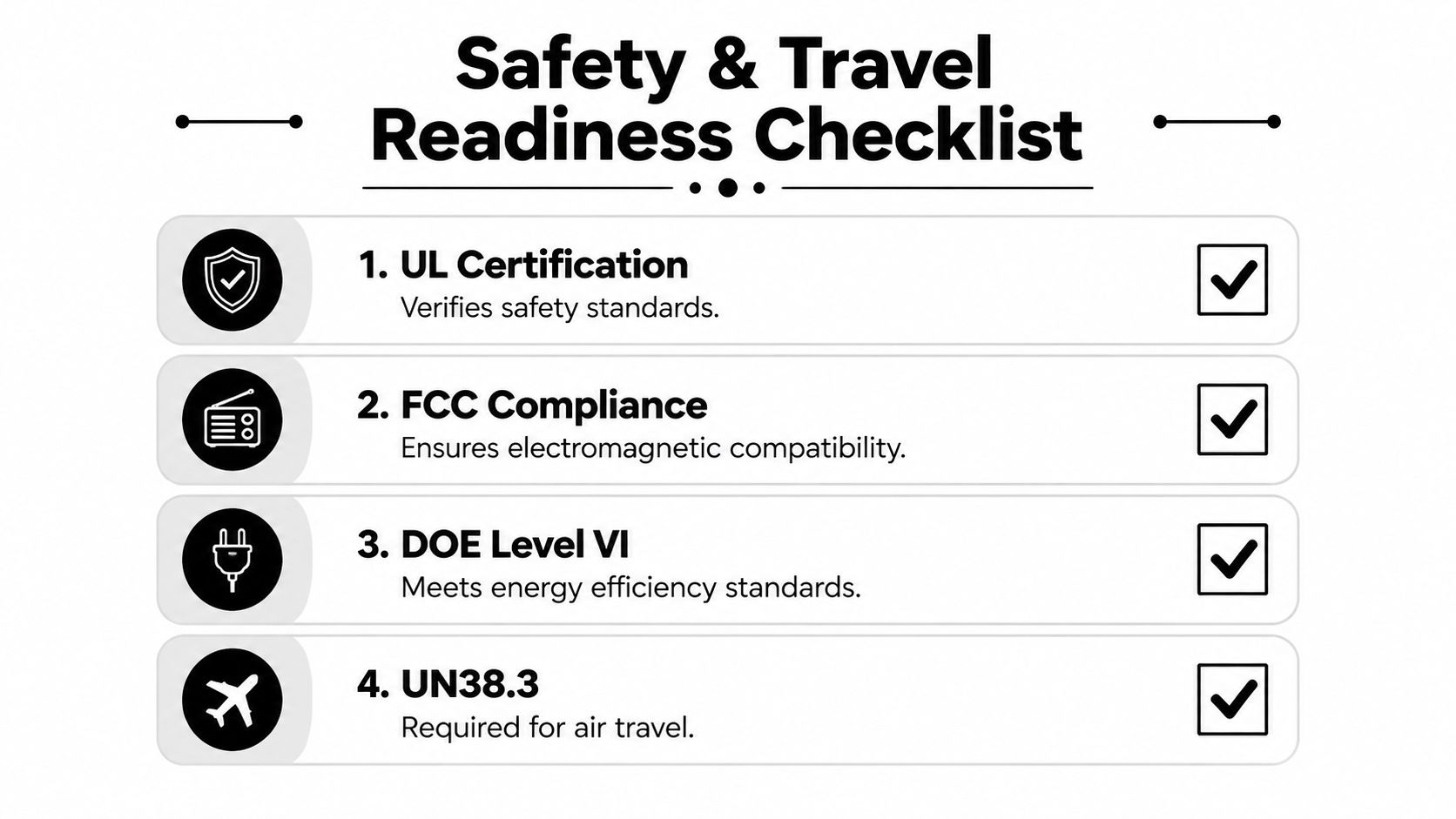
A portable power station can be portable without being suitable for air travel. Lithium batteries over 100Wh are generally restricted, while batteries between 100Wh and 160Wh commonly require airline approval. Larger batteries typically aren't permitted in carry-on or checked baggage, according to this portable power station travel guidance.
That rule eliminates many full-size models from ordinary passenger travel. A compact unit may still require advance verification, and airline policies can vary. Buyers should check the carrier's current requirements before arriving at an airport.
Certifications answer different questions
A safety listing, an electromagnetic-compliance mark, an energy-efficiency requirement, and a transport test aren't interchangeable. Amazon seller guidance identifies portable power stations with UL 2743 and UN 38.3 requirements, while New Zealand has been consulting on a dedicated household safety standard for portable inverters and portable power stations. Those developments are summarized in Amazon's portable power station compliance guidance.
Buyers should look for model-specific documentation, not just a sticker in a product photograph. UN 38.3 concerns lithium-battery transport testing. A UL reference may relate to a particular safety standard or listing. FCC compliance addresses electromagnetic compatibility, while an energy-efficiency designation concerns a different part of product performance.
The safest approach is to verify the exact model, certification scope, manufacturer documentation, charging instructions, and intended indoor-use guidance. “Certified” without an identifiable standard or test record deserves caution.
Your Portable Power Station Buying Checklist
A good purchase starts with the devices, not the product catalog. The following checklist keeps marketing claims secondary to practical requirements.
- List the loads: Record each device's wattage and identify motors, compressors, or heating elements that may create startup demand.
- Estimate usable energy: Convert the planned hours of use into Wh, then account for inverter losses rather than treating the printed battery capacity as fully available.
- Check continuous and surge output: Confirm that the inverter can support both normal operation and startup demand.
- Choose the chemistry deliberately: LiFePO4 suits frequent cycling and long-term use, while lithium-ion may suit lighter, occasional-use setups.
- Match the ports: USB-C, USB-A, AC, and 12V outputs should correspond to the equipment that will be connected.
- Review charging inputs: Wall, vehicle, and solar charging provide different levels of convenience. Check the station's input limits and compatible accessories.
- Verify safety documentation: Look for a specific model, identifiable standard, and supporting documentation. Don't rely on vague certification language.
- Consider movement: Handles, wheels, weight, and storage space can matter more than surplus capacity.
- Treat travel separately: Confirm watt-hour limits and airline approval requirements before selecting a unit for flights.
- Read warranty terms: Check coverage length, battery conditions, exclusions, support channels, and replacement procedures.
The portable power station market is expanding quickly, with 2025 estimates ranging from about USD 4.18 billion to USD 4.45 billion and projections reaching roughly USD 19.91 billion by 2033 or USD 16.27 billion by 2034, depending on the research firm, as reported in this portable power station market analysis. That growth gives shoppers more choices, but it also makes specification checking more important.
A buyer who calculates runtime, checks inverter behavior, compares chemistry, and verifies documentation is less likely to pay for capacity that won't be used or buy a unit that can't handle the intended appliance.
Granted Solutions curates practical gadgets and everyday problem-solving products that make home, travel, outdoor activities, and gifting easier. Visit Granted Solutions to browse useful technology and accessories selected for modern routines, with convenient shopping and dependable support.
Leave a comment