

Lumbar Support for Car Seats: A Practical Buyer's Guide

Four hours into a highway drive, the driver parks, opens the door, and steps out slowly. The shoulders roll first. Then comes the familiar wince as the lower back tries to straighten after spending the entire trip pressed against a seat that never quite matched the body.
That discomfort doesn't automatically mean the car seat is defective, or that a large cushion is the answer. Lumbar support for car seats works best as a fit adjustment between the driver and the factory seat. The right choice depends on the support's height, prominence, material, mounting method, and the shape of the vehicle seat.
Table of Contents
- Why Your Lower Back Begs for Help After a Long Drive
- What Lumbar Support Actually Does for a Car Seat
- Types of Lumbar Support Worth Knowing
- Choosing the Right Fit for Your Body and Car
- Installing and Adjusting Your Lumbar Support
- Care, Safety, and Compatibility Considerations
- Buying Checklist and Quick Answers Before You Shop
Why Your Lower Back Begs for Help After a Long Drive
A long drive exposes a poor match between your body and the seat. The seat pan may roll the pelvis backward, while a flat or lightly shaped backrest leaves empty space behind the lower back's natural inward curve. Instead of resting evenly, the spine and surrounding muscles keep working to hold posture.
Road vibration makes that mismatch harder to ignore. Firm contours create pressure points, and repeated stops interrupt your position without giving your back meaningful recovery. If the backrest provides inconsistent contact, the lower-back muscles make small corrections for hours.
Vehicle-seat research has examined this problem for decades. A classic 1996 SAE technical paper found that prominent, convex lumbar supports did not strongly force drivers into a matching lordotic posture. Increasing support prominence still reduced spinal flexion relative to standing by about 15% (SAE research on lumbar support and preferred driving posture). The practical point is clear: useful support should maintain contact, not create an exaggerated arch.
The missing contact point
Earlier design guidance summarized in a 2000 University of Michigan review placed a fixed lumbar-support apex 200 to 250 mm above the depressed seat surface, or 105 to 155 mm above the H-point, with a mean preferred height of 150 mm above the H-point. It also recommended 15 to 20 mm of prominence.
Those measurements gave automakers repeatable seat geometry. For an external cushion, use the simpler rule: position the thickest section at the lower-back curve, not behind the ribs or shoulder blades. Height matters as much as thickness. A cushion that reaches too high can push the torso forward, while one set too low leaves the actual gap untouched.
Drivers who work on posture at a desk often find the same fit issue in the car. A flat support surface leaves the curve unsupported, but an oversized bolster creates excessive forward pressure. Choose mild, steady contact that lets the seat share the load. Your body and the seat need to fit each other, so match the support's prominence, height, and firmness to your posture instead of choosing the most popular accessory.
What Lumbar Support Actually Does for a Car Seat
After an hour on the highway, a poorly matched seat often reveals its flaw: your pelvis slides, your lower back loses contact, and your shoulders start bracing against the wheel. The problem is usually the fit between your body and the backrest, not a lack of padding everywhere.
Standing keeps the lower spine in a gentle inward curve. Sitting changes the relationship between the pelvis, thighs, and torso. If the backrest does not reach the inward curve, the lower back can flatten, and the body may slump to find stability.
A correctly positioned lumbar support fills that gap near belt-line height. It gives the lower back a steady contact point, supports a mild forward curve, and spreads pressure across the backrest. The goal is balanced contact, not a pronounced arch.
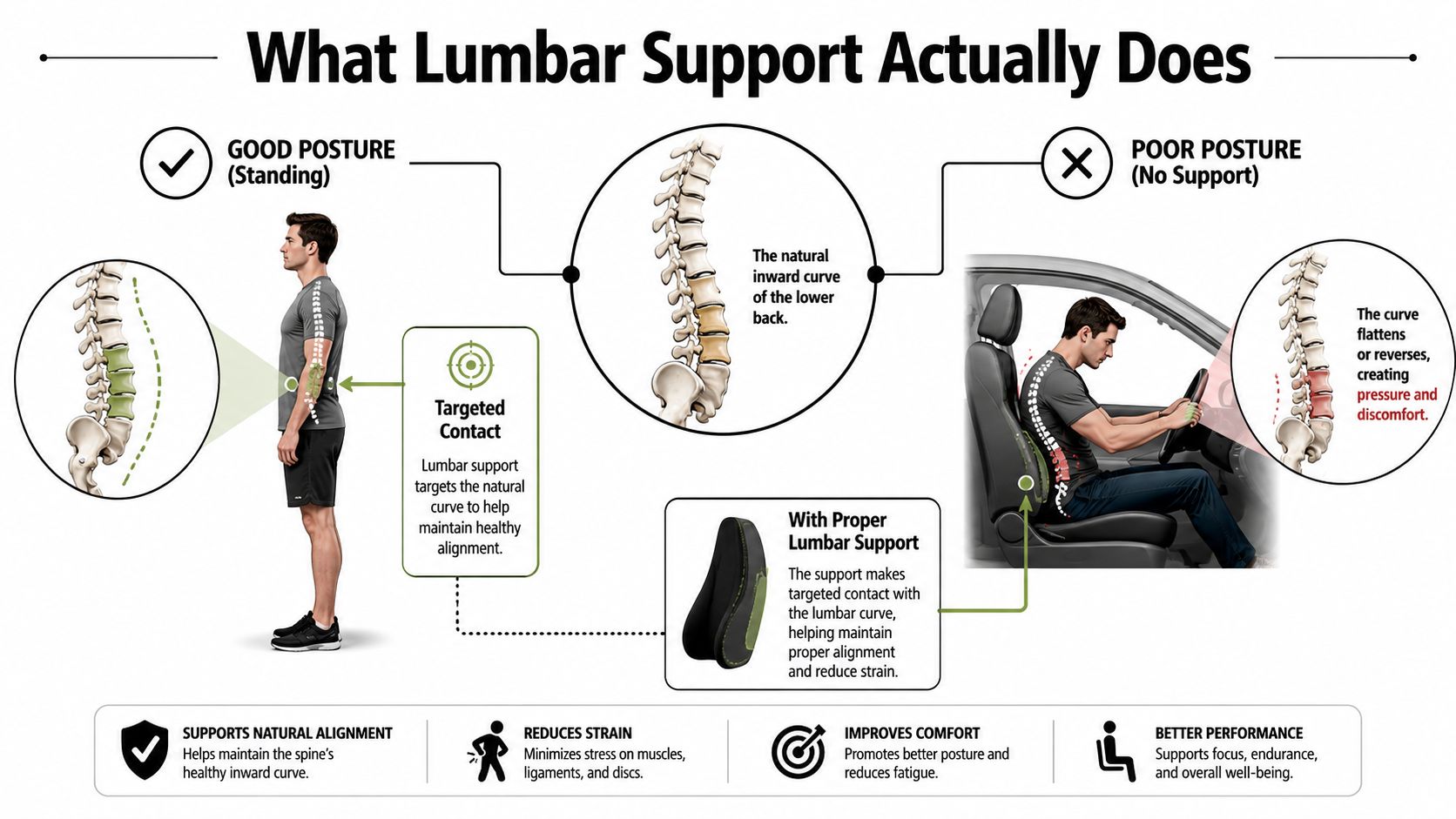
Passive padding versus active support
A soft foam pad provides passive fill. It occupies the empty space behind the lower back, while its shape and firmness remain mostly fixed as the driver moves.
An adjustable wrap, air bladder, or built-in mechanism provides active support. These systems can change height or prominence, which helps when drivers share a vehicle or one driver shifts posture during a long trip. More adjustment is not automatically better. Excessive pressure creates a hard contact point instead of useful support.
Research links lumbar support with changes in posture and comfort. A 2012 PubMed-indexed study found decreased reports of low-back pain during driving exposures, while increasing support from 2 cm to 4 cm increased lumbar lordosis (PubMed study of lumbar support during driving). A separate radiological study recorded lumbar lordosis rising from 20° to 25° to 30° as support increased from 0 cm to 2 cm to 4 cm, while flexion at lumbar disc joints decreased (radiological study of lumbar posture and support prominence).
The right fit can also reduce shoulder bracing, upper-back tension, and pressure spots behind the hips. Stable lower-back contact may leave the legs feeling less tired because the body spends less effort maintaining balance.
Match the support's prominence, height, and firmness to your posture and the seat's shape. A bestseller cannot make that decision for you.
Practical rule: Support should feel like steady contact, not a hard object forcing the spine into position.
Types of Lumbar Support Worth Knowing
A foam pillow is only one option. Each design changes the seat differently, so choose based on the fit between your lower back and the factory backrest, not on a bestseller label.
A basic foam cushion adds shape to a flat seat. Memory foam molds gradually around the body, while high-resilience foam rebounds faster when the driver shifts position. Mesh usually breathes better in warm weather, but its pressure feels lighter than solid foam. For a closer look at how shape affects support, use this ergonomic lumbar support pillow guide.
An ergonomic wrap uses straps to hold support in the lumbar zone. It suits drivers whose bodies do not match the factory seat, especially when the cushion must sit higher or lower. Check strap grip before committing. A cushion that slides during braking or cornering is poorly fitted, whatever its material.
Built-in adjusters use manual cranks, electric buttons, or air bladders. They keep the cabin tidy and work well when the vehicle already includes the hardware. Active systems may add massage nodes, vibrating motors, or inflatable sections that change prominence on demand. These features can help drivers who spend long hours behind the wheel, but they also add parts, controls, and maintenance.
| Type | How It Works | Best For | Trade-offs |
|---|---|---|---|
| Foam cushion | Adds fixed, passive fill behind the lower back | Budget fixes and short commutes | Limited height and prominence adjustment |
| Ergonomic wrap | Uses straps to target the lumbar zone | Taller or smaller drivers who need a precise position | Straps can slip or look untidy |
| Built-in adjuster | Changes support through a crank, button, or air bladder | Cars with existing lumbar hardware | Depends on the vehicle seat and may be expensive to retrofit |
| Active or air-bladder system | Changes pressure or adds massage and vibration | Long driving hours and drivers needing frequent adjustment | More complexity and more settings to manage |
Use a fixed foam cushion when the seat needs modest added shape. Choose a wrap when height matters, built-in adjustment when the car supports it, and an air system when you regularly change posture. The decisive test is contact: the support should meet the natural lower-back curve without forcing the torso forward, crowding the hips, or losing position. A product page full of features cannot correct the wrong prominence, height, or firmness.
Choosing the Right Fit for Your Body and Car
The right lumbar support starts with three questions: How long is the driver's torso? How pronounced is the lower-back curve? What shape does the factory seat already have?
A taller driver often needs a support that reaches higher, particularly in an SUV or truck with a deep backrest. A shorter driver may need a lower mounting point and a slimmer profile. Compact cars with aggressive side bolsters usually work better with a low-profile cushion that doesn't crowd the hips or push the torso forward.
The seat itself matters just as much. A contoured backrest may need only a small amount of added fill, while a flat bench-style seat can accept a broader cushion. Leather can encourage movement if the backing lacks grip. Cloth generally holds straps and friction-fit cushions more securely, although the support still needs firm testing.
Quick decision shortcuts
- Short commuter: A simple strap-on wrap usually makes sense when driving time is limited and the factory seat needs only modest help.
- Long-distance driver: A memory-foam cushion or air-bladder system gives more control for extended highway use.
- Tall SUV or truck driver: A taller support with adjustable height is more likely to meet the lumbar curve.
- Compact-car driver: A slim foam design avoids crowding the side bolsters.
- Shared vehicle: An adjustable wrap or built-in air system is more practical than a fixed wedge.
- Heated-seat owner: A thin, compatible support is preferable to a thick layer that blocks heat transfer.
Body mass also affects durability and compression. Buyers should check the product's stated weight guidance, whether the headrest can be accessed for strap installation, and whether the support is compatible with heated-seat surfaces.
| Driver Profile | Vehicle Type | Recommended Support | Why It Works |
|---|---|---|---|
| Shorter driver with a shallow lower-back curve | Compact car | Low-profile adjustable wrap | It can sit low without adding excessive depth |
| Taller driver with a longer torso | SUV or pickup | Taller cushion with height adjustment | The support can reach the lower-back curve on a deeper backrest |
| Several drivers share the vehicle | Family sedan | Air-bladder or adjustable built-in system | Each driver can set prominence separately |
| Driver sensitive to heat buildup | Any vehicle | Breathable mesh or ventilated foam | The material allows more airflow than dense foam |
| Driver dealing with a flat factory seat | Older sedan or work vehicle | Broad memory-foam cushion | It fills the unsupported area across the backrest |
Research on individual fit supports a restrained approach. One study found that standing lumbar lordosis, selected prominence, height, and mass predicted seated spinal behavior and pressure patterns, and it recommended about 10 mm of adjustable excursion in automotive seats (PubMed research on individualized lumbar-support adjustment). A separate driving-simulation study found that most drivers preferred a setting between 2 cm and 3 cm, and no participant wanted more than 4 cm (study of self-selected lumbar prominence).
Installing and Adjusting Your Lumbar Support
A good cushion can feel wrong if the seat is positioned badly. The installation routine should begin with the driver's distance from the pedals, steering-wheel reach, and seat height, not with the accessory.
A repeatable setup
- Set the driving position first. Move the seat so the driver can operate the pedals without stretching, while the thighs remain supported. Lower the seat if necessary so the added cushion doesn't raise the body too far.
- Recline the backrest. A vehicle-seat adjustment procedure from the Insurance and Harbour or Industrial Safety Association advises about 100° to 110°, followed by fine-tuning until the support creates even pressure without gaps or pressure points.
- Place the thickest point at the belt line. The peak should meet the natural inward curve of the lower back. A support positioned at mid-back height will push the torso forward and leave the lumbar area unsupported.
- Secure the mounting method. Strap-on models should sit tightly against the backrest. A wedge needs a stable friction fit, while a loose cushion should be tested for movement before the car leaves the driveway.
- Test the prominence. Sit for about two minutes and check whether the lower spine feels evenly supported. If the driver feels a sharp pressure point, reduce the thickness or lower the support.
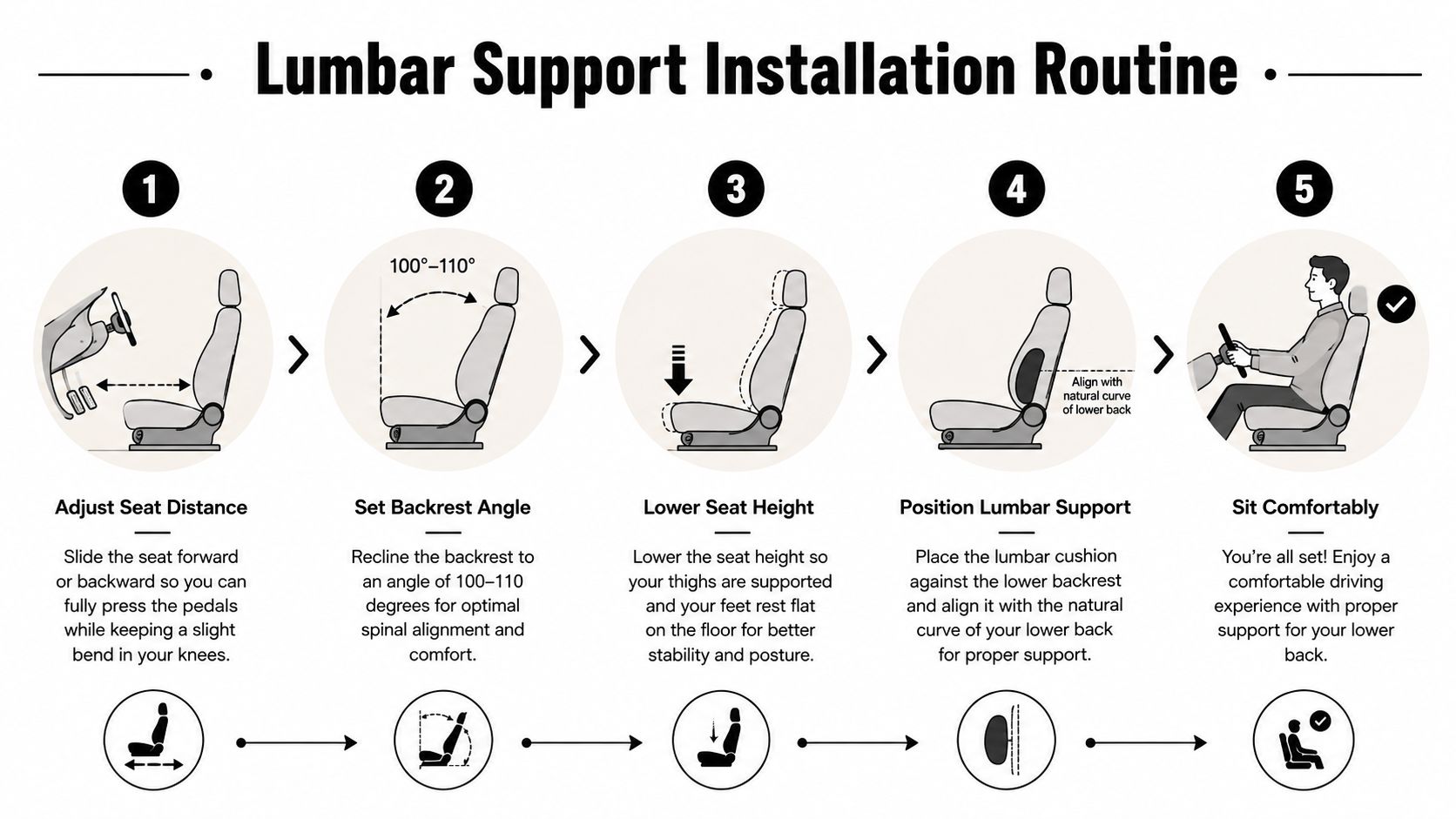
Built-in systems deserve the same gradual approach. Turn a manual wheel or adjust an electric control in small increments rather than moving straight to maximum prominence. Research has shown that support geometry and seat angle work together. In one biomechanical evaluation, adding 4 cm of lumbar support reduced overall lumbar spinal load by 11.30% and lumbar muscle force by 26.24% under a 10° seat-cushion inclination; the study recommended a backrest angle of 29° to 33° with that seat angle (biomechanical evaluation of lumbar load and seat geometry).
The final drive test should be short and controlled. The driver's eyes should remain on the road, shoulders should stay relaxed, and the legs shouldn't develop tingling or pressure. If the support shifts during braking or steering, it isn't installed securely enough.
Care, Safety, and Compatibility Considerations
Lumbar support is a contact accessory, but it sits inside a safety system. The cushion should never cover a side-airbag deployment area or interfere with the seat's original construction. Vehicle manuals and the support manufacturer's placement guidance take priority, particularly when the seat has integrated airbags, sensors, or adjustable heating elements.
Thick memory foam can insulate against seat heaters. That may slow warming, reduce the heat reaching the driver, or trigger shutoffs in some vehicles. A slimmer or more breathable design is usually a safer compatibility choice for drivers who rely on heated seats.
Maintenance that prevents avoidable problems
Sweat and dust collect quickly on a support used during daily driving. A removable, washable cover makes routine cleaning easier, while mesh can help manage warmth during summer. Dense foam should be protected from prolonged direct sunlight, especially in a convertible, because heat and ultraviolet exposure can accelerate material breakdown.
Grip changes with the upholstery. Leather may let a smooth-backed cushion slide, while cloth usually gives more traction. A strap, non-slip backing, or properly fitted wedge can prevent movement, but no accessory should be assumed secure without testing it.
- Airbag zone: Keep the support clear of side-impact deployment areas.
- Seat heating: Confirm that the material and thickness are compatible before using the heater.
- Movement: Press firmly against the support and check for shifting.
- Cover care: Choose removable fabric when the support will be used daily.
- Material condition: Replace foam that has collapsed, split, or lost its shape.
A cushion that moves during a panic stop is a safety problem, not a minor comfort annoyance.
Buying Checklist and Quick Answers Before You Shop
A product page should answer practical questions before a purchase is made. If it only shows a dramatic curve and a long feature list, it hasn't provided enough information to judge fit.
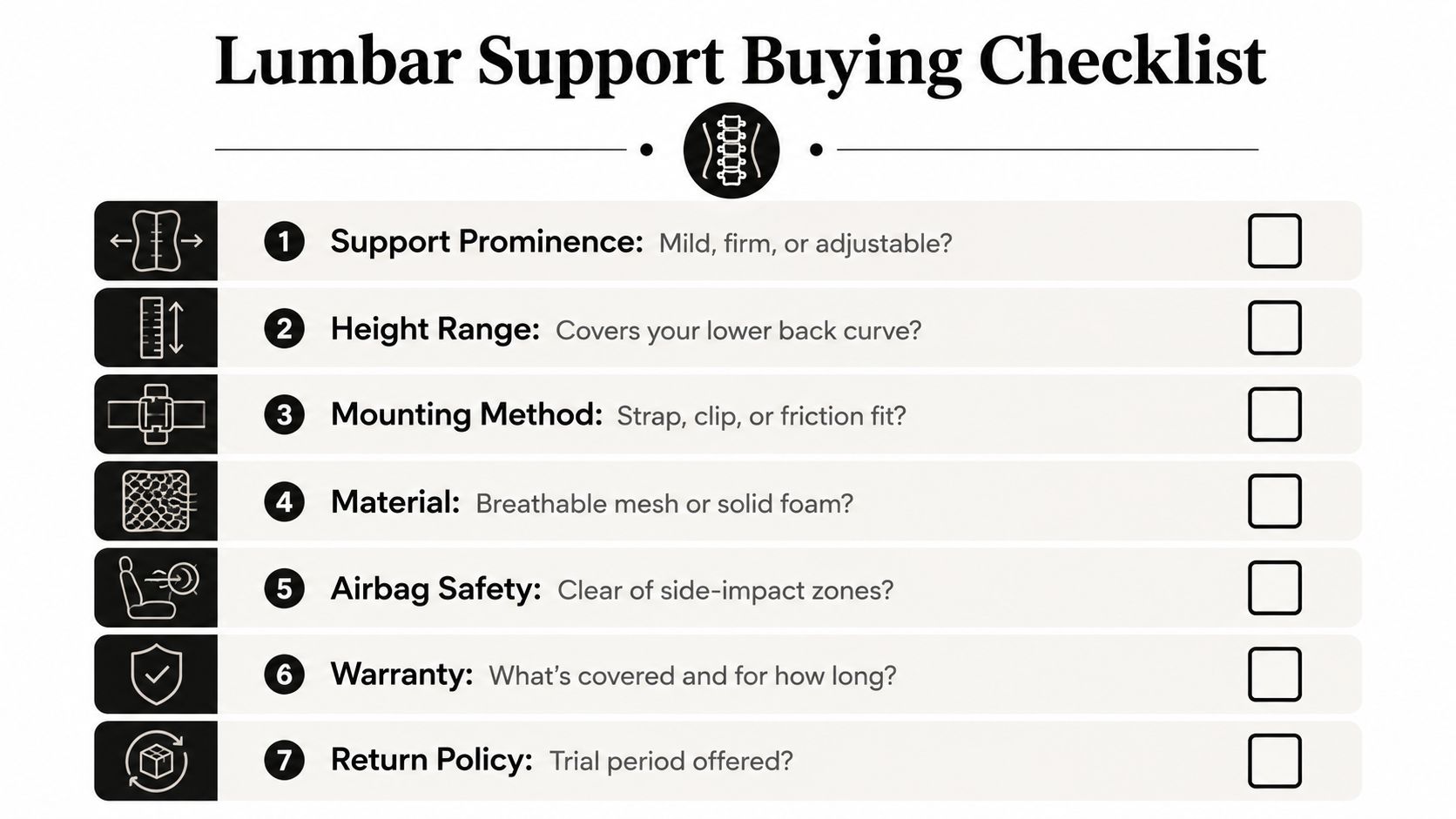
The buyer's short list
- Prominence: Choose mild, firm, or adjustable support based on the gap behind the lower back, not on the largest profile shown online.
- Height range: Confirm that the support can reach the driver's lumbar curve while seated.
- Mounting method: Compare straps, clips, and friction-fit designs for the shape and upholstery of the car seat.
- Material: Pick breathable mesh for heat management or solid foam for more substantial fill.
- Airbag safety: Make sure the support stays clear of side-impact deployment zones.
- Warranty: Check what the manufacturer covers and how long the coverage lasts.
- Return policy: A trial or return option matters because comfort depends on body and seat compatibility.
Common questions from shoppers
Do lumbar supports really help back pain?
They can reduce discomfort for some drivers by changing posture and distributing support, but they aren't a universal treatment. Research has associated lumbar supports with decreased reports of low-back pain during driving exposures, while other findings show that the result depends on support size, position, and seat geometry (PubMed driving-exposure research). Persistent or worsening pain deserves professional medical advice rather than a new cushion alone.
How can a driver tell if a cushion is too firm?
The support is probably too firm when it creates a concentrated pressure point, pushes the torso away from the backrest, or causes the driver to brace through the shoulders. A useful support feels present but doesn't demand attention.
Can it interfere with heating or airbags?
Yes. Thick materials can affect seat-heater performance, and any cushion placed over a side-airbag area can create a serious compatibility concern. The vehicle manual and product instructions should be checked before installation.
How long does adjustment take?
The initial setup can take several small changes to seat position, height, and prominence. The most reliable method is to adjust one variable at a time and take a short drive before deciding whether the support fits.
Drivers who are shopping for a thoughtful wellness gift can also browse gifts for people with back pain, while remembering that a gift recipient's seat shape and preferred firmness may differ from the buyer's.
Granted Solutions offers practical everyday accessories and giftable wellness products alongside home, gadget, fitness, and car-related items, so shoppers can compare problem-solving options in one store. Visit Granted Solutions to explore ergonomic accessories and choose a lumbar support setup that matches the driver, the vehicle, and the miles ahead.
Leave a comment