

Neck Massager Device Guide: Types & Safety Tips

Your neck feels like a rigid clamp by late afternoon. The laptop has been open too long, your shoulders are creeping upward, and a quick search for a neck massager device suddenly feels less like a luxury and more like damage control. That reaction makes sense, because this category has moved from novelty gadget to serious at-home wellness buy, with the global neck and shoulder massager market projected to grow from US$ 4.1 billion in 2026 to US$ 7.1 billion by 2033, a projected CAGR of 8.3% (Persistence Market Research report).
For buyers, the hard part isn't whether neck massagers exist. It's separating the useful ones from the flashy ones, and the safe ones from the risky ones. The best picks keep things simple, deliver targeted comfort, and don't pretend to solve every kind of neck complaint.
Table of Contents
- Why Neck Massagers Are Having a Moment
- What Neck Massager Devices Do
- Percussion, Shiatsu, Heat, and Wearable Designs
- Six Key Features to Evaluate Before You Buy
- Safe Use, Who Should Avoid, and How to Maintain Your Device
- The Practical Buying Checklist for Real-World Use
- Find Your Perfect Relief Match at The Granted Solutions
Why Neck Massagers Are Having a Moment
A desk worker usually does not start the day shopping for a gadget. The need shows up later, after hours of typing, a stiff turn of the head, and one more evening spent rubbing the same sore spot at the base of the neck. A neck massager device fits that kind of problem because it slots into real life without a long appointment, complicated setup, or much effort.
The category keeps growing because the use case is ordinary and repeatable. People want relief at home, on their schedule, and they want something that feels useful on the first try. That is the kind of purchase people keep making for themselves and for someone else, which is why these devices have become a popular practical gift as well as a personal comfort buy.
Why the category keeps expanding
The appeal is simple. Buyers want a device that can calm tight muscles after a long workday, a long trip, or a rough stretch of sleep without turning the whole evening into a routine. The best models do this by combining vibration, heat, kneading, or better ergonomics instead of relying on one weak trick.
That is also why smart shoppers compare comfort, portability, and ease of use before they buy. A device that is easy to grab, easy to control, and easy to store will get used more often than one that looks fancy but feels awkward after the first week. For gift buyers, that matters even more, because the right pick should feel thoughtful without requiring the recipient to learn a new system.
Practical rule: if a product promises comfort, portability, and simple operation, it is aimed at the exact buyer who will use it often.
Office workers, travelers, and people shopping for a useful wellness gift are all looking for the same thing, a product that earns its place through repeated use. A good neck massager device should feel helpful on ordinary days, not only when pain spikes. That is the standard that separates a worthwhile purchase from a drawer filler.
For readers comparing practical wellness gifts, the same logic applies in this guide to affordable tech gadgets. A device earns its spot when it helps week after week, not just on day one.
What Neck Massager Devices Do
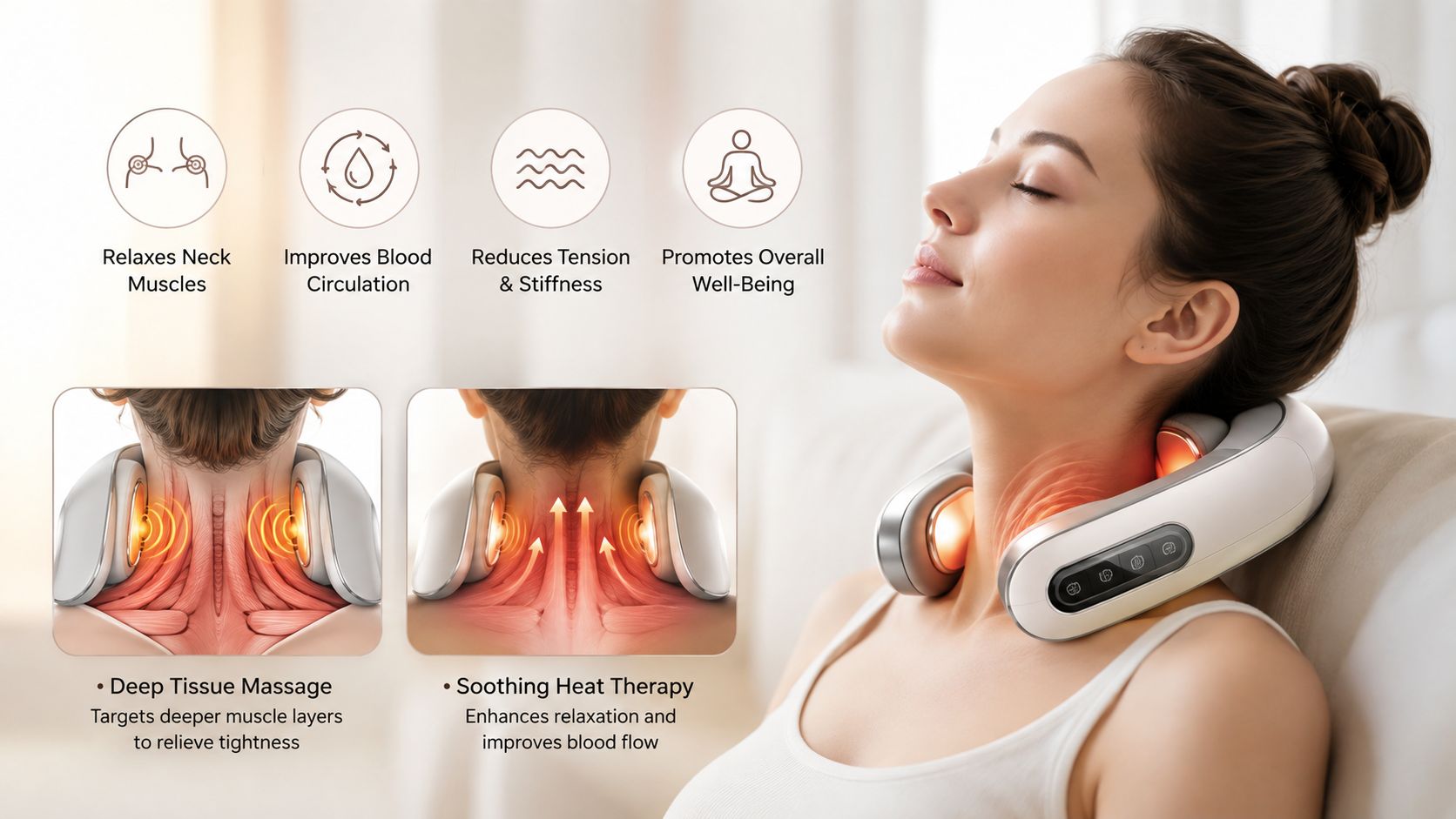
A neck massager device is designed to press, vibrate, knead, roll, or warm the muscles around the neck and shoulders. That mechanical action can ease the feeling of tightness for a while and make movement feel less restricted when the problem is ordinary muscle fatigue, posture strain, or stress-related soreness (Acıbadem International).
The basic mechanism
A good unit works like a compact, battery-powered massage tool for home or travel use. It does not correct an underlying condition, but it can change how tense tissue feels in the moment. That is why a well-made model feels satisfying after a long workday, while an overhyped one quickly feels pointless.
The best devices keep their job narrow. They focus on surface-level discomfort around the trapezius and nearby muscles instead of pretending to solve every kind of neck pain. For mild tension, that restraint matters more than flashy packaging.
What to expect, and what not to expect
A neck massager is a comfort tool, not a cure. It can make a stiff neck feel looser for a while, but it will not erase a deeper problem. If a product claims it can do that, the claim is the problem, not the device.
Treat the device as a controlled massage that should feel steady and intentional, not harsh. That matters even more for people dealing with neck pain, dizziness, or arm tingling, because those symptoms deserve caution instead of aggressive pressure.
A strong reference point is the deep tissue percussion massager guide, which helps separate real high-contact relief from generic vibration claims. Use that standard when you compare styles and decide whether the sensation matches the kind of relief you want.
Percussion, Shiatsu, Heat, and Wearable Designs
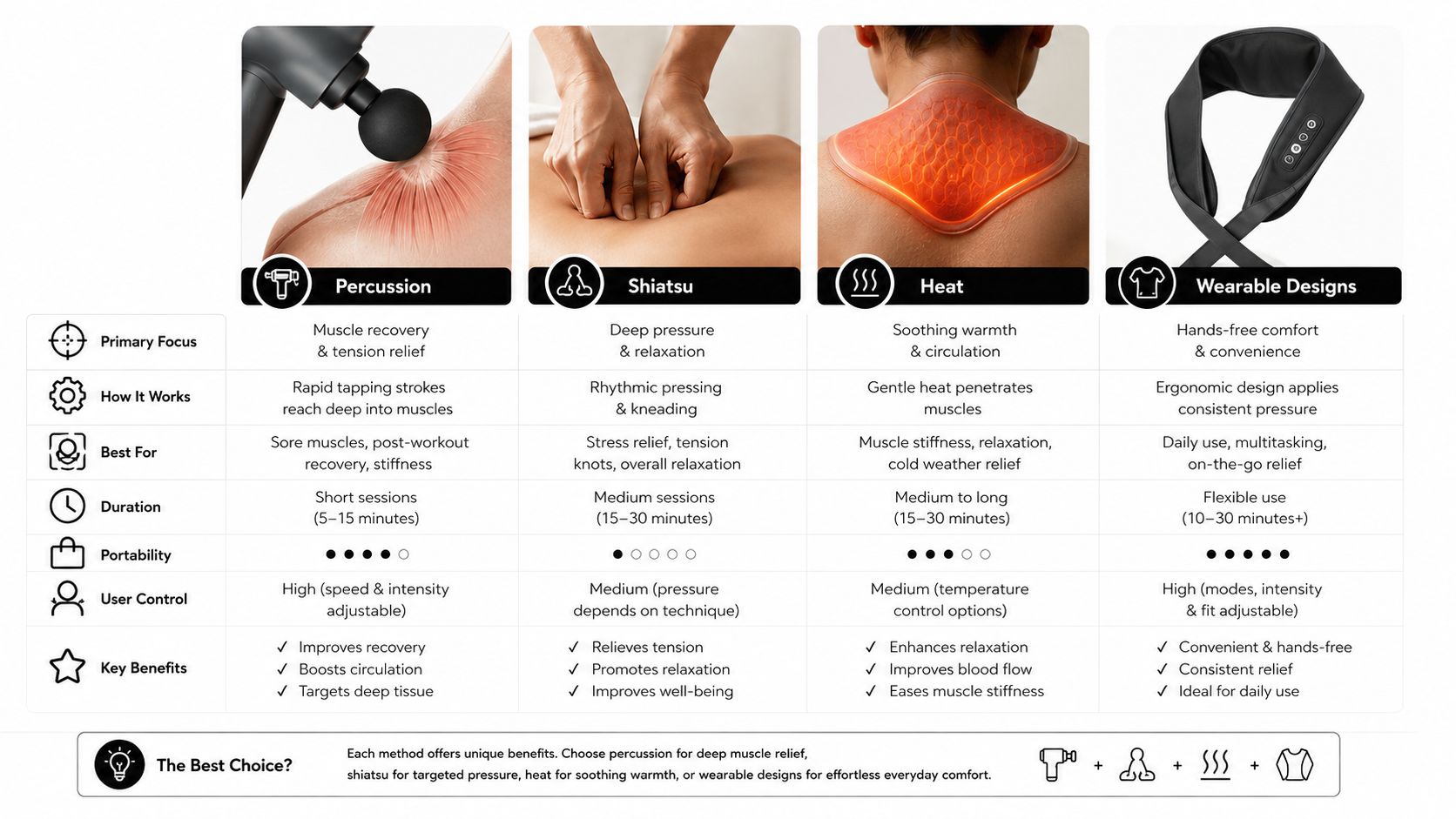
The right style depends on the job you need it to do. A person who wants quick tap-style stimulation will usually hate a bulky kneading unit. Someone who wants hands-free relief during desk work will get more value from a wearable design than from a handheld model that needs constant repositioning.
The four main styles
Percussion devices use rapid tapping. They suit users who want a forceful, punchy sensation, but they can feel too aggressive if the neck is already sensitive.
Shiatsu models rely on rotating nodes that mimic kneading fingers. They fit buyers who want a massage-like feel instead of a buzz or tap.
Heat-focused units add warmth to loosen tight tissue. They usually work best alongside another function, since heat by itself is mainly a comfort boost.
Wearable designs slip on and stay put. They suit busy users who want something they can use while working, reading, or sitting on the couch.
The smart category is also growing in a meaningful way. The smart neck massager market is projected at about USD 1.2 billion in 2024 and about USD 2.5 billion by 2033, with a 9.5% CAGR from 2025 to 2033 (DataHorizzon Research). That points to rising interest in connected or app-enabled products, not just basic one-button gadgets.
What EMS-based models add
EMS-style neck massagers sit in the spec-heavy corner of the market. One FCC-documented model lists pulse durations of 40 to 138 µs, repetition frequencies of 10 to 67 Hz, and a maximum output voltage of 62 V, with single-pulse energy below 10 mJ at 1,000 Ω, plus 1 to 1,000 Hz impulses and 20 to 400 µs pulse width (FCC report). It also lists thermotherapy at 38 to 45°C, which is the kind of detail that tells you the device is built around controlled stimulation, not vague wellness marketing.
Those numbers matter because they shape how strong or tolerable the stimulation feels. Narrower pulse widths and lower frequencies usually point to a gentler experience, while controlled low-to-mid 40°C heat is meant to stay comfortable.
If you want a practical starting point, a portable neck and shoulder massager usually makes more sense than a highly technical device. If you want a more specific stimulation profile, the specs deserve close reading.
Six Key Features to Evaluate Before You Buy
A neck massager can look polished and still disappoint in daily use. The better ones fit the neck well, stay comfortable over time, clean up easily, and avoid the kind of design choices that make a device end up forgotten in a drawer.
What affects daily use
| Feature | Typical Range | Why It Matters |
|---|---|---|
| Battery size | 950 mAh to 2,000 mAh in the Philips examples | A larger battery can support stronger output or heat, but it does not guarantee longer sessions |
| Session timer | 10 minutes or 15 minutes in the Philips examples | Short timers help limit heat buildup and battery drain |
| Intensity levels | 12 levels in one Philips model | More control helps users find a setting that feels right instead of forcing one level on everyone |
| Weight | Under 1.2 kg is a useful ceiling | Heavier devices can cause fatigue during wear |
| Noise | Lower noise is better for shared spaces | Quiet operation makes the device more practical at home, in offices, or while traveling |
| Certification and hygiene | FCC, CE, washable covers, auto shut-off | These are basic trust and maintenance signals |
Philips' PPM3311DB/97 uses a 3 W motor with a 950 mAh battery, 12 intensity levels, and a 10-minute auto shut-off. Philips' PPM3306DB/97 steps up to 5 W and 2,000 mAh, but still limits sessions to 15 minutes. Philips' own product information shows the same pattern across both models, controlled sessions matter more than chasing the biggest battery figure on the box (Philips PDF).
How to read those specs properly
A bigger battery is not the whole story. It may support stronger actuation or heat, but the timer still shows the usage pattern. The right question is whether the device fits a routine you will keep using, not whether it can run endlessly.
Buyer's lens: a good neck massager should feel easy to wear, easy to clean, and easy to trust, because anything else ends up sitting unused.
Certification also matters more than many shoppers think. A product built for repeated use, with a clear shut-off and washable contact surfaces, usually makes a better long-term choice than a flashy model with no maintenance story.
Safe Use, Who Should Avoid, and How to Maintain Your Device
A neck massager is a wellness tool, not a medical fix. That line matters, because some shoppers reach for the device while dealing with dizziness, headaches, tingling, or arm symptoms that can point to something more serious than muscle tightness.
Safety boundaries that shouldn't be ignored
Independent guidance says there is currently no research proving neck massagers are effective for symptoms like dizziness, brain fog, tingling, palpitations, migraines, or tension headaches, and it recommends avoiding use on the front of the neck, over the carotid artery, trachea, spine, or bony landmarks (TheraNeck guidance). That advice is the opposite of the usual product marketing, which is exactly why buyers need to be skeptical.
There's also a rare but serious risk signal. A PubMed case report described a 79-year-old man who developed an acute ischemic stroke after using a handheld neck massager, and the authors concluded that in rare cases, neck massager use can contribute to thromboembolic stroke when atherosclerotic plaque is present (PubMed case report). That doesn't mean the category is dangerous for everyone, but it does mean people with vascular disease risk need to be cautious and medically informed.
Usage and upkeep
Short sessions are the sane default. Evidence-based guidance repeatedly points to 15 to 20 minutes as the practical window, which helps avoid overstimulation or muscle soreness (Biology Insights). Longer use isn't better just because it feels more intense.
Maintenance stays simple.
- Wipe contact surfaces: Clean the areas that touch skin after use so oils and sweat don't build up.
- Use washable covers correctly: Wash them as directed, then let them dry fully before reuse.
- Store it dry: Moisture shortens the life of the device and can make storage messier than it needs to be.
- Inspect cords and seams: Frayed wiring or loose stitching is a sign to stop using the unit.
The safest devices are the boring ones in the best sense. They have boundaries, timers, and enough structure to prevent users from overdoing it.
The Practical Buying Checklist for Real-World Use
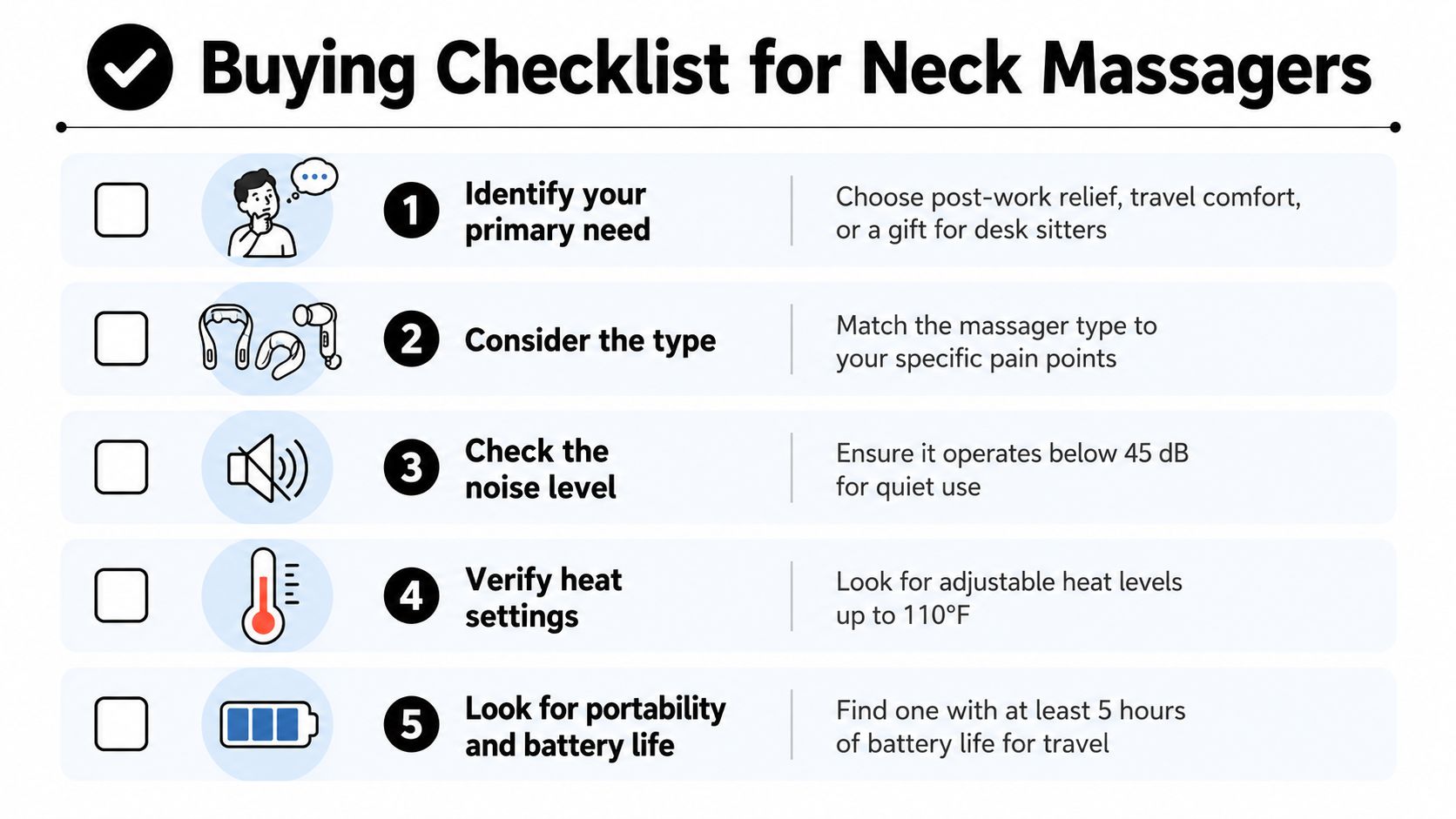
A neck massager should fit a routine, not create one. The smartest purchase starts with the actual user, whether that person sits at a desk all day, travels often, or needs a gift that will get used instead of shoved in a drawer.
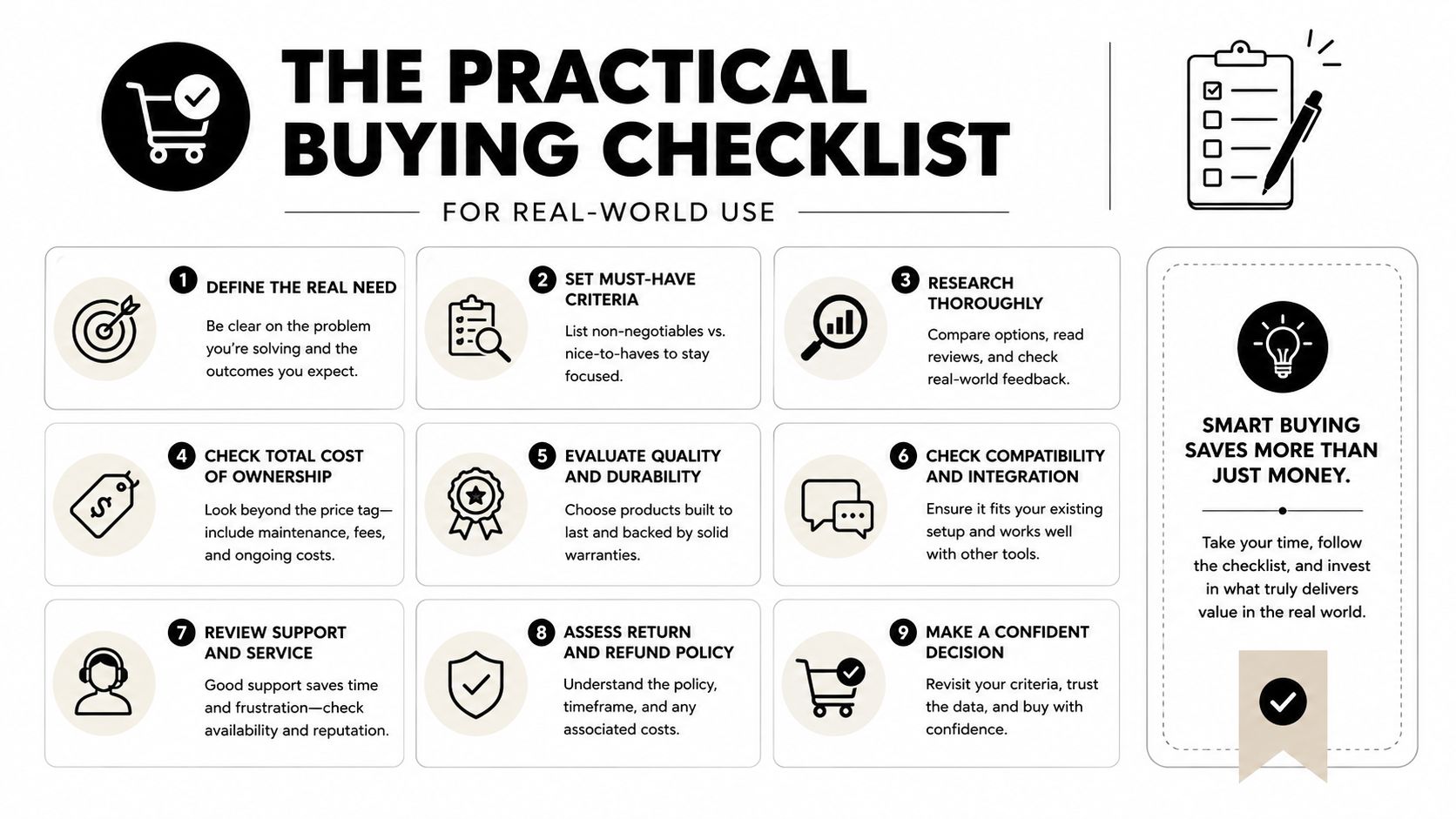
The checklist that separates good buys from regrets
1. Start with the use case. Post-work relief, travel comfort, and gift shopping are three different jobs. A device that makes sense for one usually misses the mark for another.
2. Match the type to the complaint. Percussion, shiatsu, heat, and wearable styles each create a different feel, so the category should match the kind of relief the buyer wants.
3. Judge the fit before the features. A device that does not sit comfortably around the neck becomes annoying fast, no matter how many modes it offers.
4. Pay attention to noise. Quiet operation matters if the device will be used in an office, on a plane, or in a shared living room.
5. Check weight and wear comfort. Heavier units can cause fatigue during longer sessions, so comfort in the hands and around the neck deserves real attention. For buyers comparing options, a practical guide like this portable neck and shoulder massager overview is useful for judging how a device may feel in daily use.
6. Look for auto shut-off. Short, controlled sessions are safer and usually easier on the battery.
7. Read the cleanup story. Washable covers and wipeable surfaces save time and make daily use more realistic.
8. Verify certification and build quality. FCC, CE, and solid construction are not luxury extras. They are trust signals that separate a thoughtful buy from a risky one.
9. Think beyond the first week. A device that stays comfortable after months of use is worth more than one that feels impressive out of the box.
The most overlooked buying metric is long-term comfort. Battery life, noise floor, neck-circumference fit, washable covers, and certification checks decide whether the device keeps getting used or gets abandoned. Safety matters even more for people with neck pain, dizziness, or arm tingling, since those symptoms call for a cautious, well-fitting device and a conservative approach to use.
Find Your Perfect Relief Match at The Granted Solutions
The right neck massager device isn't the fanciest one. It's the one that fits the user's routine, feels safe to use, and keeps earning its place after the novelty fades. That's what smart buying looks like for busy shoppers and practical gift-givers.
The Granted Solutions focuses on useful, trending products that solve everyday problems without adding clutter. For anyone shopping for a desk worker, a frequent traveler, or someone who just wants a better wind-down routine, the smartest move is to choose a neck massager that balances comfort, portability, and ease of use.
Gift buyers should keep it simple. Pick a device with clear controls, short-session safety, and a shape that won't fight the neck. That's the version people will use.
If a neck massager is on the shopping list, visit Granted Solutions to browse practical wellness gadgets, everyday problem-solvers, and gift-worthy picks that are easy to trust. The collection is built for real life, so it's a strong place to find a neck relief option that feels thoughtful, useful, and ready to give.
Leave a comment