

Skin Care Tools Guide for Smoother Healthier Skin
The bathroom counter is crowded, the morning routine is short, and skin still seems unpredictable. One day, cleanser leaves the face feeling fresh. The next, a product sits on the surface, texture looks uneven, and a new gadget promises to fix everything in a few minutes.
Skin care tools can make a routine easier, but they aren't magic wands. The right roller, cleansing brush, LED device, or facial razor acts as a practical helper, matched to a specific skin goal, comfort level, and schedule. The wrong tool, used too often or too forcefully, can create irritation and disappointment.
This guide takes a calm, useful approach. It explains what different tools do, how to match them with skin needs, which features matter when shopping, and how to use them with better hygiene and more realistic expectations. Readers comparing a personal purchase with a gift-worthy beauty accessory can use the same rule throughout: choose the tool for the person and the routine, not for the trend alone.
Table of Contents
- Why Skin Care Tools Belong in Your Daily Routine
- How Skin Care Tools Work From Simple to Smart
- Exploring the Main Types of Skin Care Tools and What They Do
- Choosing Skin Care Tools for Your Skin Type and Goals
- How to Use and Care for Skin Care Tools Safely at Home
- What to Know Before You Buy Skin Care Tools
- Your Next Step to Smoother Skin With the Right Tools
Why Skin Care Tools Belong in Your Daily Routine
A rushed morning can leave cleanser spread unevenly, serum sitting in one area, or moisturizer applied over dry patches. Hands alone can still support a good routine, but a simple tool can give each step a clearer shape and make the motion easier to repeat.
A facial cleansing brush provides a defined contact surface and a short movement pattern. A roller makes a brief massage feel deliberate. A silicone scrubber can encourage enough cleansing time without requiring rough pressure from the fingertips. These tools support a sensible cleanser, moisturizer, and daily sun protection. They do not replace those basics.
Convenience matters more than novelty
Busy shoppers rarely need a cabinet filled with gadgets. The better choice is usually one item that fits an existing habit, skin goal, and comfort level.
- For a rushed morning: A manual roller or compact massager can be used while moisturizer is being applied.
- For an evening cleanse: A soft silicone brush can create a consistent, easy-to-remember motion.
- For a beauty gift: A reusable tool feels more personal than another product with an uncertain shade or scent.
- For a small space: A portable handheld device avoids adding a large countertop appliance.
A toner can also feel easier to use when the surrounding routine follows a clear order. This alcohol-free toner routine helps shoppers view products and tools as complementary steps rather than competing solutions.
Tools support consistency, not instant transformation
The practical benefit often comes from repetition. A tool that is easy to clean, store, and pick up is more likely to become part of daily life than a complicated device left in a drawer.
Practical rule: A simple tool used gently and consistently is usually more useful than an advanced tool that does not fit the owner's routine.
Skin care tools can also work well as gifts because they reflect different habits. A jade roller, gua sha tool, or compact cleansing device may suit someone who enjoys wellness rituals. A facial razor may appeal to a shopper interested in precise grooming. Matching still matters. Sensitive skin, a history of irritation, or reluctance to maintain rechargeable devices can matter more than attractive packaging.
The category now extends well beyond a niche beauty accessory. A 2026 estimate values the global skincare devices market at USD 26.1 billion and projects USD 76.0 billion by 2035, at a 12.6% CAGR, while North America is projected to account for 36.8% share in 2026, according to Global Market Insights' skincare devices market analysis. More devices on the market mean shoppers need clearer criteria for choosing. Start with skin sensitivity, the intended goal, available time, cleaning requirements, and whether the device will be used.
How Skin Care Tools Work From Simple to Smart
The easiest way to understand skin care tools is to separate them into two families. Manual tools use the user's movement and pressure. Electronic tools add vibration, light, electrical current, or powered motion. Both can be useful, but each asks for a different level of attention.
A jade roller is similar to a small massage aid. It glides across the skin and adds a cooling, ritual-like step to a routine. Gua sha uses a shaped edge and deliberate strokes, so the user's pressure and direction matter. Neither tool should be treated as a mechanical exfoliator or a guaranteed lifting treatment.
Cleansing brushes work more like a soft car wash than a harsh scrub. The brush or silicone surface moves across the face to help loosen surface debris, while the user controls pressure and exposure. The goal is controlled contact, not a forceful polishing session.
From movement to electronic functions
Electronic skin care tools use different forms of energy or powered motion:
- Vibration: Powered oscillation can support cleansing or massage, but comfort depends on contact force and duration.
- LED light: Light-based devices use selected light wavelengths as part of a cosmetic routine. Product instructions and eye-safety guidance matter.
- Microcurrent: These devices use low-level electrical current and are generally marketed around toning or lifting sensations. Clear instructions and suitable use are essential.
- Microneedling: Fine needles create controlled micro-injury in the skin. This is a more involved category and shouldn't be treated like a casual roller.
Portable design now shapes the category. More than 60% of new launches are portable or handheld, and more than 45 out of 100 devices include app or AI features, as reported in the global skin care devices market report. App connectivity may help with reminders or settings, but it doesn't automatically make a device more appropriate for sensitive or reactive skin.
A compact neck massager follows the same broader convenience principle as a handheld facial tool. The relevant neck massager device guide can help shoppers compare portability and routine fit without confusing wellness convenience with a universal beauty solution.
The useful question isn't “Which tool has the most technology?” It's “What physical action does this tool perform, and can the user control it comfortably?”
Exploring the Main Types of Skin Care Tools and What They Do
A useful comparison starts with the job a tool performs, then considers the time, skill, and upkeep it requires. A cooling roller suits a quiet ritual, while a facial razor handles surface grooming. Microneedling belongs to a more involved category because technique and hygiene carry greater consequences.
Manual tools for massage and surface grooming
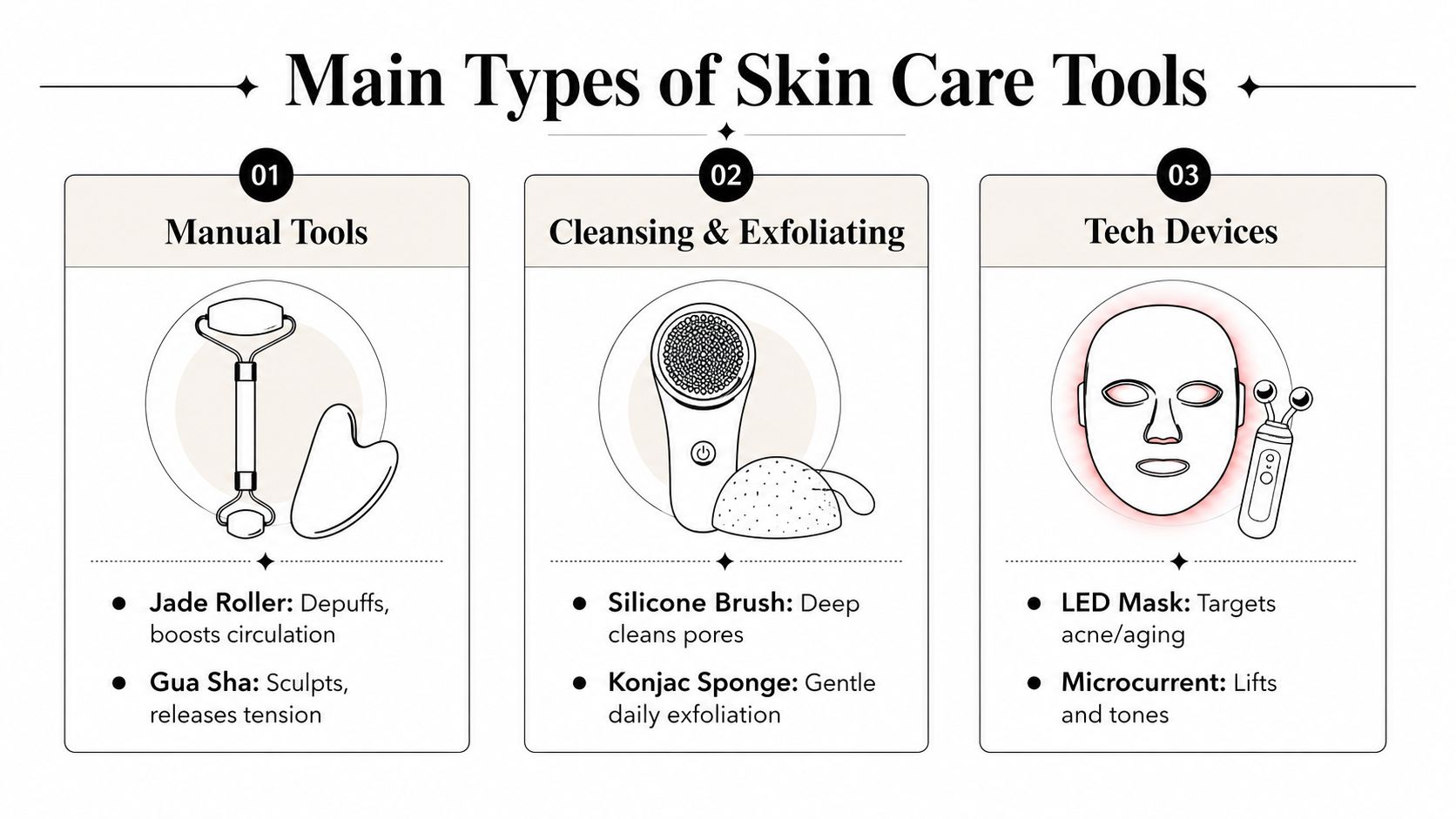
Jade rollers work well for shoppers who enjoy a cooling massage step and want a low-maintenance accessory. They need no charging, make little noise, and can suit a small beauty gift. Their appeal is the experience and simplicity, rather than strong mechanical action.
Gua sha tools encourage slower, more deliberate strokes. Users should keep pressure light and avoid dragging the tool across irritated areas. This format can suit someone who enjoys wellness routines and has the patience to learn controlled movement.
Dermaplaning razors are intended for facial grooming and surface hair removal. Facial razors generated USD 297.6 million in market revenue in 2024, with historical data tracked from 2018 to 2023, according to Grand View Research's facial razors market statistics. That established category sits alongside newer electronic devices, but a razor still depends heavily on careful technique and clean handling.
Cleansing and exfoliating options
Silicone brushes are generally easier to rinse than fabric or bristle tools, so cleaning and drying should influence the purchase. Konjac sponges offer a soft, tactile cleansing experience, yet they also need thorough rinsing and drying between uses.
A powered cleansing brush may suit someone who likes a defined evening routine. A manual scrubber can be easier for travel or for anyone who prefers not to manage batteries. Both require a light touch. More pressure does not automatically produce better cleansing and may make the routine uncomfortable.
Technology-led devices
LED masks, microcurrent devices, and microneedling rollers support more structured routines, but their similar appearance can hide major differences in instructions, intended use, and safety requirements. Check how often the device should be used, what preparation it needs, and how it must be cleaned before treating it as a convenient gift.
The recipient's habits matter as much as the feature list. Someone who enjoys quiet self-care may prefer an LED mask or manual roller. A tech enthusiast may welcome a rechargeable device if they are willing to charge it, clean it, and follow a schedule. Microneedling should not be selected only because its packaging suggests professional-style results.
Use the goal and trade-off as a quick filter:
| Goal | Tool family to consider | Main trade-off |
|---|---|---|
| Cooling massage ritual | Roller | Limited mechanical action |
| Deliberate facial massage | Gua sha | Requires controlled pressure |
| Surface grooming | Facial razor | Technique and hygiene matter |
| Gentle cleansing support | Silicone or sonic brush | Overuse may irritate |
| Tech-based routine | LED or microcurrent device | Higher maintenance and instruction demands |
| Texture-focused procedure | Microneedling device | Greater safety responsibility |
Choosing Skin Care Tools for Your Skin Type and Goals
Selection should start with the skin and the lifestyle, not with the device's feature list. A tool that feels pleasant on normal skin may be too stimulating for sensitive skin. A gadget that suits an occasional beauty ritual may frustrate someone who wants a quick, low-maintenance routine.
Match the tool to the concern
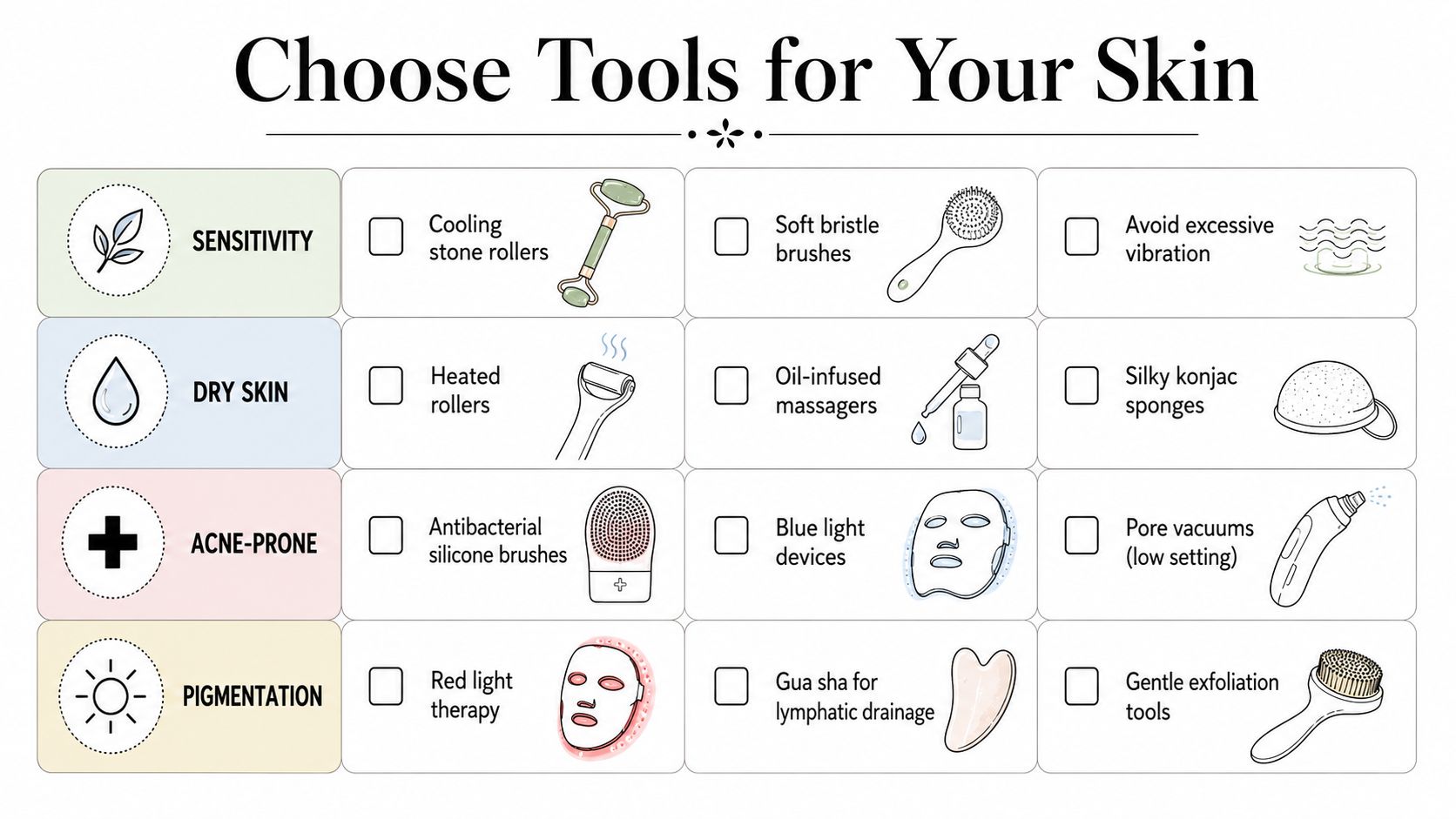
Sensitive or easily irritated skin generally calls for the gentlest approach. Manual cooling rollers may be easier to control than powered exfoliation, while a soft cleansing surface can be preferable to a rough scrubber. Inflamed, compromised, or recently treated skin needs extra caution, and a tool should be paused rather than used to “work through” discomfort.
Dry skin often benefits from routines that prioritize comfort and product application over aggressive exfoliation. A smooth roller can add a soothing massage step, but it won't replace a suitable moisturizer. Oily or acne-prone skin may tempt shoppers toward pore vacuums and forceful brushes, yet pressure and frequency still matter more than a dramatic suction setting.
Pigmentation and melasma-prone concerns require realistic expectations. Light, massage, or exfoliation tools shouldn't be presented as guaranteed ways to erase discoloration. Darker skin tones also deserve the same careful device screening as every other skin type, particularly when heat, light, electrical energy, or intentional skin injury is involved.
Treat microneedling as a separate category
Microneedling isn't a stronger facial roller. A systematic review describes it as a minimally invasive tool for atrophic acne scars and facial rejuvenation, with randomized trials reporting improvements in lines, wrinkles, skin laxity, and texture after a series of treatments spaced about four weeks apart. The proposed mechanism is controlled dermal micro-injury, which activates wound-healing cascades and collagen remodeling, so changes are cumulative rather than immediate, as detailed in the systematic review of microneedling evidence.
A standard dermaroller design has been described as a drum-shaped roller with 8 rows and 192 fine needles, with needle lengths ranging from 0.5 to 2.0 mm, according to a medical review of collagen induction therapy. Another review notes that 0.5 mm or 1.0 mm lengths are usually recommended for aging skin and wrinkles, while pain perception increases as penetration depth rises, as discussed in the literature evaluation of microneedling.pdf).
Use a practical filter before purchase
A useful shortlist asks:
- What is the goal? Massage, cleansing, grooming, or a technology-led routine require different tools.
- How much time is available? A manual roller may suit a brief habit, while an electronic device may require charging and a set schedule.
- What level of sensation is acceptable? Cooling contact, vibration, heat, and needles feel very different.
- Can the tool be cleaned properly? If maintenance feels burdensome, the tool may not be used consistently.
- Does the recipient understand the instructions? A complicated beauty gift can become an unwanted obligation.
How to Use and Care for Skin Care Tools Safely at Home
The common assumption that stronger pressure means better results needs correcting. Skin isn't a countertop that becomes cleaner through harder scrubbing. Contact force, time, cleanliness, and the condition of the skin all shape whether a tool feels supportive or irritating.
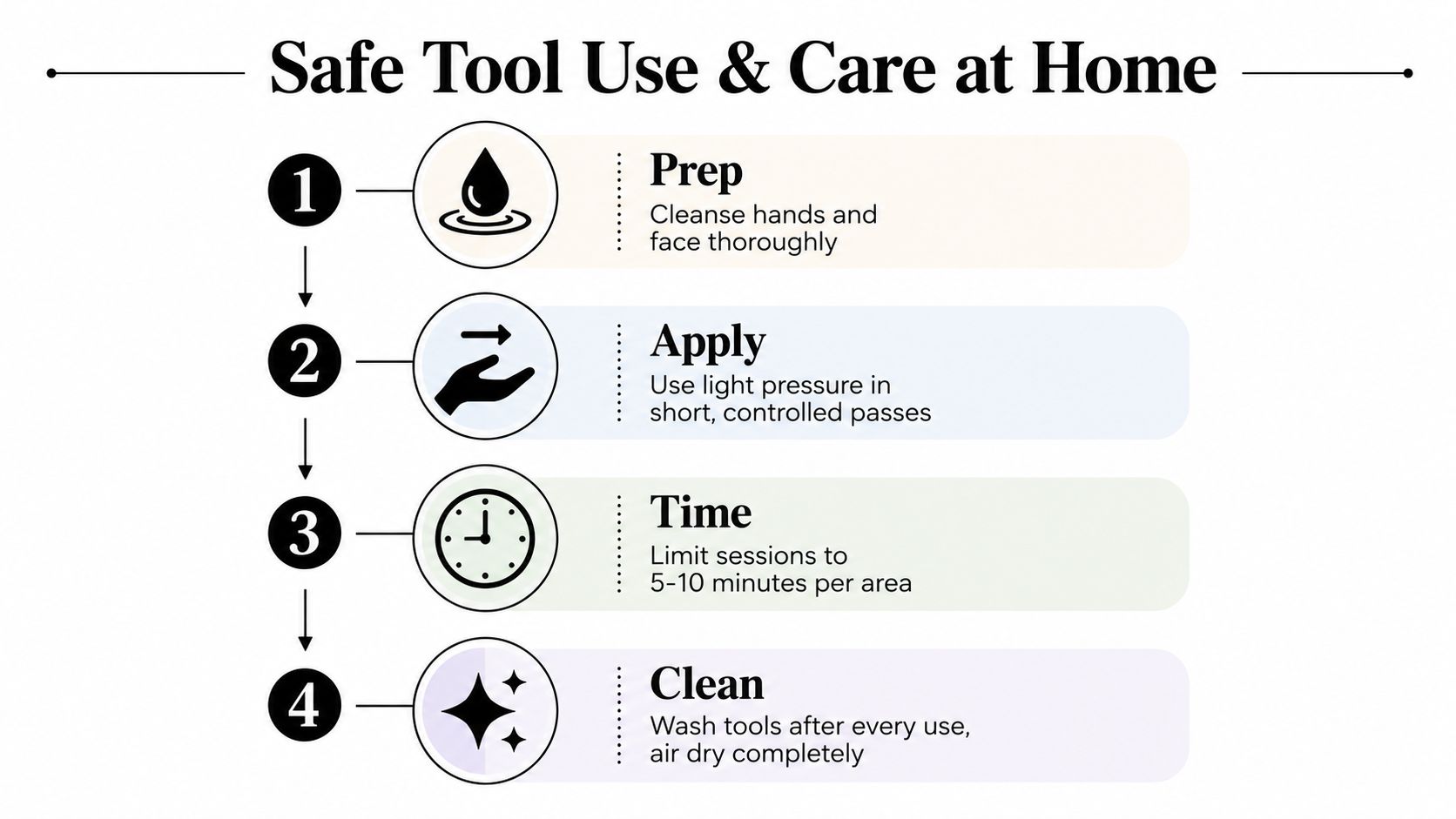
Start with clean hands and a clean face. Read the product directions before the first use, especially for powered devices, light-based tools, heat, suction, or needles. A tool should stay away from inflamed, broken, compromised, or recently post-procedure skin unless a qualified professional has specifically advised otherwise.
A repeatable home routine
Use the following sequence as a general safety framework, while treating the manufacturer's directions as the controlling instructions:
- Prepare the surface: Cleanse the face and hands, then inspect the tool for residue, damage, or worn parts.
- Begin gently: Use light pressure and short, controlled passes. Avoid repeated movement over the same patch to create a stronger sensation.
- Watch the skin: Stop if burning, sharp pain, unusual swelling, or persistent discomfort develops.
- Clean immediately: Wash the tool according to its instructions, rinse away cleanser or residue, and let it air dry completely.
- Store it carefully: Keep the tool in a dry, clean place where it won't touch makeup, towels, or other unwashed accessories.
- Replace what needs replacing: Bristles, heads, blades, and disposable or single-use components shouldn't be kept past their intended condition.
Clinical testing of a sonic brush protocol used light pressure and five overlapping circular motions per facial region, reflecting a goal of mechanical cleansing with minimal abrasion rather than aggressive scrubbing, as described in the clinical facial cleansing protocol. That doesn't create a universal home prescription, but it offers a useful reminder that controlled contact is preferable to force.
Care is part of the product
A brush that stays damp can become unpleasant to use. A roller left on a makeup-covered counter can transfer residue. A facial razor stored without protection can lose its edge or become unsafe to handle.
A dedicated accessory such as a makeup brush cleaner can also help organize the wider beauty routine, although it shouldn't be assumed to replace the cleaning method specified for a particular skin care tool.
Safety check: A tool promising tightening, resurfacing, or professional-style effects deserves extra attention to its device type, intended use, labeling, and user restrictions.
The U.S. FDA has warned about serious complications reported with certain radiofrequency microneedling uses, including burns, scarring, fat loss, disfigurement, and nerve damage, with some cases requiring surgical repair or other medical intervention, as explained in the FDA safety communication on radiofrequency microneedling. The warning reinforces a simple distinction: a beauty gadget and a regulated medical procedure aren't interchangeable.
What to Know Before You Buy Skin Care Tools
A useful shopping decision balances the intended result against the work required to get there. Feature-heavy packaging can make every device seem necessary, but a shopper should first decide whether manual simplicity or electronic convenience fits the routine.
A buyer's checklist
Start with the tool's action. A facial razor grooms. A roller massages. A cleansing brush creates mechanical contact. An LED mask and a microcurrent device use different forms of technology and require closer attention to instructions. A product description should explain the action in plain language instead of relying only on phrases such as “advanced,” “smart,” or “spa-like.”
Compare maintenance. Manual tools usually avoid charging, but they still need cleaning and storage. Rechargeable devices add convenience for some users and another task for others. Removable heads, drying time, charging accessories, and replacement parts can influence whether a gift becomes part of a routine.
Check comfort and control. A user should be able to adjust pressure, intensity, or exposure where the product allows it. If a device feels too strong at its lowest comfortable setting, it isn't a good match because it has more power.
Consider travel and storage. Compact handheld products are easier to pack, but small parts can be easier to lose. A protective case, simple controls, and a clear charging method may matter more to a frequent traveler than extra app features.
Review trust signals. Clear instructions, appropriate warnings, customer reviews, a transparent return policy, and secure checkout all reduce uncertainty. For a gift, the recipient's skin sensitivity and comfort with technology should guide the purchase more than the shopper's excitement.
Why electronic devices often cost more
LED masks, microcurrent devices, and rechargeable cleansing brushes made up an estimated 50% to 60% of category value in 2026, following double-digit expansion from 2019 to 2025. That value mix helps explain why buyers increasingly encounter higher-priced, feature-rich products, but it doesn't prove that every electronic tool is more effective for every user.
A sensible budget starts with the routine problem. Someone who wants a quiet evening ritual may receive more practical value from a manual roller than from a connected device. Someone who enjoys tracking settings and charging accessories may prefer smart technology. The purchase makes sense only when the features support a habit rather than complicate it.
Granted Solutions offers beauty and health products alongside practical gadgets and everyday accessories, so shoppers can compare gift-friendly formats with routine-focused solutions in one store. Buyers should still check each product's instructions, compatibility, care requirements, and return terms before ordering.
Your Next Step to Smoother Skin With the Right Tools
A busy morning, a sensitive cheek, or a gift recipient who dislikes complicated gadgets can change which skin care tool makes sense. The right choice starts with the person, not the trend. Look for a tool that serves a clear goal, feels comfortable, and can be cleaned without turning a short routine into another task.
Use these four checks before buying:
- Match the action to the goal: Choose massage tools for a massage ritual, grooming tools for surface hair removal, and cleansing tools for controlled cleansing. Technology-led devices make sense only when the user understands their instructions and intended use.
- Match the sensation to the skin: Sensitive or reactive skin calls for a gentle starting point. Persistent discomfort is a reason to stop and reassess, not to increase intensity.
- Match the routine to the lifestyle: Manual tools suit low-maintenance habits. Rechargeable or app-connected devices fit shoppers who enjoy charging, settings, and a more involved routine.
- Match expectations to reality: Microneedling evidence describes cumulative outcomes after a series of treatments, not an overnight transformation. Judge every tool by its specific cosmetic purpose rather than broad promises.
Safety belongs in the buying decision. The FDA states that microneedling devices have been cleared to improve the appearance of facial acne scars, facial wrinkles, and abdominal scars in patients aged 22 years or older. The same source lists possible short-term effects, including bleeding, bruising, redness, tightness, itching, and peeling. These effects generally resolve without treatment after a few days or weeks, as summarized in the FDA microneedling device information. This clearance does not make every at-home product suitable for every person, so check the device label, intended use, and care instructions.
More choices make fit more important. A tool should earn its place by supporting a habit the recipient can maintain, whether that means a compact roller, a simple cleansing accessory, or a clearly labeled device.
A thoughtful beauty gift does not need to promise total transformation. Browse with purpose, comfort, hygiene, maintenance, and realistic expectations in mind. Those checks help turn an appealing tool into a useful part of someone's routine.
Granted Solutions brings together practical beauty and health products, trending gadgets, and gift-ready everyday accessories. Visit Granted Solutions to browse skin care-friendly solutions and choose a personal tool or gift that fits the recipient's goals, comfort, and lifestyle.
Leave a comment