

UV Light to Clean Phone How to Use It Safely

The phone probably touched a kitchen counter this morning, disappeared into a pocket on the commute, landed face-up on a desk, and ended up in a hand at the gym or on the couch. Then it went right back near a face.
That's why so many people look for UV light to clean a phone. Not because they want a lab tool, but because they want a fast daily habit that feels easier than dragging out sprays, wipes, and microfiber cloths every single time.
Used the right way, a UV phone sanitizer can be a practical part of a busy household routine. Used the wrong way, it turns into one more gadget that looks useful but misses the spots that matter.
Table of Contents
- Why Your Phone Needs More Than a Quick Wipe
- How UV Light Cleans Your Phone Without Chemicals
- How to Use UV Light to Clean Your Phone Correctly
- What UV Sanitizers Can and Cannot Do Compared to Other Methods
- How to Choose the Right UV Phone Sanitizer at The Granted Solutions
- Make Phone Sanitizing a Simple Daily Habit
Why Your Phone Needs More Than a Quick Wipe
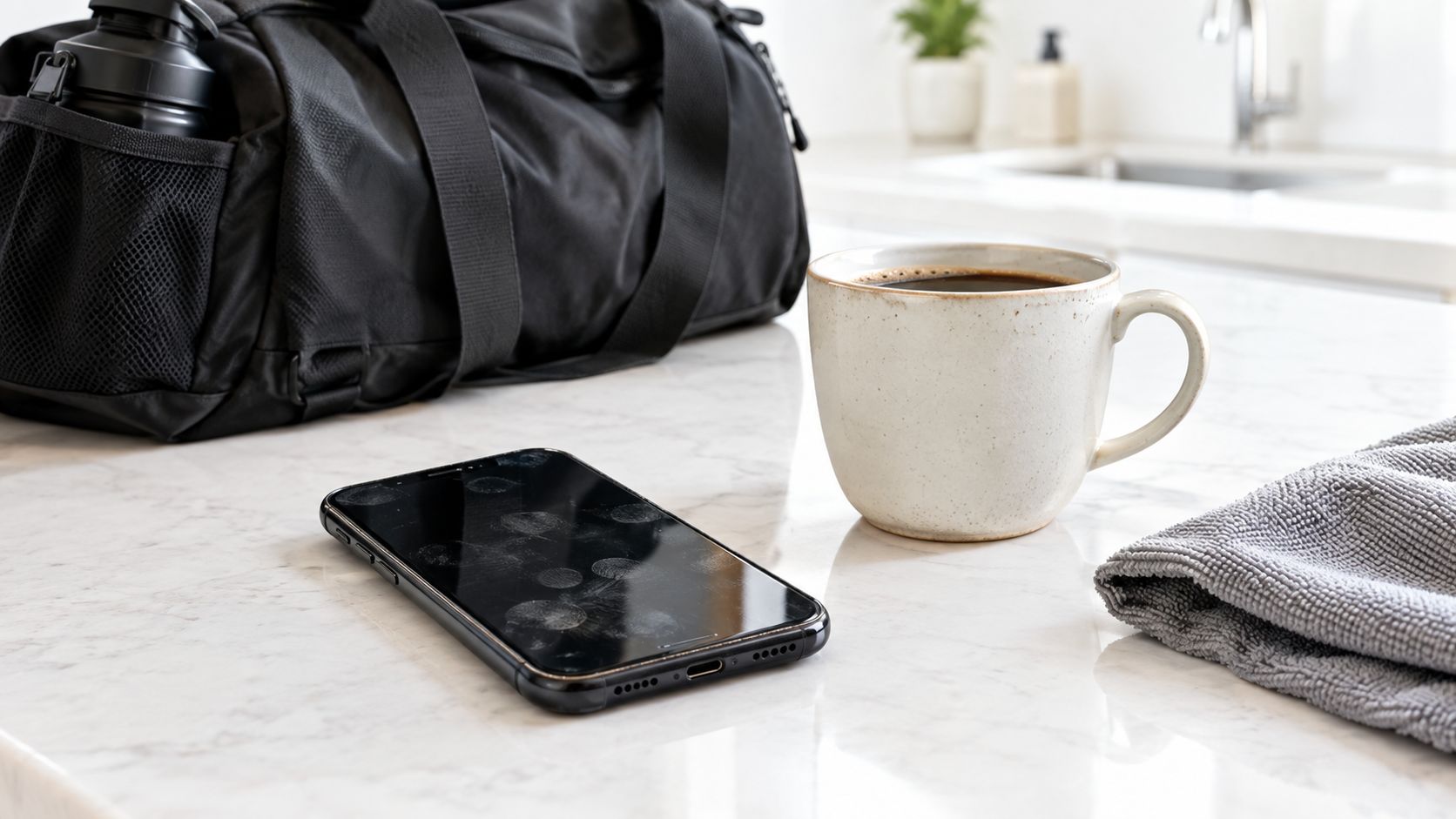
A phone collects smudges in all the obvious places. The screen gets fingerprints. The camera bump picks up pocket lint. The edges around the case trap grime that a casual sleeve swipe won't touch.
The less obvious problem is how often the phone changes environments. It moves from bathroom shelf to car cup holder to kitchen island to nightstand. Each stop adds residue, skin oils, dust, and whatever settled on the surface before it got picked up again.
Wipes help, but they don't solve everything
A quick wipe can remove visible mess. That part matters. But wipes often miss the seams around a case, the edges near buttons, the speaker openings, and the underside areas that never get cleaned unless someone slows down and does it carefully.
That's where a UV sanitizer becomes useful as a repeatable routine, not a miracle fix. The practical appeal is simple. No liquid on the charging port, no streaky residue on the display, and no need to keep rethinking the process every day.
Keep expectations realistic. UV light is best treated as a convenience habit for routine surface sanitizing, not as a replacement for basic cleaning or safe handling.
Why the habit matters more than the gadget
Busy households usually don't need another complicated maintenance task. They need something easy enough to do after commuting, after the gym, after a child borrows the phone, or before setting it on a bedside table.
A good UV box fits that rhythm. Open the lid, place the phone correctly, let the cycle finish, and move on. That's much more sustainable than promising a deep manual clean every day and never doing it.
Key takeaway: A phone gets dirty because it travels everywhere. UV sanitizing works best when it becomes a short, consistent daily habit rather than an occasional cleanup.
How UV Light Cleans Your Phone Without Chemicals
UV-C is the part of ultraviolet light generally used for germicidal applications. A review of UV disinfection research notes that the germicidal range is generally 200 to 280 nm, with the most lethal range described as 250 to 270 nm, and 262 nm identified as optimal for germicidal action. The same review notes that 254 nm is close to that optimal point and is commonly produced by low-pressure mercury vapor lamps, which is why that wavelength shows up so often in sanitizer products (review of germicidal UV-C wavelength ranges).
That's the first filter when shopping. If a product talks vaguely about “UV” but doesn't make clear that it's using UV-C in the germicidal range, that's not enough.
Wavelength matters, but it isn't the whole story
The second filter is dose. The light has to be strong enough, close enough, and applied long enough to do useful work on the phone's surface. The third filter is geometry, which is the part many product listings skip.
If the light can't reach a surface, that surface doesn't get sanitized. Shadows matter. Crevices matter. The angle of the phone inside the device matters.
Coverage is what separates useful devices from weak ones
A review on UV-C device performance states that effectiveness is influenced by distance, wavelength, organic matter, and whether the light can reach folds, crevices, and undersurfaces. The same evidence summary also notes that one handheld-device study using 253.7 nm and 360-degree exposure reduced bacterial load to a minor fraction within one minute, while a separate mobile-phone sanitization study reported at least a 2 log10 CFU/mL reduction in 10 seconds for one device (review discussing geometry, distance, and exposure).
That's why the phrase UV light to clean phone only tells part of the story. The practical question isn't just whether a device emits UV-C. It's whether the sanitizer's design gives the light a real chance to reach both sides and the hard-to-hit edges.
Practical rule: UV-C only works where the light lands. If the phone is blocked by a case lip, stacked on an angle, or partially shadowed, performance drops fast.
A strong UV sanitizer should be thought of like a small enclosed light environment. The better the enclosure and the interior layout, the less likely the phone will have untreated shadow zones.
How to Use UV Light to Clean Your Phone Correctly
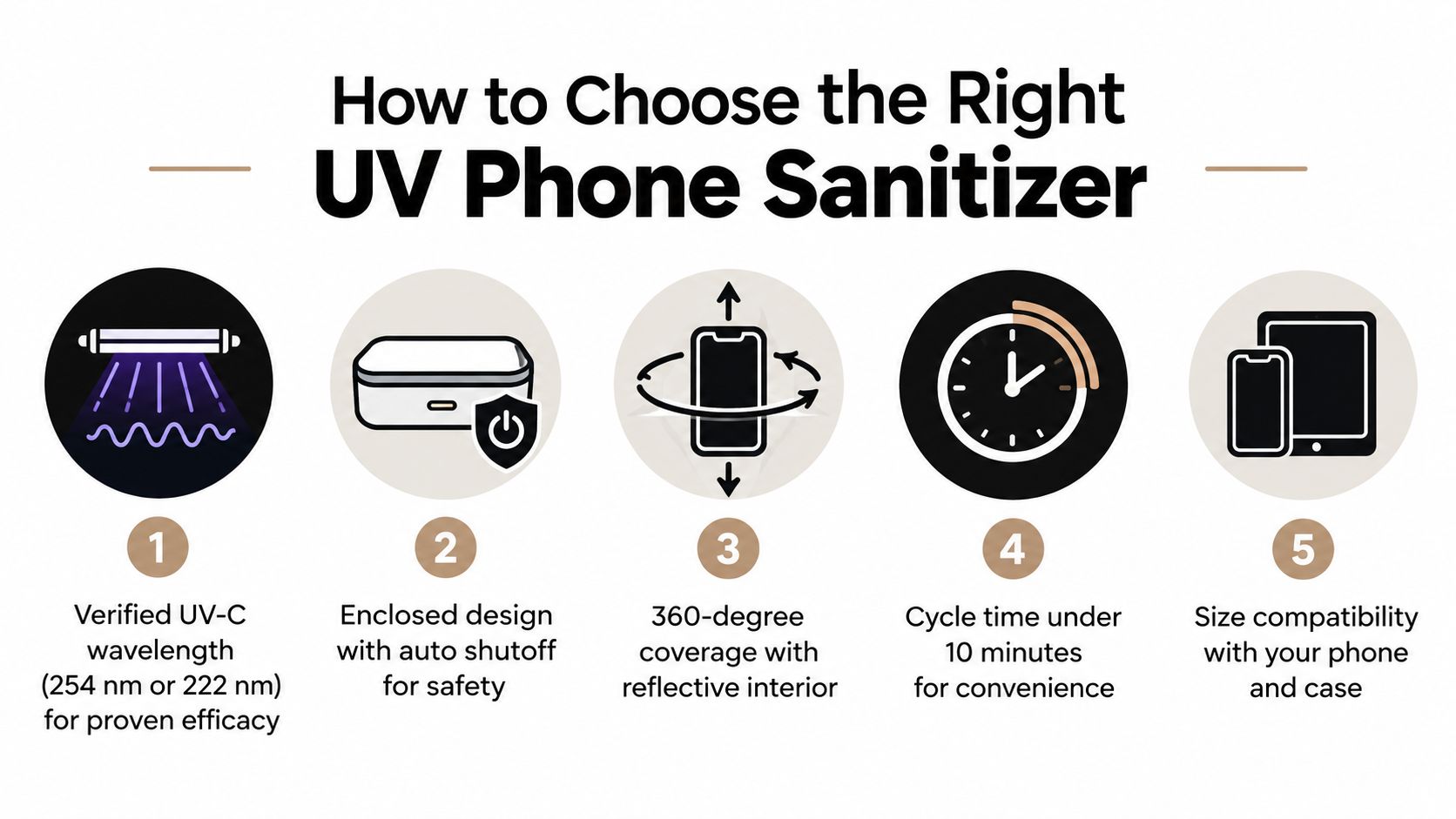
The easiest mistake is dropping the phone into a sanitizer exactly as it was being used. If there's visible dirt, makeup, lint, or oily residue on the surface, that layer can interfere with light reaching what's underneath. A fast prep makes the UV cycle more meaningful.
Start by removing the case if the sanitizer's fit is tight or if the case has thick edges that block exposure. Then wipe off visible grime with a dry or lightly appropriate phone-safe cloth so the sanitizer isn't trying to work through buildup.
Set up the phone for full exposure
Placement matters more than one might think. The phone should sit flat inside the sanitizer, not tilted against a wall or overlapping any other object. If the box is designed for one phone, use it for one phone. Crowding the chamber creates shadowed areas.
Devices with enclosed lids are usually the most practical for home use because they help contain the UV-C and keep the exposure directed where it belongs. Once the phone is placed, close the lid fully and let the cycle run without interruption.
Build it into real daily moments
The most realistic use cases are the ordinary ones:
- After commuting: The phone has been in public spaces, handled often, and set down in the car or office.
- After workouts: Sweat, hands, and gym surfaces all add residue fast.
- After kids use it: Sticky fingers and dropped devices are part of the deal.
- Before bed: Running a cycle at night turns sanitizing into a set-it-and-forget-it habit.
Many portable phone sanitizers in the market are timed in the minutes, not the seconds. An independent product report notes that many portable devices require 5 to 10 minutes per cycle and only sanitize surfaces directly touched by the light. The same report also notes that some products recommend 10 to 20 minutes for effective virus control (independent overview of portable UV-C phone sanitizer cycle times).
That's why the “60-second habit” idea works best as a trigger, not necessarily as the full machine cycle. The habit can take a minute to start. The device itself may need longer.
Keep safety simple
UV-C is useful, but it isn't something to stare at or expose skin to casually. Choose enclosed devices, follow manufacturer instructions, and don't bypass safety features.
A formal UV safety position statement notes that UV exposure limits are a core constraint for disinfection systems, and for 222 nm radiation it reports an actinic UV hazard exposure limit around 240 J/m² (CIE position statement on UV exposure limits). For everyday shoppers, the practical takeaway is straightforward. Enclosed sanitizer boxes are easier to use safely than open-light gadgets.
For people comparing formats, a UV sterilizer wand guide helps show why open UV tools require more care around angle, coverage, and safe handling than a closed phone-sanitizing box.
What UV Sanitizers Can and Cannot Do Compared to Other Methods
UV sanitizers are convenient, but they aren't magic. They work best for routine surface sanitizing when the phone is placed correctly and the full cycle is allowed to finish.
They're less effective when users expect them to blast through heavy grime, reach fully blocked crevices, or sanitize areas the light never touches. Sometimes the best answer is combining methods instead of trying to force one tool to do everything.
UV Light vs Other Phone Cleaning Options
| Method | Best For | Watch Out For |
|---|---|---|
| UV sanitizer box | Daily low-effort routine, dry surface sanitizing, bedtime or post-commute use | Only treats surfaces reached by light. Needs correct placement and full cycle time. |
| Alcohol wipe | Removing visible residue and quick manual cleanups | Can miss seams and ports if the wipe is rushed. Some users prefer to limit frequent chemical contact with screens and cases. |
| Cleaning spray with cloth | General surface cleanup when dirt is visible | Adds moisture management and more handling steps. Not ideal for people who want a fast daily habit. |
| Antimicrobial case | Ongoing convenience for the case itself | Doesn't replace actual cleaning of the phone and screen. |
| Cleaning pen or detail tool | Ports, speaker grilles, camera edges, earbuds case corners | It's a detail tool, not a full-phone sanitizing method. |
Where UV fits best
A UV sanitizer is strongest when convenience is the deciding factor. It's tidy, dry, and easy to repeat. That's a big advantage for people who won't consistently do a full manual clean.
A manual tool still has a place, especially for dust and buildup around small openings. Something like a 5-in-1 tech hygiene cleaning pen makes sense for ports, earbuds, and camera edges that UV light may not fully address on its own.
UV is great for routine maintenance. Manual cleaning is still the better choice when the phone looks visibly dirty.
How to Choose the Right UV Phone Sanitizer at The Granted Solutions
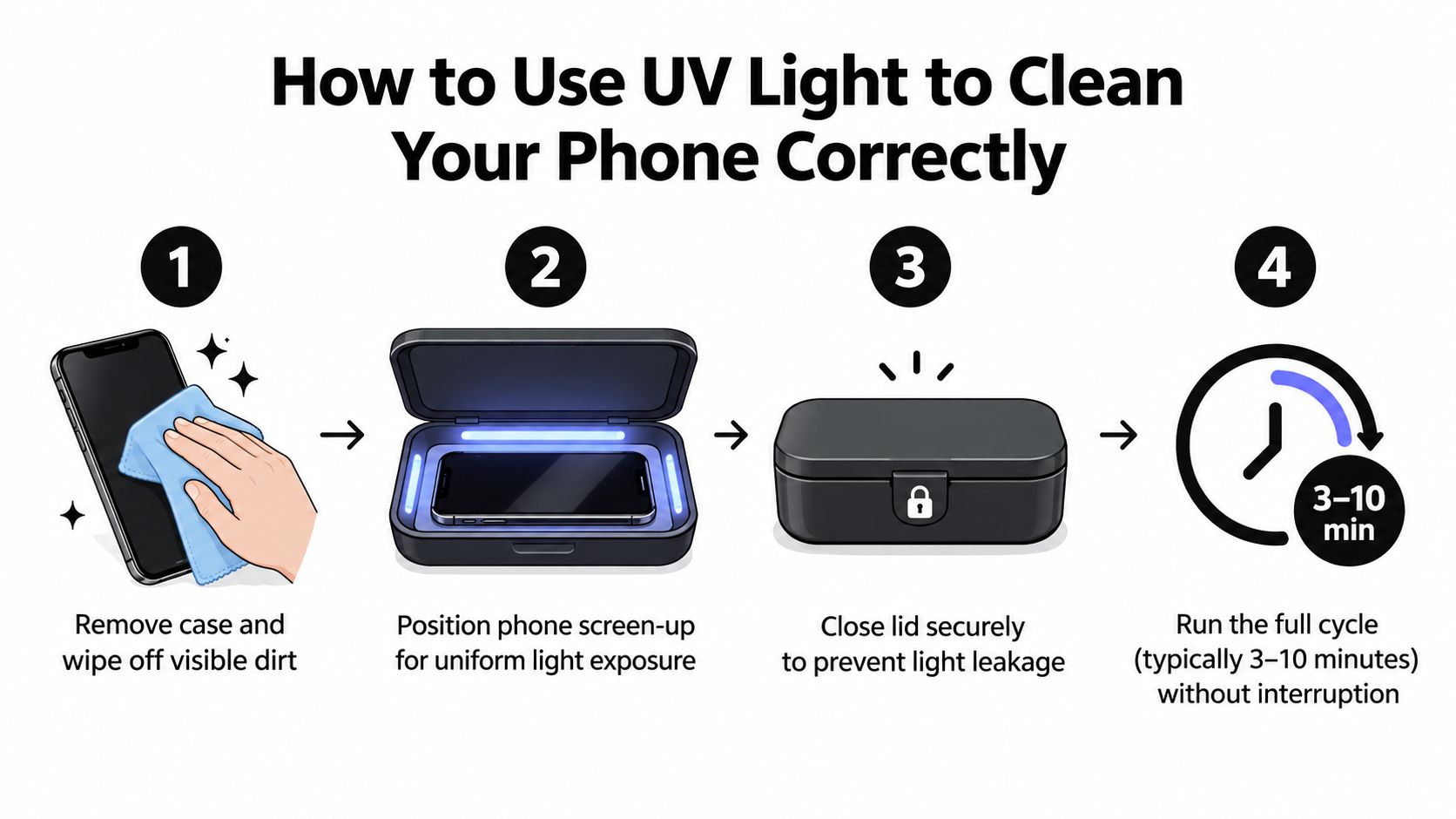
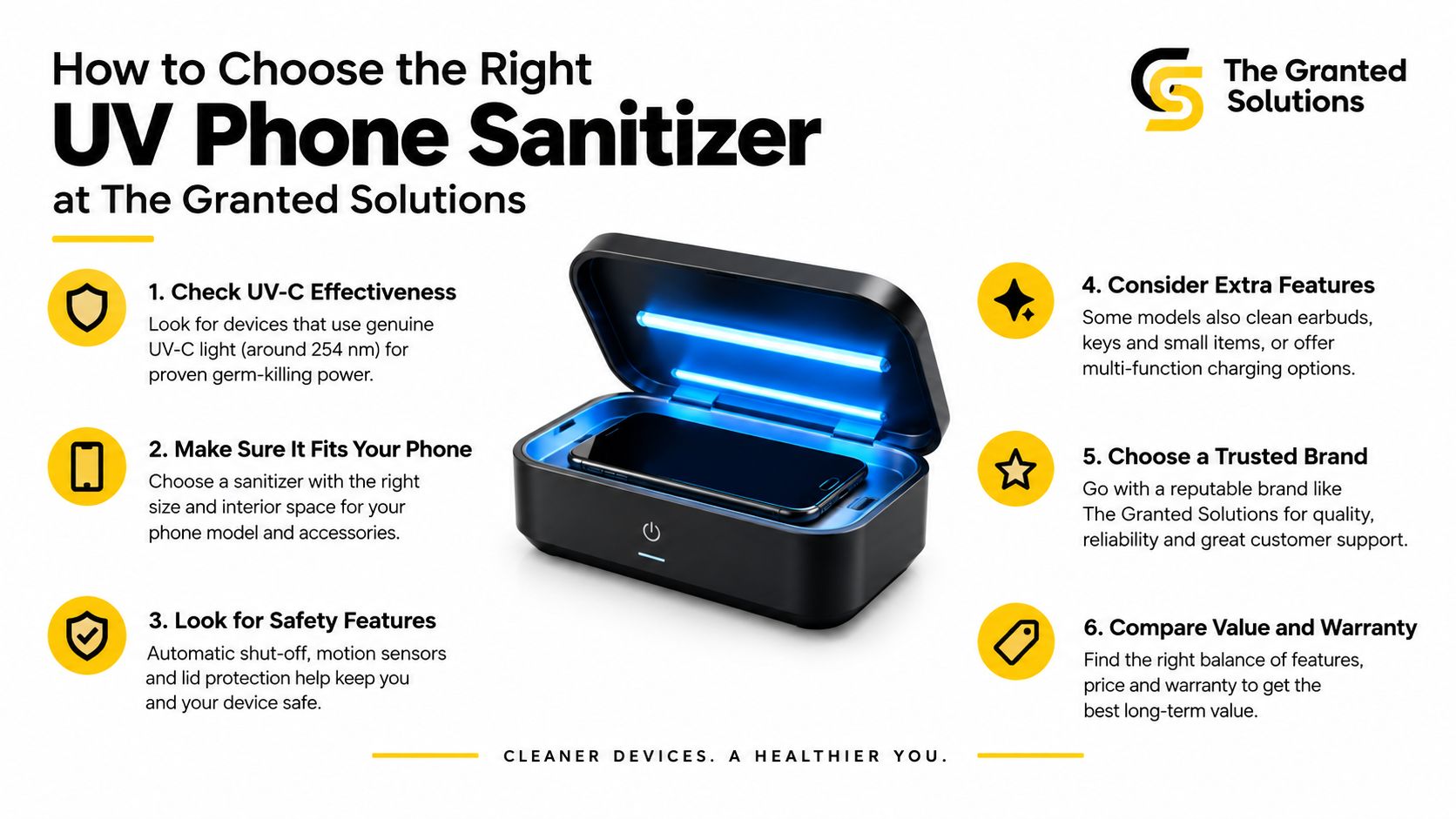
The first thing to check is whether the sanitizer clearly identifies a UV-C wavelength in a germicidal range. The second is whether the design is enclosed, because that usually supports both safer use and more consistent exposure inside the chamber.
The third check is coverage. A phone sanitizer should make it easy to expose both sides or use an interior layout that reduces shadowing. Fancy extras are fine, but they matter less than wavelength, enclosure, and coverage.
The buyer checklist that actually matters
- Verified UV-C range: Look for a device that specifies the wavelength instead of using vague “UV sterilizing” language.
- Closed-lid design: This is the most practical setup for home use and helps avoid accidental exposure.
- Thoughtful interior layout: Reflective interiors and all-around lamp placement can improve real coverage.
- Reasonable cycle time: Faster sounds nice, but complete exposure matters more than marketing claims.
- Size compatibility: Check whether the sanitizer can fit the phone model and, if needed, a slim case.
- Power convenience: USB-powered units are easier to place on a nightstand, desk, or entryway shelf.
Why dose and geometry should influence the purchase
One of the most useful benchmarks comes from a peer-reviewed smartphone sanitization evaluation published in 2018. It found that 254-nm UVC devices delivering a total dose of about 60 mJ/cm^2 and exposing both sides of the phone achieved 100% reduction in aerobic bacterial colonies to zero across all 7 phones tested, showing that UV-C can be highly effective when dose and geometry are sufficient (peer-reviewed smartphone UV-C evaluation).
That single finding says a lot. It doesn't mean every UV gadget performs the same way. It means the details matter. A product that treats both sides and supports adequate exposure is far more convincing than one that glows blue and promises a lot.
For shoppers who want a sanitizer that can handle more than just phones, a portable UVC cleaner for dentures and jewelry points toward the kind of multi-use format that can fit into a bathroom counter or bedside setup without taking over the space.
Good extras are nice, but they come second
Wireless charging, compact styling, and multi-item storage are useful bonuses. They just shouldn't be the reason for the purchase.
The right order is simple. Confirm the UV-C basics first. Then look at convenience features, fit, and whether the device feels easy enough to use every day or easy enough to give as a practical gift.
Make Phone Sanitizing a Simple Daily Habit
The best phone sanitizer is the one that gets used. That usually means an enclosed UV-C device placed somewhere obvious, near the bed, near the keys, or near the desk, where a quick nightly routine can stick.
The core habits are simple. Remove visible grime first. Position the phone so the light can reach it well. Run the full cycle. Handle the device safely and keep expectations grounded in what UV can do.
A UV sanitizer also makes sense as a gift because it solves a small everyday problem without adding clutter. It fits students, commuters, parents, gym regulars, and anyone who likes practical gadgets that earn their spot on the counter.
For shoppers browsing giftable tech, it's also worth checking Trending Now and Best Sellers to compare compact daily-use gadgets that make routines easier.
Granted Solutions curates practical gadgets and everyday problem-solvers that fit routines like this, from UV sanitizing options to smart tech accessories and gift-worthy home finds. Shoppers looking for useful, easy-to-choose products with free shipping, secure checkout, and a 30-day return policy can explore the full collection at Granted Solutions.
Leave a comment