

Power Strip Surge Protection: How to Choose the Right One

A storm rolls through, the lights flicker, and a laptop, game console, or television suddenly shuts down. The power returns, but the device doesn't. The nearby strip looked reassuring, with several outlets and perhaps a reset button, yet those features alone don't prove it offered power strip surge protection.
That confusion can turn a simple purchase into an expensive mistake. A basic power strip distributes electricity, while a certified surge protective device is designed to limit transient voltage before it reaches connected electronics. The difference is easy to check once shoppers know which labels, ratings, and end-of-life signals matter.
Table of Contents
- Why Your Power Strip Might Not Be Protecting Anything
- How Power Strip Surge Protection Actually Works
- Key Specifications to Compare Before You Buy
- The Hidden Problem of Surge Protector Degradation
- How to Choose the Right Surge Protector for Your Needs
- Installation Safety Tips and Common Mistakes to Avoid
- Frequently Asked Questions About Surge Protection
Why Your Power Strip Might Not Be Protecting Anything
A family may plug a laptop, monitor, console, and router into one strip beside a desk. During a thunderstorm, a brief voltage surge enters the electrical system. The laptop loses unsaved work, the console won't boot, and the router may need replacement. The strip still powers its outlets afterward, which makes the failure especially difficult to understand.
A power strip can continue delivering electricity even after its surge protection has weakened or failed. That means working outlets aren't proof that connected devices remain protected. The first question should always be whether the product is explicitly identified as a surge protector, rather than assuming every multi-outlet device provides the same safeguard.
More outlets don't mean more protection
A basic strip adds outlets and may include overload protection. It doesn't necessarily contain components that limit transient overvoltage. Look for clear labeling such as Surge Protector, a stated joule rating, protection-status information, and recognized certification details.
Practical rule: Outlet count describes convenience. Certification and protection specifications describe performance.
The distinction matters for computers, televisions, audio equipment, networking hardware, and other electronics with sensitive power supplies. A surge can cause immediate hardware damage or interrupt storage and connectivity, while replacing the affected equipment may cost far more than choosing a properly rated protector in the first place.
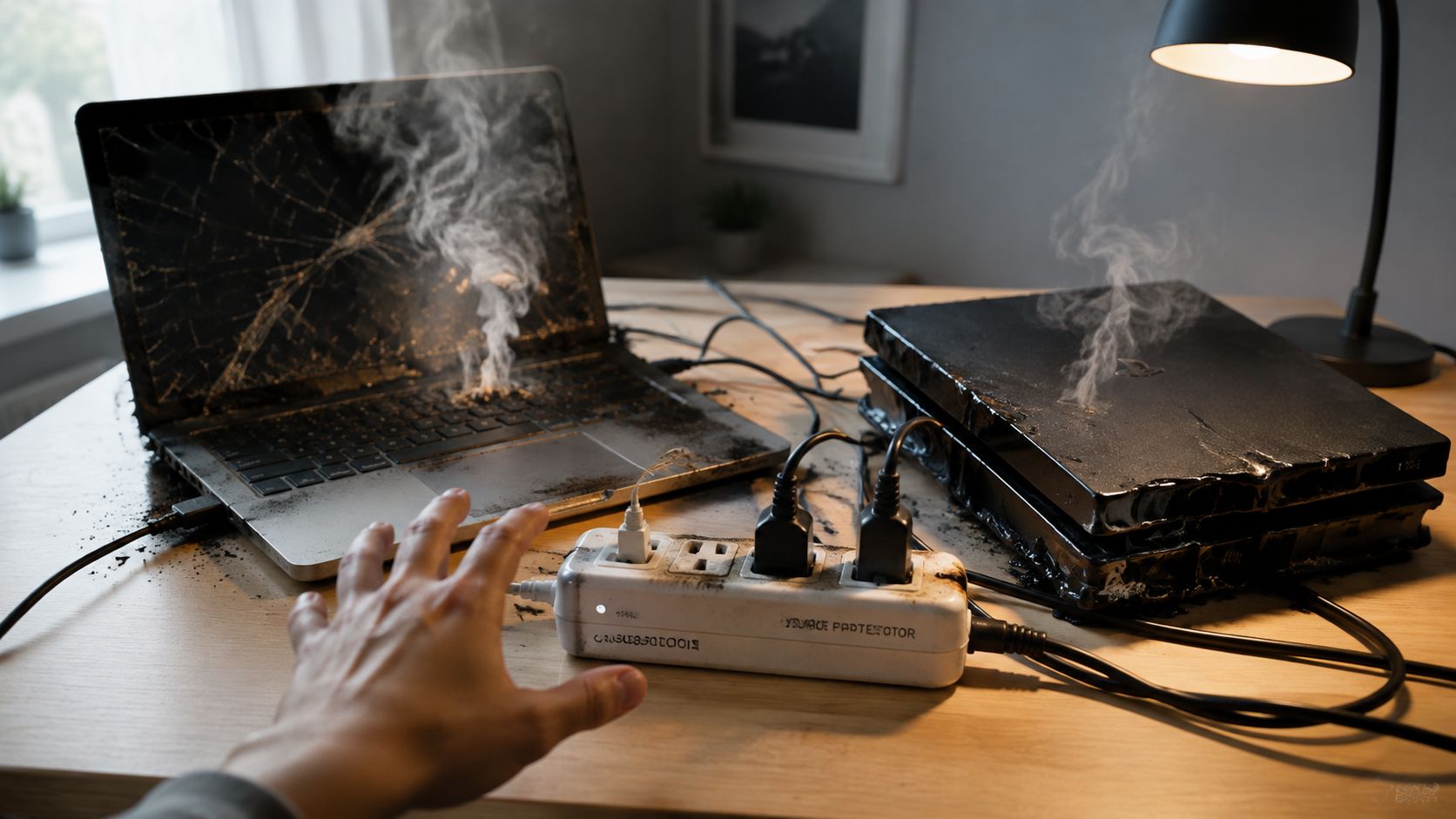
The safest approach starts with the label on the strip and its packaging. If neither one states surge protection or provides meaningful performance information, the product should be treated as an outlet extender, not as protection for valuable electronics.
How Power Strip Surge Protection Actually Works
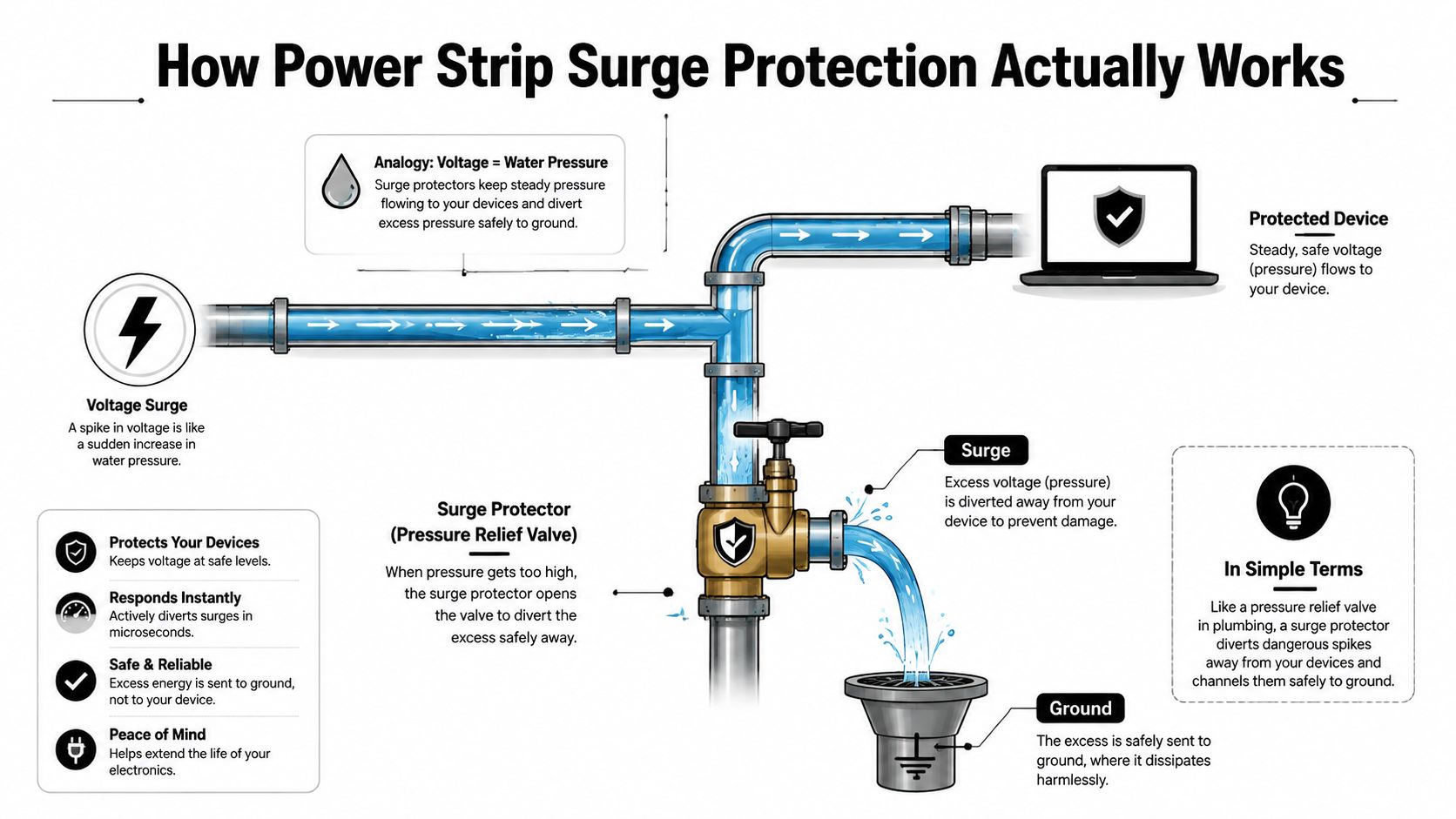
A simple plumbing analogy makes the mechanism easier to understand. Voltage is similar to water pressure moving through a pipe, and connected electronics are like appliances attached to that pipe. Normal pressure flows toward the appliance, but a sudden pressure spike needs somewhere safer to go.
A surge protector acts like a pressure-relief valve. When voltage rises beyond the device's protective threshold, internal components create a lower-resistance path that diverts excess energy away from connected equipment and toward ground. The protector doesn't make a surge disappear. It redirects part of the dangerous excess quickly enough to reduce the stress placed on power supplies and circuitry.
The components inside the housing
Several technologies can perform this diversion:
- Metal oxide varistors, or MOVs: These components change their electrical behavior when voltage rises, helping divert transient energy.
- Gas discharge tubes: These use a gas-filled path that conducts during an overvoltage event and redirects the excess.
- Silicon avalanche diodes: These provide fast voltage-limiting behavior for suitable applications.
A technical industry note describes surge protection as diverting transient overvoltage within 25 nanoseconds or less and says UL 1449 5th Edition testing evaluates clamping voltage and response time. Those details connect the internal parts to the specifications printed on product packaging. The technical explanation of surge protector construction and response offers further context.
Why certification carries more weight
A real surge protective device isn't defined by its cord length, number of outlets, or dramatic packaging language. UL 1449 is the primary North American safety standard for surge protective devices. It was first published in 1985, updated to a second edition in 1996, and reached its third edition on September 29, 2006, which became mandatory on September 29, 2009. That milestone also replaced the older TVSS term, Transient Voltage Surge Suppressors, with SPD, Surge Protective Device terminology for the relevant product class. ABB's UL 1449 overview documents that development.
For readers checking wiring and grounding fundamentals, this guide to three-wire connections with ground can help clarify why a proper grounding path matters.
Key Specifications to Compare Before You Buy
Three specifications deserve attention before outlet count or USB features: joule rating, clamping voltage, and response time. Each describes a different part of the protection job, so a high value in one category doesn't automatically compensate for a weak result in another.
Joule rating measures energy capacity
The joule rating indicates how much surge energy the protector can absorb before its MOVs degrade. For sensitive consumer electronics, practical guidance commonly positions products with at least 800 to 1,000 joules as a useful target. Higher-capacity setups often target 2,000 joules or more, especially when several valuable devices share one protector. New Mexico State University's surge protector guidance explains the relationship between joule capacity and protection margins.
A higher rating isn't a guarantee of superior design, but it generally provides more absorption capacity before the protective components wear down. A product with no stated joule rating gives shoppers little basis for comparing its surge-handling capability.
Clamping voltage limits what reaches devices
Clamping voltage is the point at which the protector begins attenuating the surge. Lower clamping voltage generally means less transient voltage reaches the connected equipment. 330 V and 400 V are commonly treated as meaningful low-voltage classes, and practical shopper guidance favors a unit that doesn't exceed 400 V. Home Depot's surge protector buying guide also identifies clamping voltage as a key comparison point.
Response time indicates reaction speed
Response time describes how quickly the protector reacts to a transient. Home Depot's guidance measures response time in nanoseconds and identifies one nanosecond or less as ideal. Faster response matters because a shorter delay can reduce the period during which sensitive components experience abnormal voltage.
| Use Case | Joule Rating | Clamping Voltage | Response Time |
|---|---|---|---|
| Sensitive computer and home-office electronics | 800 to 1,000 J or more | Below about 400 V | One nanosecond or less is ideal |
| General household electronics | Above 600 J | No more than 400 V is preferred | Faster is better |
| Higher-capacity multi-device setup | 2,000 J or more | Lower class preferred | Fast response preferred |
| Basic outlet expansion | Not necessarily stated | Not necessarily stated | Not necessarily stated |
The final row is important. A basic strip may provide outlets without offering a meaningful joule rating, clamping specification, or response-time claim. That absence is itself useful buying information.
The Hidden Problem of Surge Protector Degradation
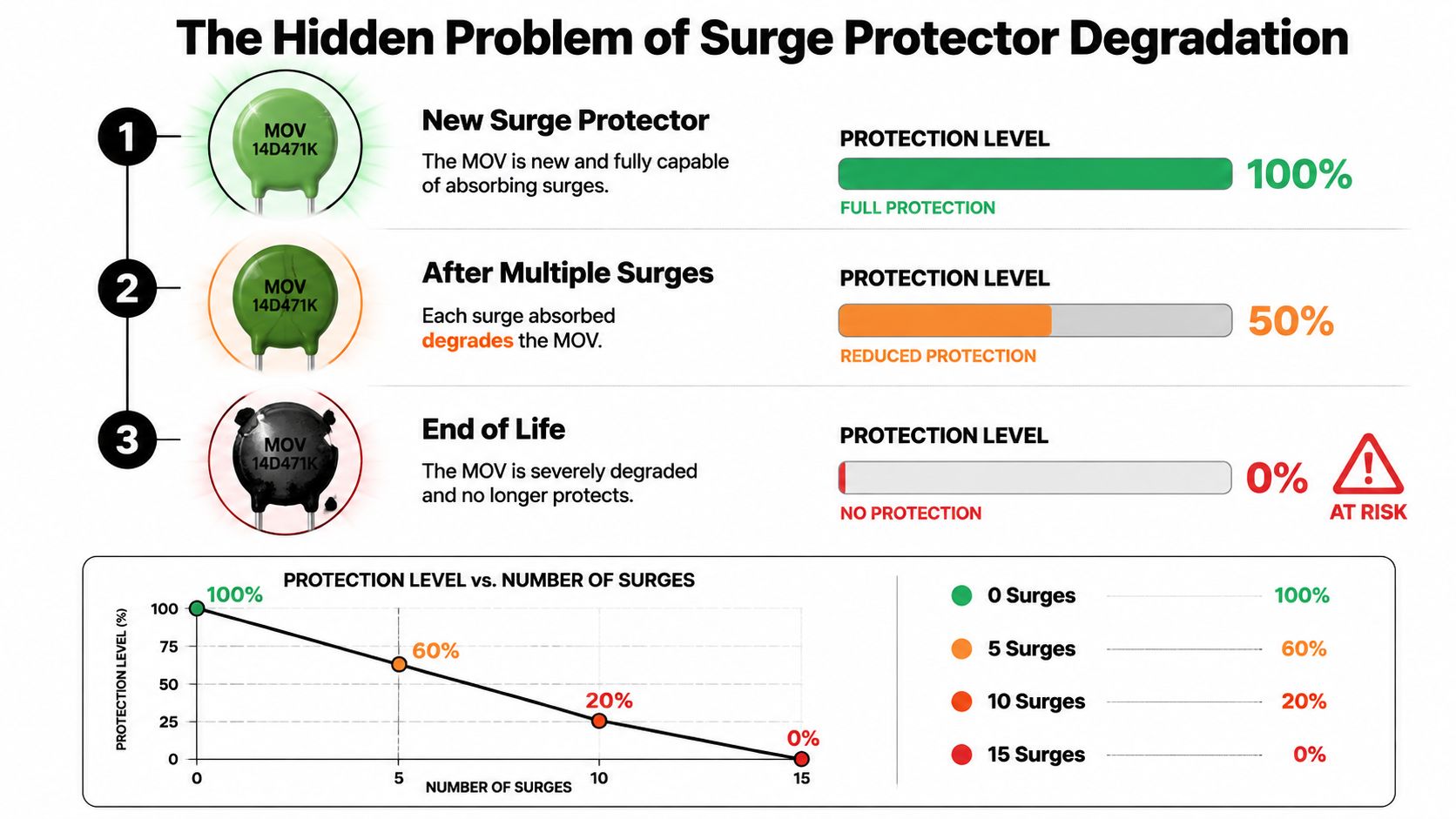
Surge protection is a consumable safety measure, not a permanent promise. MOVs absorb or divert energy during transient events, and repeated exposure gradually reduces their remaining capacity. The strip may continue powering devices after that process has advanced, so a normal-looking outlet can hide declining protection.
One technical source reports that after roughly 3.2 years of average service, MOVs can lose 38% to 52% of their energy absorption capacity and show 210% to 340% higher clamping voltage. In practical terms, the protector may still pass everyday power while allowing a stronger transient through to the equipment. The technical discussion of MOV aging explains why service life matters.
What to inspect today
Start with the protection-status indicator, if the strip has one. A dark, flickering, or noticeably dimmed protection light can indicate that the surge-suppression function is no longer active, even if the outlets still work.
Also remove any strip showing physical warning signs:
- Heat or odor: Unusual warmth or a burnt smell calls for immediate replacement.
- Visible damage: Melted plastic, burn marks, cracks, or discoloration shouldn't be ignored.
- Cord deterioration: Frayed, crushed, or pinched cables can create separate electrical hazards.
- Missing specifications: If the product never identified surge protection or a joule rating, it may only be an outlet strip.
Replacement depends on exposure
Lightning frequency and unstable utility power can accelerate the need for inspection and replacement. A technical example describes a 100 J MOV absorbing 1,000 discrete 6 kV/3 kA surges before its clamping voltage exceeds 120% of nominal. That example illustrates finite endurance, not a universal lifespan for every consumer strip.
The current fifth edition of UL 1449, issued as UL 1449 Ed. 5-2021, covers enclosed and open-type SPDs for repeated limiting of transient voltage surges on 50 or 60 Hz power circuits not exceeding 1,000 V, with coverage extending to photovoltaic applications up to 1,500 V dc. ANSI's UL 1449 scope shows how the category now includes more than simple household strips.
How to Choose the Right Surge Protector for Your Needs
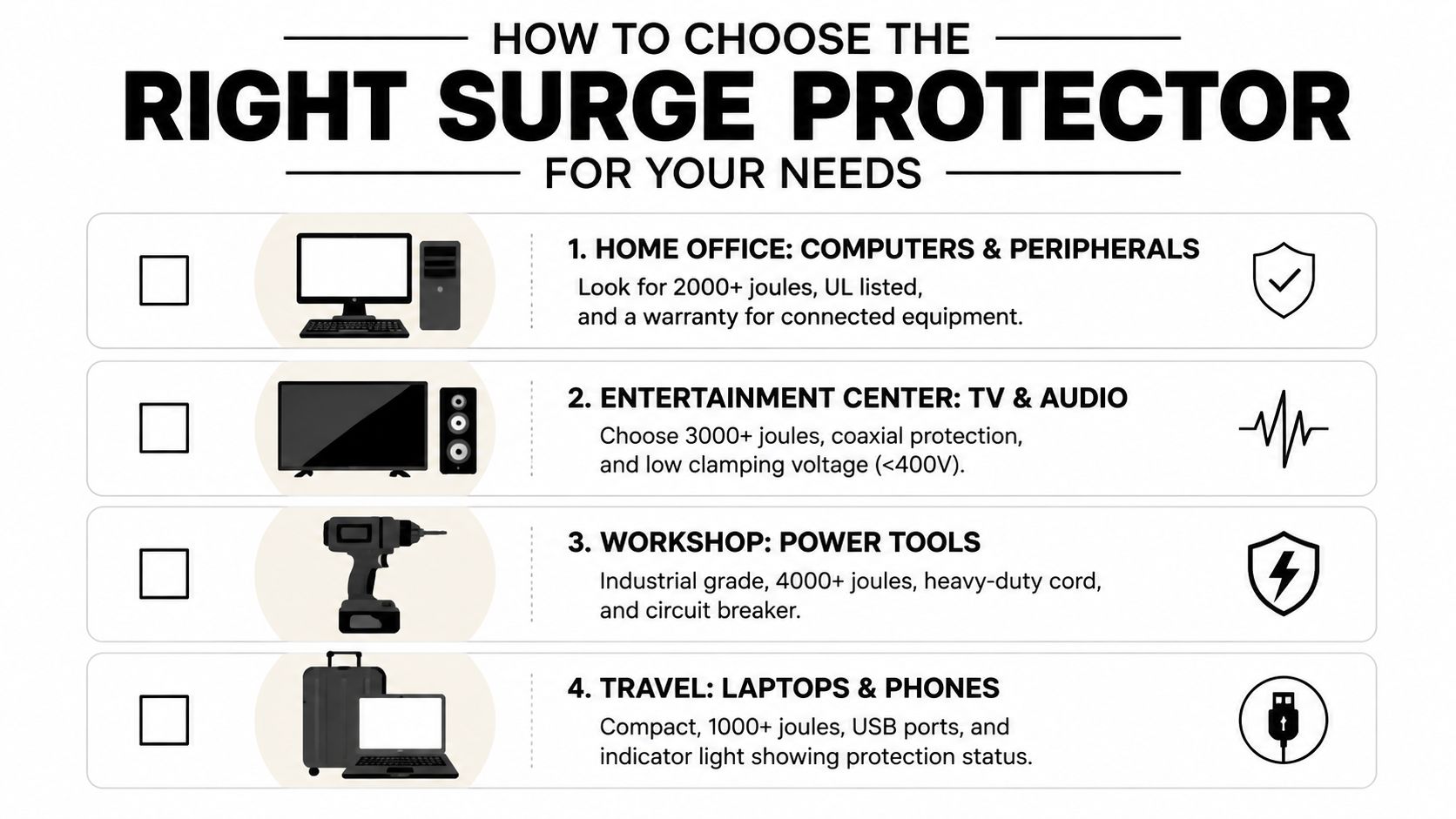
The right choice depends on the equipment, the environment, and the information printed on the product. A home-office setup with a computer, monitor, router, and storage devices deserves more attention than a strip used only for low-cost chargers.
Match the protector to the setup
For sensitive electronics, prioritize a stated 800 to 1,000 joules or more, a clamping voltage below about 400 V, fast response, and credible certification. A television and audio system may also benefit from protection for connected signal lines when the product explicitly supports that feature.
Travel creates a different tradeoff. A compact protector with a clear protection indicator and USB charging can reduce the number of accessories carried, but USB ports don't automatically prove that every connected circuit receives the same surge protection. Packaging still needs to state the actual protection features.
Workshop tools require caution because motors and other equipment can create demanding electrical conditions. A product intended for that environment should have appropriate electrical ratings, a durable cord, and overload protection. A household travel strip shouldn't be treated as an industrial device just because it has many outlets.
Certification comes before impressive packaging
UL 1449 compliance matters because it ties the product to a formal safety and performance framework. The fourth edition was issued on August 20, 2014 and took effect on March 11, 2016, with later certification schedules extending through December 29, 2017 for noted revisions. Intertek's standards update outlines that progression.
A large joule number shouldn't override missing certification details, unclear clamping information, or absent end-of-life monitoring. Buyers should compare the complete label, not one headline specification.
Surge protectors also make practical gifts. A carefully selected unit can suit a tech enthusiast, a student setting up a desk, or someone moving into a new home. For portable charging and backup-power planning, this portable power station guide offers a related way to evaluate mobile electricity needs without confusing backup power with surge suppression.
Installation Safety Tips and Common Mistakes to Avoid
A correctly rated protector can't compensate for unsafe use. The strip should sit in a dry, ventilated location where its cord isn't crushed, pinched, tightly coiled, or covered by rugs and furniture. Indoor-rated products shouldn't be used outdoors or in damp areas.
Avoid overloaded arrangements
Daisy-chaining one power strip into another increases the risk of overloading the outlet path and makes the setup harder to inspect. Plug the protector directly into a properly grounded wall outlet, and follow the product's electrical load rating rather than judging capacity by the number of available sockets.
A reset button or circuit breaker can help interrupt excessive current, but it doesn't automatically make a basic strip a surge protector. The label still needs to identify surge-suppression capability and provide relevant specifications.
Safety check: If a strip becomes hot, smells unusual, sparks, or shows burn damage, disconnect it safely and replace it instead of continuing to test it.
A point-of-use protector also has limits. Larger homes, sensitive installations, photovoltaic equipment, or systems needing coordinated protection may require a qualified electrician to assess whole-house SPD options. A UPS serves a different purpose by providing battery backup and power conditioning, so it shouldn't be treated as a substitute for every surge-protection need.
For a cleaner desk arrangement that reduces cord strain and accidental overloads, this home-office organization guide provides useful setup ideas. Once the installation is safe, shoppers can select a certified protector with clear specifications and a visible status indicator.
Frequently Asked Questions About Surge Protection
Do surge protectors work during lightning strikes?
They can limit transient voltage, but no point-of-use strip should be treated as an absolute guarantee against every lightning-related event. A properly installed, certified device reduces risk rather than making electronics invulnerable.
Can a surge protector work with a UPS?
Yes, but the two products have different roles. A UPS supplies battery backup, while a surge protector limits transient voltage. The manufacturer's connection guidance should be followed to avoid incompatible arrangements.
Do USB ports guarantee protection?
No. USB charging convenience doesn't prove that the strip provides surge protection on every output. The package should state the protection design and relevant certification.
How can an existing strip be checked?
Look for a protection-status light, a stated joule rating, clear surge-protection labeling, and the absence of heat, odor, or physical damage. If the indicator has failed or the strip has experienced severe electrical events, replacement is the safer choice.
Granted Solutions offers practical gadgets and home essentials selected for everyday problem-solving, including useful accessories for safer, more organized tech setups. Visit Granted Solutions to browse gift-worthy products, convenient collections, secure checkout, free shipping, and a 30-day return policy.
Leave a comment