

Muscle Recovery Tools That Actually Work in 2026

Muscle recovery tools are everywhere, but the most popular device isn't automatically the smartest purchase. A premium massage gun can feel impressive in the hand while a simple foam roller delivers the mobility benefit a shopper wants. The right choice depends on the outcome, whether that means less perceived soreness, easier movement, or a more comfortable return to training.
The category has grown far beyond a niche fitness accessory. One market estimate projects the global massage guns market to rise from USD 1.62 billion in 2025 to USD 2.48 billion by 2031, at a 7.7% CAGR, while percussion massage guns represented 61.12% of market share in 2025. North America held 37.05% of revenue share in 2025 in another part of the same forecast, showing how firmly these products have entered mainstream recovery routines. These figures come from Mordor Intelligence's massage guns market analysis.
Table of Contents
- Why Most Muscle Recovery Tools Are Oversold
- How Muscle Recovery Tools Actually Work
- The Main Types of Muscle Recovery Tools Explained
- What the Research Really Says About Each Tool
- A Simple and Safe Recovery Routine You Can Stick To
- Choosing the Right Muscle Recovery Tools for You
- Common Questions and Smart Final Picks
Why Most Muscle Recovery Tools Are Oversold
Many muscle recovery tools feel useful without producing a dramatic change in actual recovery. That distinction matters. A device may make stiff legs feel looser for a while, yet have little effect on strength restoration, muscle adaptation, or the time needed to recover from a demanding training session.
Social media tends to flatten those differences. A flashing massage gun, heated wrap, or compression boot appears beside a confident promise, and shoppers are left with the impression that every uncomfortable muscle needs a separate gadget. The evidence is much less tidy. A 2026 editorial in the German Journal of Sports Medicine describes the overall impact of recovery interventions as unclear, with meaningful differences between individuals. A related systematic review found that performance and perceptual measures generally returned to baseline within 72 to 120 hours, regardless of the recovery method, and that no method consistently outperformed non-intervention controls. The editorial on recovery interventions and their limits puts the hype into perspective.
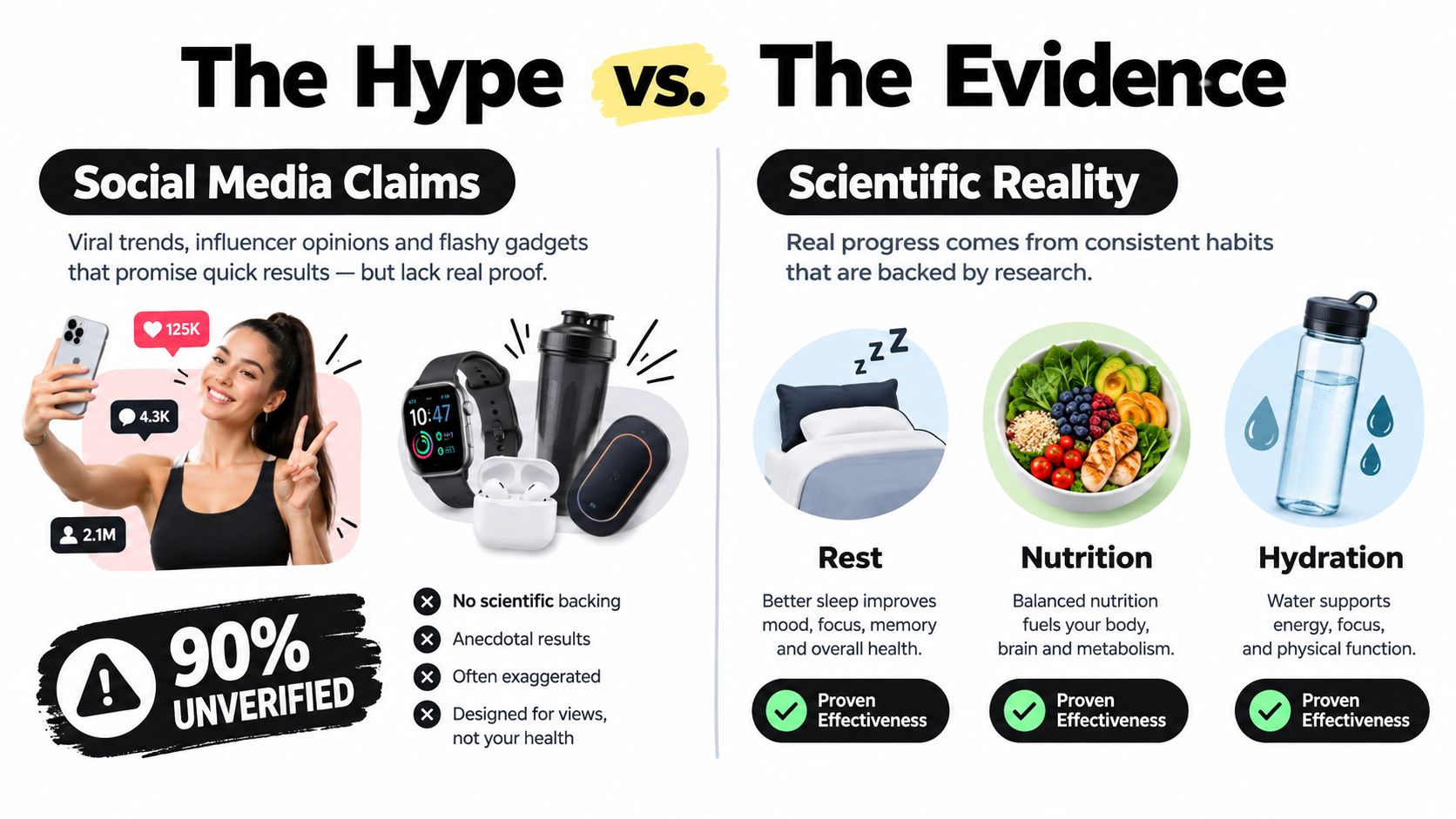
Comfort is not the same as recovery
Pressure, warmth, vibration, and compression can change how a body feels. They may calm soreness signals, encourage a short-term sense of movement, or make a post-workout routine easier to follow. Those are useful outcomes, especially for someone who otherwise skips recovery entirely.
They don't replace sleep, adequate food, hydration, or sensible training progression. A massage gun can't compensate for repeatedly training hard without enough rest, and a compression sleeve won't correct a movement limitation caused by weakness or poor technique.
Practical rule: Buy a tool for a defined job, not for the promise of “faster recovery” in general.
A USD 500 massage gun versus a USD 30 foam roller would be an easy comparison if those prices were universal, but they aren't verified market facts and vary by seller. The more useful point is simpler: a costly device doesn't automatically beat an inexpensive one when both provide the same short-term mobility benefit. A foam roller can be the better purchase for large muscle groups, while a massage gun earns its place for targeted, convenient work.
The wider recovery tools category is also expanding beyond percussion. One market study estimates growth from USD 1.5 billion in 2025 to USD 3.5 billion by 2035, with foam rollers holding 24% share in 2025. Another report places the myofascial release tools market at USD 1.69 billion in 2025, forecasting USD 3.31 billion by 2034, with online stores accounting for 35.2% of distribution revenue. The figures appear in Fact.MR's recovery tools market research. More products create more choice, but they also make goal-based buying essential.
How Muscle Recovery Tools Actually Work
A shopper doesn't need a biology degree to understand recovery devices. Most of them use one or more of five basic inputs: mechanical pressure, heat, cold, compression, or electrical stimulation. Each input changes tissue sensation and movement in a different way.
Mechanical pressure
Foam rollers, massage balls, massage sticks, and percussion guns press into muscle and surrounding connective tissue. The easiest analogy is kneading dough. Pressure doesn't magically rebuild muscle fibers, but it can make a tight area feel less guarded and help a person move through a more comfortable range.
A roller spreads body weight over a broad surface. A ball concentrates pressure into a small point. A stick lets the user control pressure with the hands. A massage gun adds rapid repeated pulses, which can make isolated work feel more intense without requiring floor space.
Heat and cold
Heat works like warming stiff plastic. As tissue becomes warmer, many people find movement and stretching more comfortable. Heating pads and infrared wraps suit stiffness and pre-movement comfort, but they aren't a substitute for gradual activity.
Cold produces the opposite sensation. An ice pack or cold-water method can numb discomfort and alter the perception of soreness. Cold is a specific tool for a specific situation, not a universal post-workout requirement. Excessive intensity can make the experience unpleasant and may distract from the actual problem.
Compression and electrical stimulation
Compression boots and sleeves rhythmically squeeze a limb, creating a sensation of pressure and release. Their value depends heavily on fit, pressure, timing, and the outcome being measured. Electrical devices use signals to influence sensation or muscle contraction. TENS is generally chosen for comfort and pain perception, while NMES is intended to create muscle activation.
The nervous system matters in every category. A tool may reduce the alarm signals associated with soreness without repairing damaged tissue. That doesn't make the experience fake. It means perceived recovery and physiological recovery aren't identical.
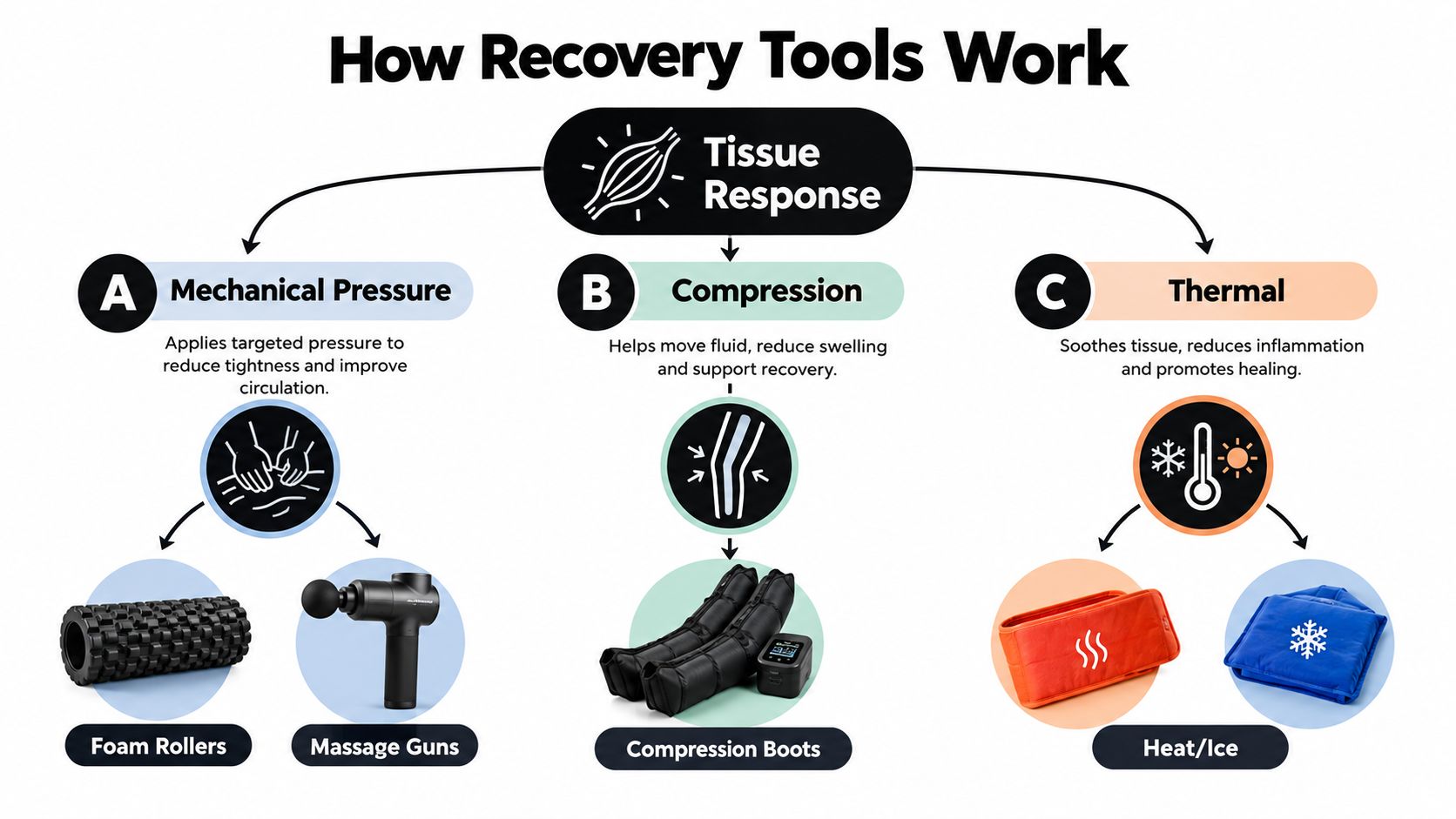
The practical takeaway is straightforward. Pressure tools suit stiffness and mobility work, thermal tools change comfort and sensation, compression tools target a pressured limb feeling, and electronic devices offer a different route to sensory or muscular stimulation. A useful shopping decision starts with the desired outcome, then selects the mechanism that matches it.
The Main Types of Muscle Recovery Tools Explained
The market has seven main categories. None deserves automatic priority, and each solves a different practical problem.
Foam rollers
A smooth roller offers broad, predictable pressure. A textured model concentrates pressure into ridges, while a vibrating roller adds a motor and battery. Foam rollers suit quads, hamstrings, glutes, calves, and the upper back.
They disappoint when a shopper expects them to reach every small trigger point or produce permanent flexibility. Runners and lifters usually get the most value from a firm roller because it covers large muscle groups quickly. Desk workers can choose a smaller, less aggressive model.
Massage guns
Percussion guns deliver repeated pressure to one area at a time. Adjustable speed, a comfortable grip, usable battery life, and manageable noise matter more than a long list of attachments.
They suit runners who want compact spot work and lifters who prefer direct attention on heavily loaded muscles. They disappoint when used aggressively over joints, bones, or already-irritated tissue. A deep-tissue percussion massager guide can help shoppers compare the category without focusing on one brand.
Handheld massagers
Massage balls, sticks, canes, and small handheld rollers provide pressure without a charging cable. A ball reaches the sole of the foot or a glute area, while a stick works well on calves and forearms.
These tools offer excellent portability and control, but they require more effort from the user. They suit desk workers, travelers, and anyone who wants recovery equipment in a gym bag.
Compression boots and sleeves
Compression systems cycle pressure around the limb. Boots target the legs, while sleeves provide a smaller and often more portable setup.
They can feel useful after demanding leg sessions, but fit and pressure determine the experience. These systems cost more, take up storage space, and don't replace mobility work. They make more sense for frequent trainees than for a beginner who has no basic recovery routine.
Cold therapy devices
Ice packs, chill sticks, cold wraps, and plunge tubs all use temperature reduction. They can make soreness feel less noticeable, but cold is uncomfortable for many people and requires a clear reason for use.
A compact cold pack fits occasional home use. A plunge tub demands space, preparation, and a higher tolerance for inconvenience. The more elaborate option isn't automatically more effective.
Heat therapy tools
Heating pads, heated wraps, and infrared products suit stiffness, relaxation, and preparation for gentle movement. They work particularly well for desk workers who feel rigid after long periods of sitting.
Heat can become disappointing when shoppers treat warmth as proof that an underlying problem has been fixed. The benefit is usually comfort and readiness, not a complete solution.
Electronic stimulators
TENS and EMS devices use electrical signals for different purposes. TENS is commonly selected for sensory comfort, while EMS creates a muscle contraction.
These devices suit older users or shoppers who prefer low-vibration options, but they have a steeper learning curve than a roller. Users should follow product safety information and seek professional advice when a medical condition, implanted device, or unexplained symptom is involved.
| Tool Category | Best For | Main Drawback | Ideal User |
|---|---|---|---|
| Foam roller | Broad mobility and pressure work | Needs floor space | Lifters, runners, and beginners |
| Massage gun | Targeted percussion | Battery, noise, and technique demands | Runners and frequent gym users |
| Massage stick or ball | Portable spot work | Requires hand control | Desk workers and travelers |
| Compression boots | Pressured leg recovery sensation | Cost and storage | Heavy lower-body trainees |
| Cold therapy | Temporary soreness relief | Uncomfortable and inconvenient | Shoppers with a specific cold protocol |
| Heat therapy | Stiffness and relaxation | Doesn't address the cause of a limitation | Desk workers and comfort-focused users |
| TENS or EMS | Sensory or activation support | More setup and safety considerations | Users comfortable with electronic devices |
What the Research Really Says About Each Tool
The trendiest recovery device is rarely the best buy. Research supports a more useful conclusion: some tools improve comfort or short-term movement, while evidence for faster physiological recovery remains mixed. Choose by the result you want, whether that means soreness relief, mobility, or returning to training sooner.
Massage guns can improve flexibility and some short-term recovery-related outcomes, including stiffness and range of motion. A 2024 systematic review found no reliable improvement in strength, balance, acceleration, agility, or explosive performance, and some settings reduced output. Research also varies widely in speed, duration, and amplitude, with no agreed optimal protocol. The systematic review of percussion massage guns supports a practical rule: use a massage gun for targeted comfort or mobility, not as proof that recovery has accelerated.
Foam rolling has the strongest case for temporary mobility and perceived soreness relief. In a randomized crossover trial involving 37 physically healthy men, a specific foam-rolling protocol reduced pain versus passive recovery by 22.8% at 24 hours, 39.2% at 48 hours, and 59.7% at 72 hours. Those results come from the PubMed trial on foam rolling after resistance exercise. The protocol was specific, so do not assume every roller, pressure level, or session will produce the same result. For context on pain-relief positioning, see this guide to devices for pain relief and how evidence differs by outcome.
Compression belongs in the mixed-evidence category. In combat-sports athletes, pneumatic intermittent compression at 100 mmHg preserved superior muscle elasticity up to 48 hours after exercise, while cryo-compression reduced soreness more immediately. Both improved tissue perfusion compared with passive rest in that study. Earlier controlled work found no meaningful superiority over sham for delayed soreness, strength, or joint mobility. The Frontiers study on compression and cryo-compression makes the buying advice clear: pressure, timing, and protocol matter more than the category label.
Cold-water immersion has defined protocols in the literature, not one universal setting. An ACSM article describes effective recovery at 10°C for 10 minutes and suggests two 5-minute exposures at 10°C with a 2-minute break. A 2022 review identified 11 to 15°C for 11 to 15 minutes as an optimum protocol while describing the evidence base as limited. The ACSM overview of cold-water immersion supports using cold for a specific soreness or comfort goal, rather than random exposure.
| Tool | Best-Supported Outcome | Evidence Strength | Typical Effect Size |
|---|---|---|---|
| Massage gun | Short-term flexibility and stiffness changes | Mixed | Small to moderate, outcome-dependent |
| Foam roller | Temporary mobility and perceived soreness | Moderate for specific protocols | Meaningful in some soreness measures |
| Compression | Tissue elasticity, perfusion, or comfort in selected protocols | Mixed | Variable |
| Cold water | Perceived soreness after strenuous work | Relatively supportive for comfort | Stronger for perception than adaptation |
| Heat | Comfort and movement readiness | Context-dependent | Usually short term |
| Electronic stimulation | Sensory comfort or muscle activation | Device and goal dependent | Not consistent across uses |
A Simple and Safe Recovery Routine You Can Stick To
A useful routine should be short enough to repeat and gentle enough not to create another training stress. Most shoppers need one broad pressure tool and one targeted option, not a cabinet full of devices.
Before training, a light pass with a foam roller can help a tight area feel ready to move. The purpose is not deep pressure. It's a brief check-in across the muscles that will do the work, followed by an active warm-up that raises body temperature and rehearses the training movement.
After training, a massage gun can provide targeted comfort at a low or moderate setting. The head should move over muscle rather than joints or bones, and the user should avoid open wounds, bruises, varicose veins, numb areas, and acute injuries. Sharp pain is a stop signal. A tight or unfamiliar sensation should never be forced into pain.
A practical weekly pattern
- Before training: Use a roller lightly on areas that feel restricted, then complete active movement preparation.
- After training: Choose either broad rolling or gentle percussion, focusing on the muscles that carried the workload.
- On demanding leg days: Add compression only if the fit and pressure feel comfortable and the goal is a pressured, refreshed leg sensation.
- During desk work: Use a small ball against the upper back or a handheld tool on the forearms during a brief movement break.
- On rest days: Choose easy movement and light pressure rather than aggressive work on tender spots.
Compression research illustrates why shoppers should follow the device protocol instead of improvising. One study used 100 mmHg and assessed outcomes up to 48 hours after exercise, but that doesn't make the same pressure suitable for every person or product. The device manual and individual circumstances still matter.
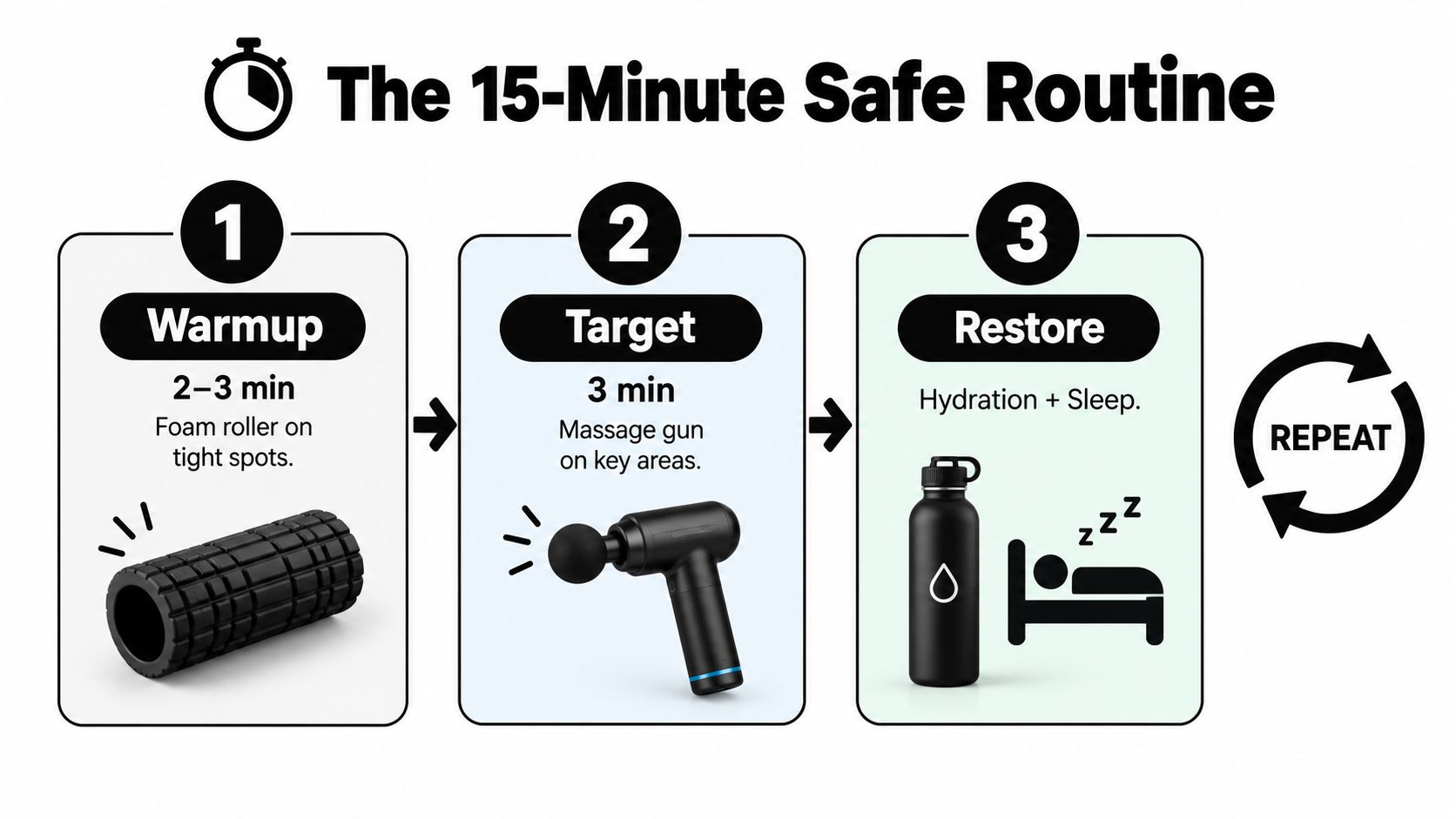
The most common error is chasing intensity. Harder pressure isn't automatically better, and soreness during a session isn't proof that tissue is improving. Sleep, hydration, adequate protein, and sensible training load remain more important than any individual device.
Choosing the Right Muscle Recovery Tools for You
A five-minute buying checklist prevents most expensive mistakes. A massage gun shopper should inspect amplitude, stall force, grip comfort, battery life, attachment design, and noise. A foam-roller shopper should compare density, surface texture, size, and whether the material will hold its shape under regular use.
Compression shoppers should check pressure range, leg measurements, sleeve fit, cleaning requirements, and return terms. Shared spaces make noise important, but a manufacturer's decibel claim should be verified rather than assumed. A solid warranty and recognized safety certification add more practical value than a decorative attachment or an oversized specification list.
Match the tool to the training life
A recreational runner usually needs portability and fast access. A firm roller handles broad lower-body work, while a mid-range percussion device can target calves or glutes after a run.
A desk worker doesn't need a full recovery station. A lacrosse-style ball, compact roller, or small handheld massager can address upper-back, forearm, and hip comfort without taking over a room. The back-pain gift guide from Granted Solutions offers another way to compare practical comfort-oriented products.
A strength lifter may justify more equipment because heavy lower-body sessions create a larger need for broad rolling and targeted pressure. Compression boots become a considered purchase only when the person trains frequently enough to use them consistently.
Budget should follow the goal. Entry-level mechanical tools offer the lowest barrier and the fewest maintenance concerns. Mid-range percussion devices add convenience and targeted intensity. Full compression systems occupy a higher-cost category and need enough use to justify their space and price.
| User Profile | Primary Tool | Secondary Tool | Budget Range | Most Important Feature |
|---|---|---|---|---|
| Recreational runner | Firm foam roller | Mid-range massage gun | Entry to mid-range | Portability and easy calf access |
| Desk worker | Small roller or massage ball | Handheld massager | Entry range | Compact storage and simple controls |
| Strength lifter | Dense foam roller | Percussion device or compression system | Mid-range to higher | Pressure control and durability |
| Older user | Low-vibration handheld option | Heat wrap or gentle roller | Entry to mid-range | Comfort and straightforward operation |
The best feature-versus-goal match is often less exciting than the most expensive product. Portability matters when a tool must travel. Pressure control matters when muscles are sensitive. Durability matters when training is frequent. Shoppers shouldn't pay for settings, accessories, or intensity that won't be used.
Common Questions and Smart Final Picks
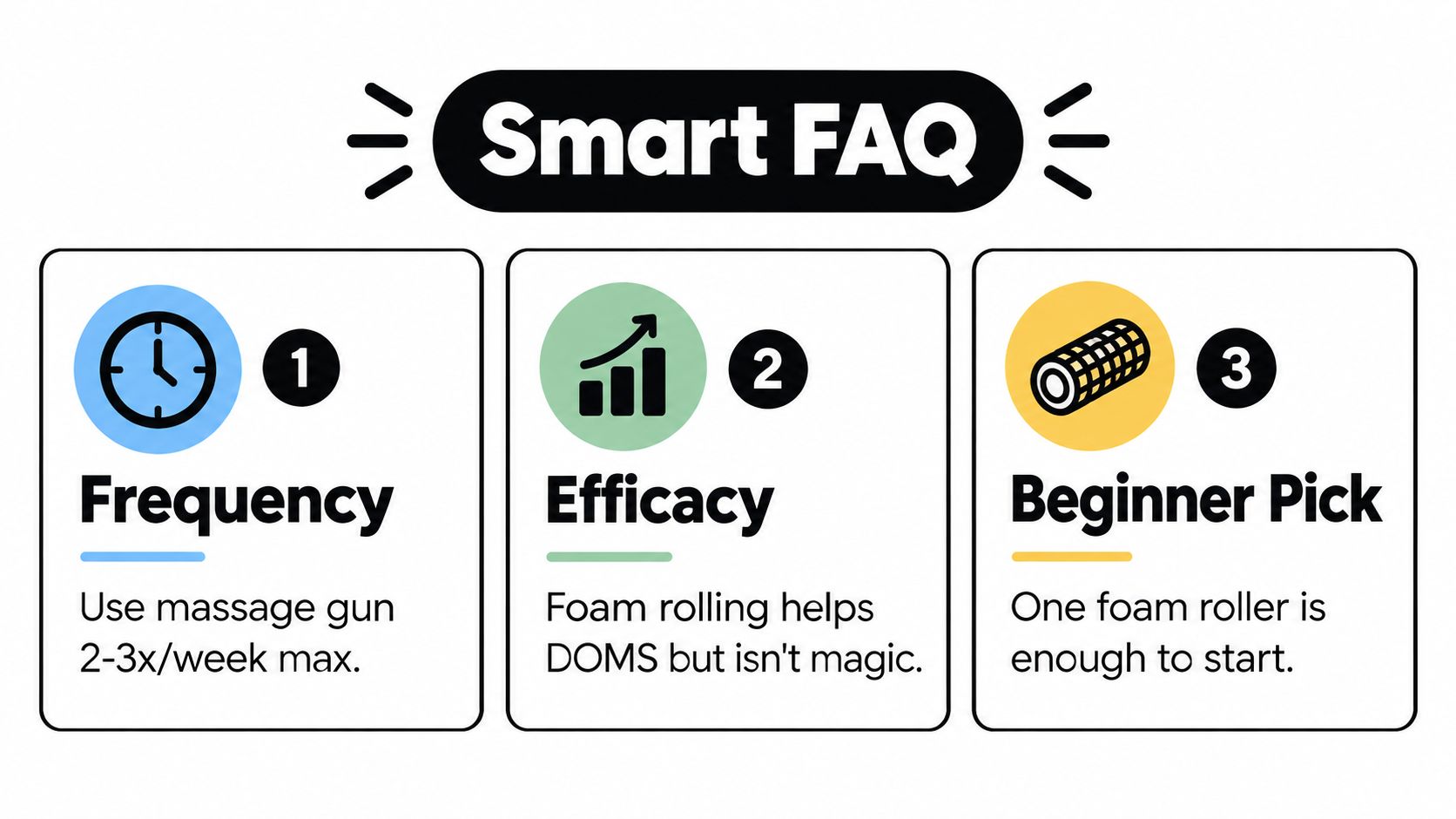
How often should a massage gun be used?
Use a massage gun when targeted percussion improves comfort or movement. Keep intensity low and pressure controlled. Repeatedly attacking the same area with aggressive settings adds irritation, not better recovery.
Does foam rolling reduce real soreness?
A randomized trial reported lower pain after resistance exercise, including 22.8% at 24 hours, 39.2% at 48 hours, and 59.7% at 72 hours, as reported in the foam-rolling research record. That result supports foam rolling for soreness relief under the tested protocol. It does not prove faster tissue repair or make rolling a complete recovery plan.
What should a beginner buy first?
Start with a firm foam roller that feels comfortable enough to use regularly. It covers large muscle groups and requires no charging or complicated setup. Add a massage ball or stick later if smaller areas need more precise pressure.
Do expensive tools outperform budget tools?
Usually, the price reflects convenience rather than a guaranteed recovery advantage. Premium devices may have quieter motors, stronger construction, better fit, or easier controls. Those upgrades matter only if they solve a problem you have. A basic tool used after training beats an expensive device left in a drawer.
Match the tool to the outcome you care about. Choose a foam roller for broad soreness relief and a massage ball for focused pressure. Choose portable percussion when quick access or movement before training matters. Consider compression only if you train often enough to use it consistently and want a more passive routine. Evidence for faster return to training remains thinner than the marketing suggests.
A beginner should buy a foam roller. A runner should favor a firm roller and portable percussion. A lifter can add a stronger massage gun after building a simple routine. A desk worker usually needs a compact ball, small roller, heat option, or handheld massager, not a large recovery machine.
Buy for a clear goal, then choose the tool you will use. Granted Solutions offers compact recovery accessories, exercise gear, and everyday home-use tools. Compare features with your training needs, budget, and storage space before buying.
Leave a comment